
Turbo Energy and HiTHIUM deploy 366 MWh AI storage across 15 sites
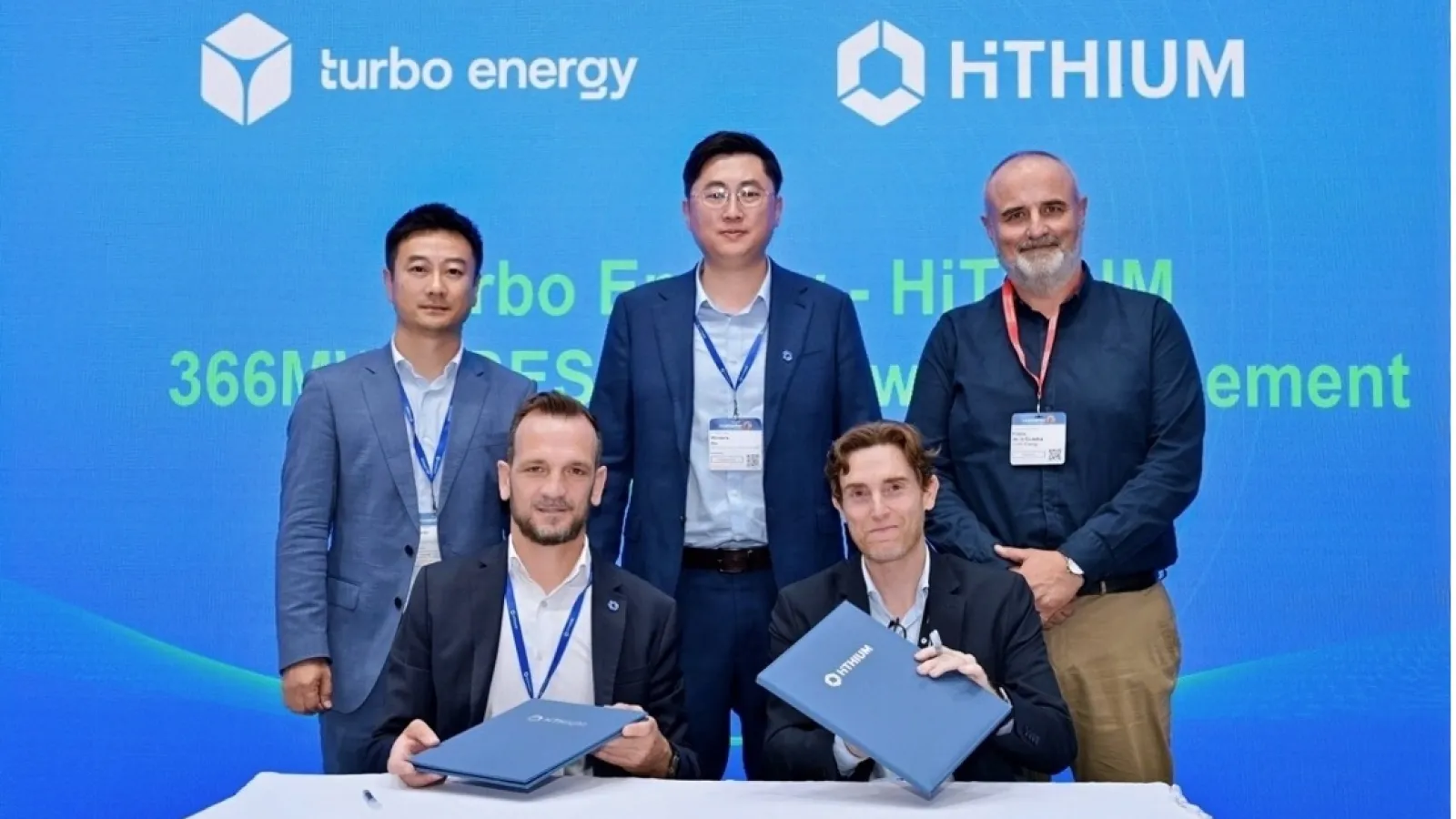
Turbo Energy (Nasdaq: TURB) and Chinese battery maker HiTHIUM have announced a joint deployment of 366 MWh of battery energy storage capacity across 15 industrial facilities belonging to what the companies describe as one of Europe's largest electro-intensive ceramic manufacturing groups. The project, unveiled at Intersolar Europe 2026 in Munich, forms part of the Pamesa Net Zero initiative, an industrial decarbonisation programme aimed at electrifying and energy-proofing the ceramics group's operations across the continent.
More than 130 MWh of storage capacity has already been installed, with the remainder to follow as the project scales. The deployment marks the first time Turbo Energy's AI-driven energy management platform has operated alongside HiTHIUM's battery systems at industrial scale, according to the companies.
The deployment
At the core of the project is Turbo Energy's proprietary optimisation platform, which the company positions as an intelligence layer sitting across renewable generation, battery storage and industrial consumption. The platform uses predictive analytics and demand forecasting to dynamically route energy flows in real time, with the stated goal of reducing exposure to electricity market price volatility and improving operational resilience across multiple sites simultaneously.
Kelson Li, Vice President of HiTHIUM Europe, said the combination of long-duration battery storage and AI-driven management is "becoming increasingly critical" as industrial customers contend with energy cost volatility, grid constraints and tightening decarbonisation targets. Mariano Soria, Chief Executive of Turbo Energy, framed the deal as evidence that "industrial energy infrastructure is evolving beyond hardware," arguing that the next generation of energy systems will be defined by software intelligence rather than physical assets alone.
The companies did not disclose the full contract value, the revenue split between hardware and software services, or the projected energy cost savings for the end customer.
Market context
The commercial and industrial energy storage market in Europe is expanding rapidly, driven by record electricity price volatility since 2021, the EU's REPowerEU targets and an accelerating push to decarbonise heavy industry ahead of 2030 milestones. Vendors ranging from established inverter makers to software-first energy management platforms are competing to position battery storage as a dispatchable, AI-orchestrated asset rather than a simple backup device.
HiTHIUM is a significant force in this space: the company claims it surpassed 100 GWh in cumulative lithium-ion energy storage shipments by the end of 2025 and ranked in the top two globally for utility-scale battery shipments that year, citing data from market research firms InfoLink, SMM and ICC. Those claims have not been independently verified by this publication.
Turbo Energy, by contrast, is a smaller listed integrator whose pivot towards AI-managed energy services mirrors a broader industry shift: hardware margins in battery storage are under sustained pressure from Chinese manufacturers, pushing European and US-listed players to differentiate on software and managed services.
Regulatory read-across
European industrial operators deploying grid-connected battery storage at this scale must navigate a growing regulatory framework. The EU's Electricity Market Reform, which passed into law in 2024, introduced new rules on energy storage participation in balancing markets, while the Energy Efficiency Directive's revised industrial targets create additional compliance pressure on energy-intensive sectors such as ceramics. Projects of this size will also fall under national grid operator rules on demand response and curtailment, which vary across the European markets where the Pamesa group operates.
Turbo Energy said it is continuing to expand its international footprint through large-scale deployments in Europe, North America and Latin America, though no specific pipeline figures or signed contracts beyond the Pamesa project were disclosed.