
Microchip Technology adds CPLD-like logic to low-cost PIC MCUs
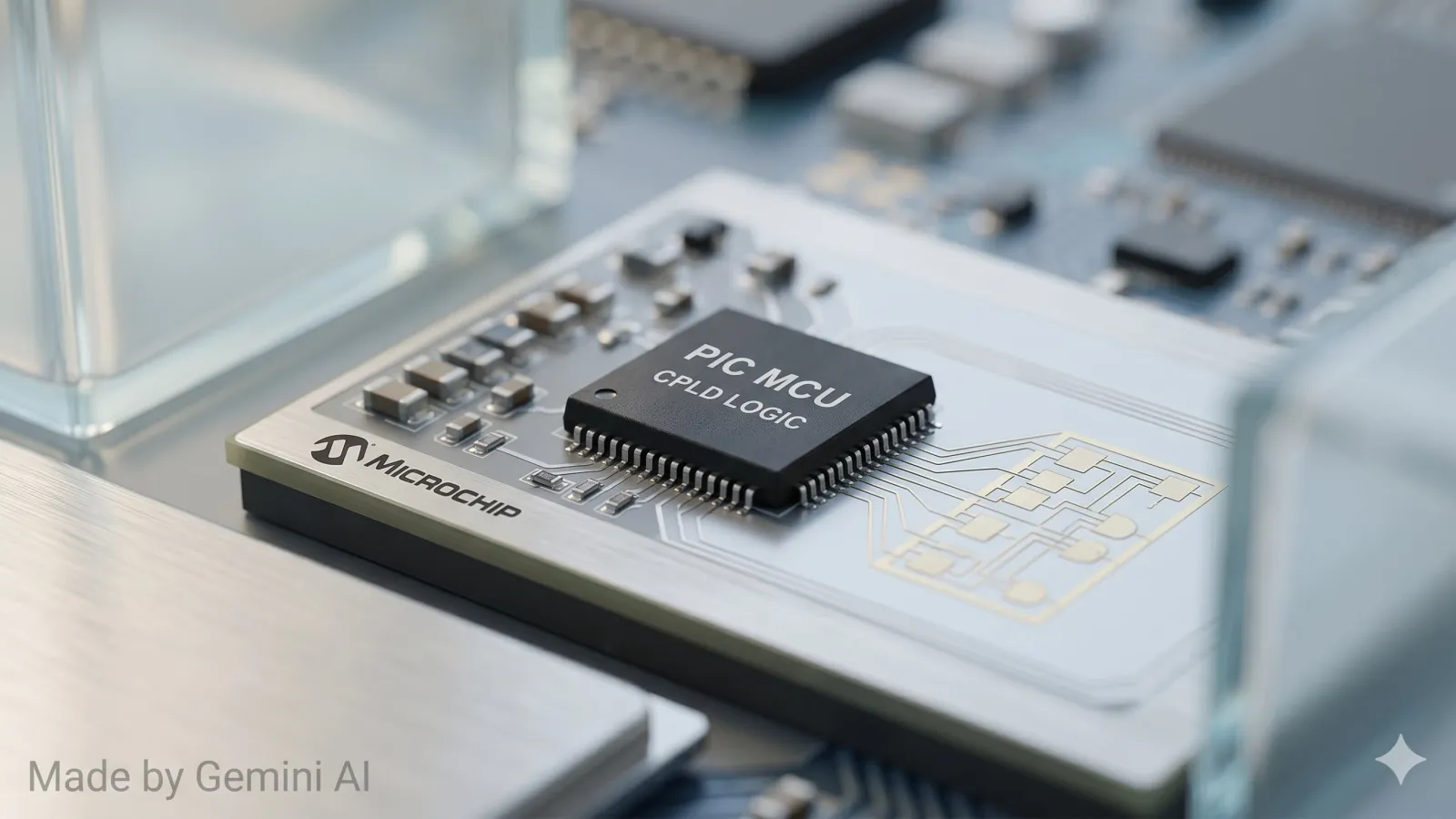
Microchip Technology has expanded its Configurable Logic Block (CLB) microcontroller portfolio with two new device families — the PIC16F13276 and PIC18-Q35 — that embed Complex Programmable Logic Device (CPLD)-like functionality directly inside a low-power MCU. The Chandler, Arizona-based semiconductor company says the move is aimed at engineers building timing-critical systems for motor control, industrial automation and automotive safety, where software-based execution latency and nondeterministic behaviour create design headaches.
The core proposition is integration: rather than pairing a discrete CPLD with a separate MCU on the board, engineers can now offload parallel, deterministic logic to dedicated hardware on a single die. The PIC16F13276 family offers 32 logic elements; the larger PIC18-Q35 raises that to 128. Both families support automatic CLB loading at power-up or reset, meaning the logic block initialises independently of the CPU — a feature Microchip highlights as relevant to functional-safety and automotive applications where predictable startup sequencing is a requirement. Pricing starts at $0.32 per unit at volume for the PIC16F13276 and $0.62 for the PIC18-Q35.
The design case
Microchip argues the integrated approach reduces bill-of-materials count, board space and overall system cost relative to discrete CPLD-plus-MCU designs. The devices are engineered to be drop-in compatible with existing PIC16 and PIC18 designs, which lowers the migration barrier for customers with established schematics and firmware. An anti-tamper feature — Programming and Debugging Interface Disable (PDID) — is included to guard against unauthorised access and design cloning, a concern that has grown in embedded industrial and automotive supply chains.
Greg Robinson, corporate vice president of Microchip's MCU business unit, said the development was driven by customer design problems rather than competitive benchmarking. "By enabling CPLD-like functionality on a low-power, cost-effective microcontroller, these two families give engineers an easy way to add programmable logic to their designs," he said.
On the tooling side, Microchip has updated its CLB Configuration tool to run inside Microsoft Visual Studio Code via a drag-and-drop graphical interface, removing the need to write Hardware Description Language (HDL) code or manually configure registers. An integrated synthesiser adds timing analysis, simulation and hardware debug in the same workflow. Both families are also supported by Microchip's established MPLAB X IDE and MPLAB Code Configurator, and evaluation kits (the PIC18F56Q35 and PIC16F13276 Curiosity Nano boards) are available for prototyping.
Market context
The market for mixed-signal and programmable-logic-integrated MCUs has been quietly expanding as embedded applications in automotive and industrial automation demand tighter real-time control without the cost penalty of larger FPGAs or the latency of pure software solutions. Microchip competes in this space against Texas Instruments, Renesas, STMicroelectronics and NXP Semiconductors, all of which offer varying degrees of hardware-accelerated peripheral logic in their MCU lines.
At the sub-$1 price point, Microchip is targeting cost-sensitive, high-volume applications — home appliances, BLDC motor drivers, industrial sensors — where a BOM reduction of even a single discrete component can meaningfully affect unit economics. The automotive safety angle adds a longer-term growth lever: ISO 26262 functional-safety requirements increasingly demand deterministic hardware behaviour, favouring integrated logic over software-only control loops. Whether 128 logic elements satisfies the complexity needs of higher-end automotive subsystems remains a question; designers requiring several hundred logic elements will still be looking at standalone CPLDs or low-density FPGAs. Microchip has not disclosed a roadmap for higher logic-element counts in the CLB portfolio.