
AMD Q1 2026: Data Centre revenue hits $5.8bn, up 57% year-on-year
AMD has reported first-quarter 2026 revenue of $10.3 billion, a 38% increase on the same period last year, as sustained demand for AI infrastructure elevated its Data Centre segment to the primary driver of group earnings. Net income on a GAAP basis reached $1.4 billion, up 95% year-on-year, while non-GAAP diluted earnings per share came in at $1.37, against $0.96 in Q1 2025.
Free cash flow for the quarter was a record $2.57 billion, roughly three and a half times the $727 million generated in Q1 2025, a figure that will reassure investors who have been watching AMD's capital expenditure rise alongside its AI ambitions. Capital expenditure in the quarter was $389 million, nearly double the year-ago level, reflecting ongoing infrastructure investment.
Data Centre dominance and product pipeline
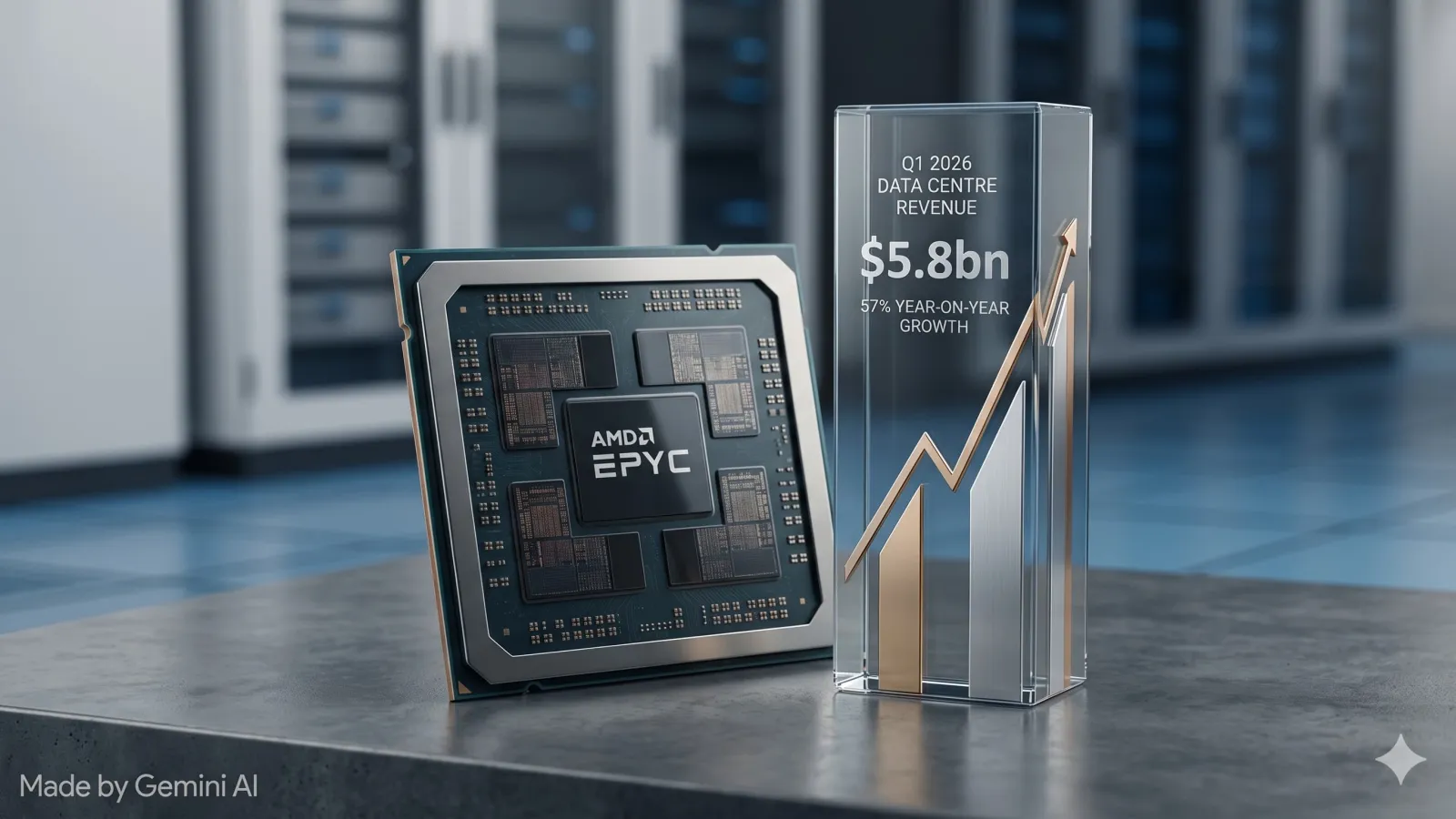
The Data Centre segment generated $5.775 billion, up 57% year-on-year and ahead of the prior quarter's $5.38 billion, driven by EPYC server CPU demand and the continued ramp of Instinct GPU shipments. The Client and Gaming segment contributed $3.6 billion (up 23%), with the Client sub-segment alone growing 26% on strong Ryzen processor demand. The Embedded segment, which had been recovering slowly from an inventory correction, added $873 million, up 6%.
Chair and chief executive Lisa Su said customer engagement around the MI450 Series GPU and the Helios rack-scale platform is strengthening, and that leading customer forecasts are already exceeding AMD's initial projections. The most significant disclosed commitment is a plan by Meta to deploy up to six gigawatts of AMD Instinct GPUs, with the first gigawatt to be powered by a custom MI450-based GPU. Meta will also act as a lead customer for AMD's forthcoming sixth-generation EPYC CPU — codenamed "Venice" and "Verano". Separately, AMD and Tata Consultancy Services are co-developing Helios-based rack-scale AI infrastructure targeting enterprise and sovereign AI deployments in India.
On the memory side, AMD confirmed a collaboration with Samsung covering HBM4 supply for the Instinct MI455X GPU and advanced DRAM for sixth-gen EPYC — an arrangement that signals AMD's intent to keep pace with the memory-bandwidth demands of next-generation AI workloads. AWS, Google Cloud, Microsoft Azure and Tencent all announced new or expanded EPYC-powered cloud instances during the quarter.
Market context and competitive read-across
AMD's Data Centre trajectory puts it in increasingly direct competition with NVIDIA across both training and inference workloads, though NVIDIA continues to hold a commanding position in the high-end training cluster market. The MI355X GPU posted competitive results in the latest MLPerf benchmarks, with the company reporting leadership scores in several inference categories — though independent replication of vendor-reported benchmark claims should be treated with caution until third-party analysis is available.
The broader AI infrastructure market is bifurcating: hyperscalers are committing to multi-gigawatt-scale deployments while enterprise buyers are weighing total cost of inference, software-stack maturity and supply-chain reliability. AMD's growing pipeline of rack-scale deployments — Helios in particular — is a deliberate move to address the latter cohort, where tight integration of CPU, GPU and networking is increasingly valued over raw accelerator performance alone.
Export-control headwinds remain a material risk. US Bureau of Industry and Security restrictions on advanced AI accelerator exports to certain markets could constrain AMD's addressable market for Instinct GPUs, and the company's cautionary disclosures explicitly cite government actions and export regulations as factors that could cause actual results to differ from forward-looking guidance.
Outlook
For Q2 2026, AMD guided revenue to approximately $11.2 billion (plus or minus $300 million), representing year-on-year growth of roughly 46% at the midpoint and a sequential increase of approximately 9%. Non-GAAP gross margin is expected to be around 56%. The sequential revenue acceleration, if delivered, would mark a meaningful step up from the flat Q1-to-Q4 trend and will be closely watched as a signal of whether AI infrastructure demand continues to outpace supply constraints.