
ASUS ProArt P16 and P14 laptops debut with NVIDIA RTX Spark chip
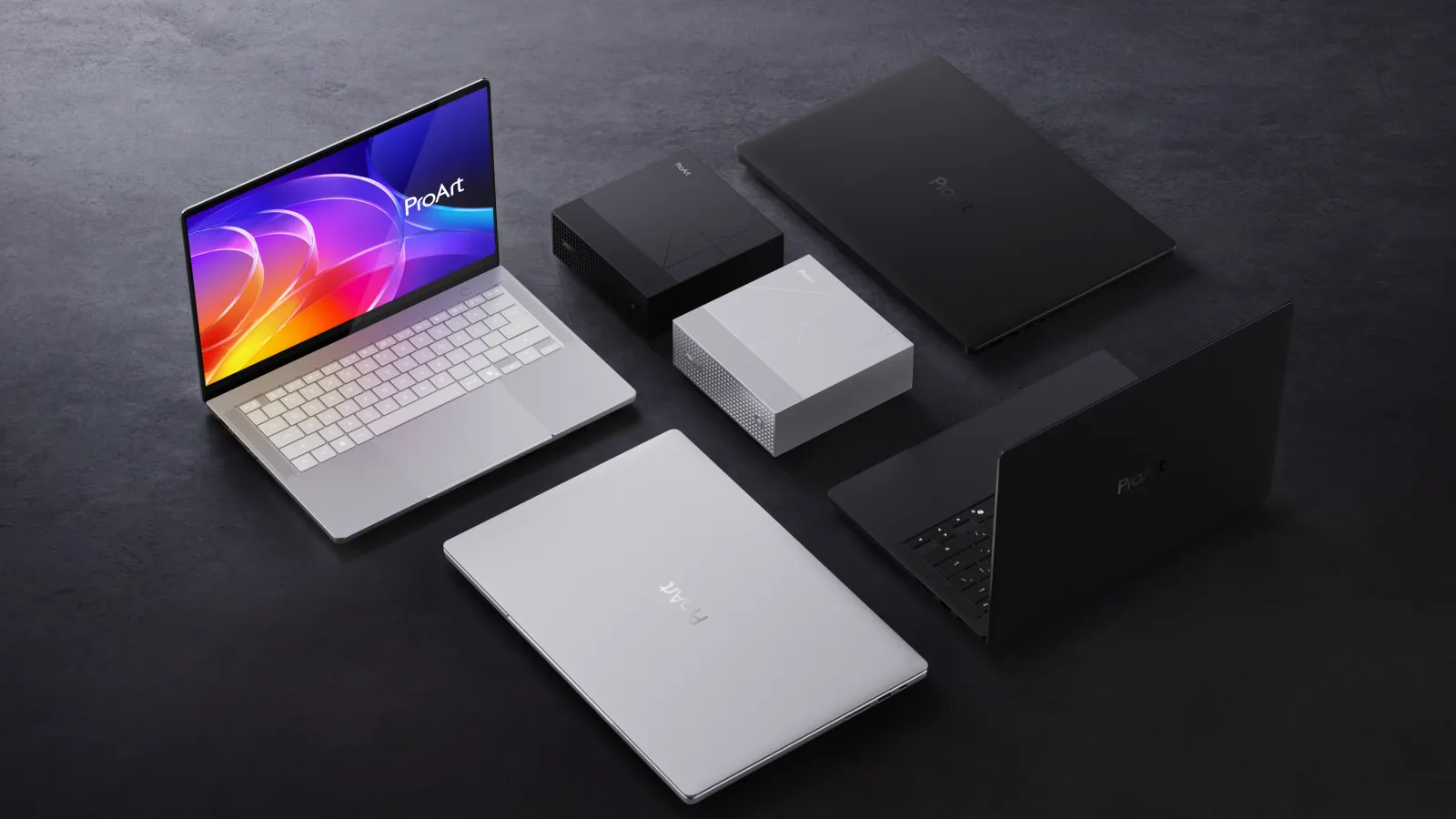
ASUS has announced the ProArt P16 (H7607) and P14 (H7407) laptops alongside a ProArt Mini PC, all built around NVIDIA's newly unveiled RTX Spark superchip. Revealed at Computex 2026 in Taipei, the devices are aimed at creative professionals, AI developers and workflow builders who want to run demanding generative AI workloads on local hardware rather than in the cloud. All three products are scheduled to reach select markets in autumn 2026; pricing and full regional configurations have not yet been disclosed.
RTX Spark pairs an NVIDIA Blackwell RTX GPU — carrying 6,144 CUDA cores and fifth-generation Tensor Cores with FP4 precision — with a 20-core NVIDIA Grace CPU via the NVLink-C2C chip-to-chip interconnect. The result is a unified memory architecture that scales to 128GB and delivers, according to NVIDIA and ASUS, 1 petaflop of AI compute. That figure is sufficient, the companies say, to run 120-billion-parameter large language models locally with up to one million tokens of context, render 3D scenes larger than 90GB, or generate 4K AI video without offloading to a data centre.
Hardware and display specifications
The P16 and P14 are positioned as slim, mobile workstations. ASUS says the new P16 chassis is 13% thinner and 16% lighter than its direct predecessor, and both models carry up to a 99.9Wh battery for all-day use. Display panels use ASUS's Lumina Pro OLED technology, with Delta E < 1 colour accuracy, anti-reflection coating, and peak brightness of 1,600 nits. The P16 supports 4K at 120Hz with NVIDIA G-Sync variable refresh; the P14 tops out at 3K resolution.
The ProArt Mini PC occupies a 150 × 150 × 51 mm chassis but inherits the same 1 petaflop AI compute and 128GB unified memory ceiling. It includes 10GbE wired networking, M.2 PCIe Gen 5 x4 expansion, and a 140W thermal envelope — specifications that ASUS says make it suitable for edge AI deployment as well as studio workstations.
On the software side, Adobe is described as re-architecting Photoshop and Premiere specifically for RTX Spark, with the companies claiming 2x faster AI and graphics performance as a result. The ProArt ecosystem bundles three months of Adobe Creative Cloud, along with GoPro Cloud and Goodnotes subscriptions, and ASUS's own ProArt Creator Hub, MuseTree and StoryCube tools for AI-assisted content production.
Market context and competitive landscape
The AI PC category has become one of the most actively contested segments in the consumer and prosumer hardware market. Intel's Core Ultra series, AMD's Ryzen AI processors and Qualcomm's Snapdragon X Elite all incorporate dedicated neural-processing units, but RTX Spark represents NVIDIA's first move into a fully integrated CPU-GPU-memory superchip targeting the Windows laptop form factor — a direct challenge to Apple's M-series unified-memory architecture, which has dominated the creative-professional segment for the past four years.
For enterprise buyers and independent software vendors, the ability to run 100B+ parameter models on-device carries genuine workflow implications: lower latency, no data-egress costs, and reduced dependency on cloud AI service availability. However, none of the performance claims in the release are supported by independently audited benchmarks, and the 2x Adobe performance figure comes from a co-marketing relationship rather than a third-party test. Buyers should treat those numbers as directional until reproducible benchmarks are published.
The RTX Spark launch also has implications for the broader AI-at-the-edge discussion. As enterprises weigh sovereign AI and data-residency obligations under the EU AI Act and UK GDPR, on-device inference hardware that can handle large models locally becomes a practical compliance tool — not merely a performance upgrade. ASUS has not yet confirmed European availability dates or whether the devices will carry any formal regulatory certifications for enterprise deployment.