
ASUS Zenni Claw agentic AI assistant launches as free beta download
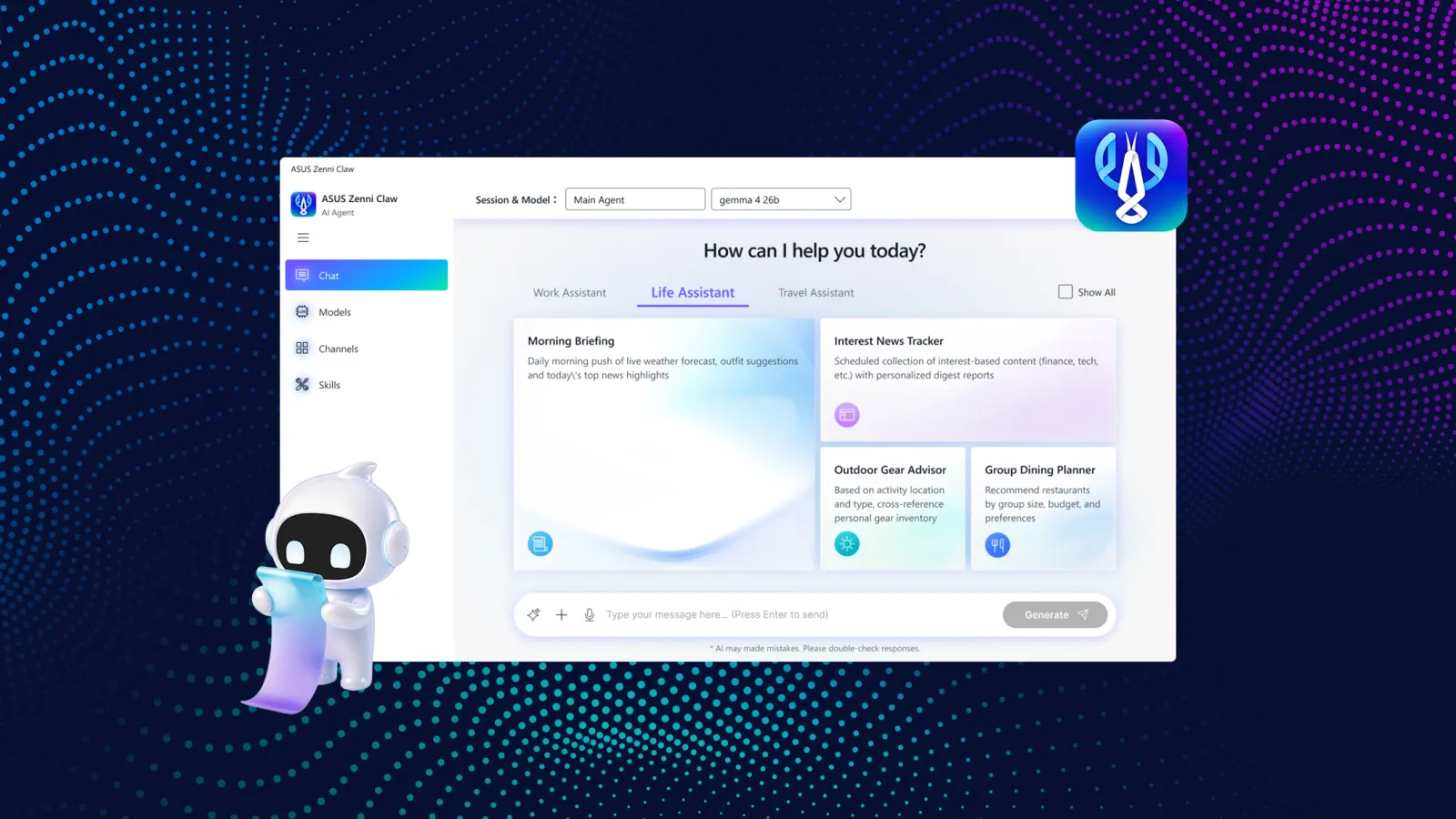
ASUS has made Zenni Claw available as a free download for supported Windows 11 devices, marking the company's entry into the consumer-facing agentic AI assistant market. The software, launching in beta, runs multi-step AI workflows across three built-in assistants covering work, travel, and daily life, with two further assistants (Creator and System) listed as coming later.
The application supports a hybrid processing model, routing tasks either to local compute or to cloud-based AI models depending on hardware capability, task type, and user preference. A cloud-only mode is available for devices that fall below the local model threshold. The hardware bar is notable: local model execution requires at minimum 32 GB of RAM and an Intel Core Ultra Series X or AMD Ryzen AI Max processor, while ASUS recommends an NVIDIA GeForce RTX 5090 GPU with 24 GB of VRAM for best performance. These are high-end specifications that effectively restrict on-device inference to ASUS's most capable AI PC configurations.
What Zenni Claw does
At launch, Zenni Claw ships with 11 ready tasks and 14 pre-built ASUS Skills. The Work Assistant handles meeting notes, action-item extraction, industry news digests, and slide generation from reference materials. The Travel Assistant monitors flight prices, builds trip itineraries, and surfaces locally authored recommendations from blogs and forums. The Life Assistant provides daily briefings, personalised news digestion, and lifestyle utilities such as restaurant recommendations and outdoor gear planning.
Users can also add custom skills and invoke them directly through the chat interface, which ASUS positions as a path toward more personalised automation over time. The application runs in a sandboxed workspace, with sensitive-data filtering, prompt-injection protection, and on-device API key storage cited as safety measures. ASUS did not publish independent security audit results or detail which third-party AI models the cloud routing can call.
While the app itself is free, ASUS notes that some advanced cloud model usage may depend on the user's own API configuration or token consumption, meaning ongoing costs could fall on the end user depending on which model backend is selected.
Market context
The agentic AI assistant category is becoming increasingly crowded, with Microsoft Copilot deeply embedded in Windows 11, Apple Intelligence expanding across macOS and iOS, and a range of third-party tools (including Notion AI, Zapier Agents, and OpenAI's own operator-style interfaces) competing for the same workflow automation use cases. ASUS's differentiator is tight hardware integration: Zenni Claw is distributed exclusively through ASUS's own channel and is optimised for the company's AI PC lineup, which runs on NPU-equipped silicon from Intel and AMD.
The broader AI PC push from both chipmakers has created competitive pressure on OEMs to ship differentiated software alongside capable hardware. ASUS's decision to launch in beta rather than general availability reflects the early state of agentic tooling, where reliability and task completion rates remain variable. Enterprise buyers evaluating agentic AI will note that Zenni Claw is positioned as a consumer and prosumer tool rather than a managed enterprise deployment, and it carries no stated compliance certifications such as SOC 2 or ISO 27001 in this release.
The EU AI Act's provisions on general-purpose AI systems and transparency obligations will apply as ASUS expands availability beyond North America. The release does not address whether Zenni Claw's cloud routing transfers data outside the user's jurisdiction, a question that will matter to buyers in regulated industries considering hybrid local-cloud AI tools.