
Firefly Aerospace posts record $80.9m Q1 revenue, widens net loss
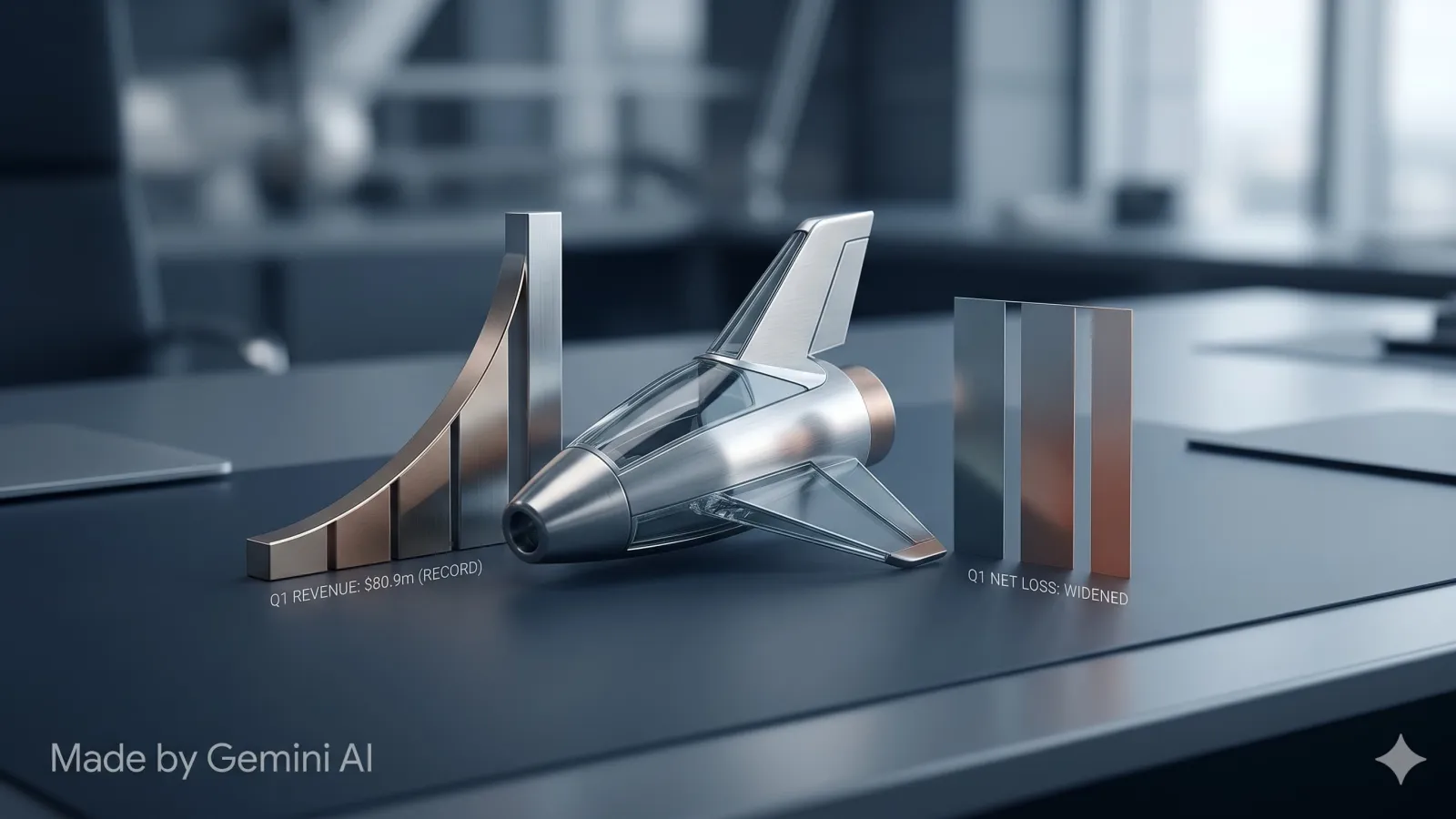
Firefly Aerospace (Nasdaq: FLY) has reported first-quarter 2026 revenue of $80.9 million, a 40% increase on the prior quarter and the company's highest quarterly figure to date. The result was underpinned by activity across its launch, lunar lander and defence software businesses, though net losses widened to $96.7 million from $60.1 million in the equivalent period a year earlier.
The Cedar Park, Texas-based company maintained full-year 2026 revenue guidance of $420 million to $450 million. Chief executive Jason Kim attributed the quarter's momentum to a combination of mission milestones and new contract awards. "We've maintained steady progress across our launch and spacecraft business, and remained focused on scaling up our production lines to meet the demand for frequent landings on the Moon, a regular launch cadence, and critical national security missions," he said.
Contract wins and programme milestones
The quarter's most commercially significant award was a $109 million engineering change proposal under the U.S. Space Force's FORGE Enterprise OPIR Services contract, won by Firefly's SciTec subsidiary to accelerate and expand data centre delivery for the missile-warning system. Separately, SciTec was selected to support the space-based interceptor programme under the Golden Dome initiative, which the Trump administration has positioned as a next-generation homeland missile defence architecture.
On the launch side, Alpha Flight 7 completed all mission objectives, including validating Block II subsystems and deploying a demonstrator payload for Lockheed Martin. Firefly also participated in the U.S. Space Force's VICTUS DIEM tactically responsive space exercise alongside Lockheed Martin. A Block II configuration upgrade to the Alpha vehicle — aimed at improving reliability and streamlining production — was unveiled, with qualification testing for Alpha Flight 8 components now completed.
For its lunar programme, Firefly completed separation testing for Blue Ghost Mission 2, which will carry the European Space Agency's Lunar Pathfinder satellite, and verified interoperability between its Elytra orbiter and Blue Ghost lander for far-side communications relay on behalf of NASA's LuSEE-Night radio telescope.
An AFRL contract was also awarded to SciTec for deep learning and advanced algorithm development on small Size, Weight and Power (SWaP) processors to support enhanced target tracking — a capability area where edge AI inference on constrained hardware is increasingly central to defence procurement.
Market context and financial position
Firefly's revenue growth is occurring against a backdrop of sustained U.S. government appetite for commercial space and defence technology. The Golden Dome programme, in particular, represents a significant addressable market for companies combining launch, on-orbit services and AI-enabled sensor processing. Firefly's dual-track positioning — as both a launch provider and a defence software vendor through SciTec — distinguishes it from pure-play small-launch competitors such as Rocket Lab and ABL Space Systems.
Cash and cash equivalents fell sharply to $326 million at 31 March 2026, from $793 million at the start of the year, driven largely by the repayment of $260 million on a revolving credit facility. With short-term investments of $225 million also on the balance sheet, total liquid resources remain meaningful, though the free cash outflow of $78.9 million in the quarter will focus investor attention on burn rate relative to the full-year revenue ramp.
Operating expenses of $113 million — including $67.5 million in R&D — reflect the company's continued investment phase. Adjusted EBITDA loss was $64.7 million. Investors will look for the revenue guidance range to narrow and operating leverage to emerge as Alpha Block II reaches its debut launch cadence.