
Hanwha and Ambarella sign $800m edge AI chip partnership
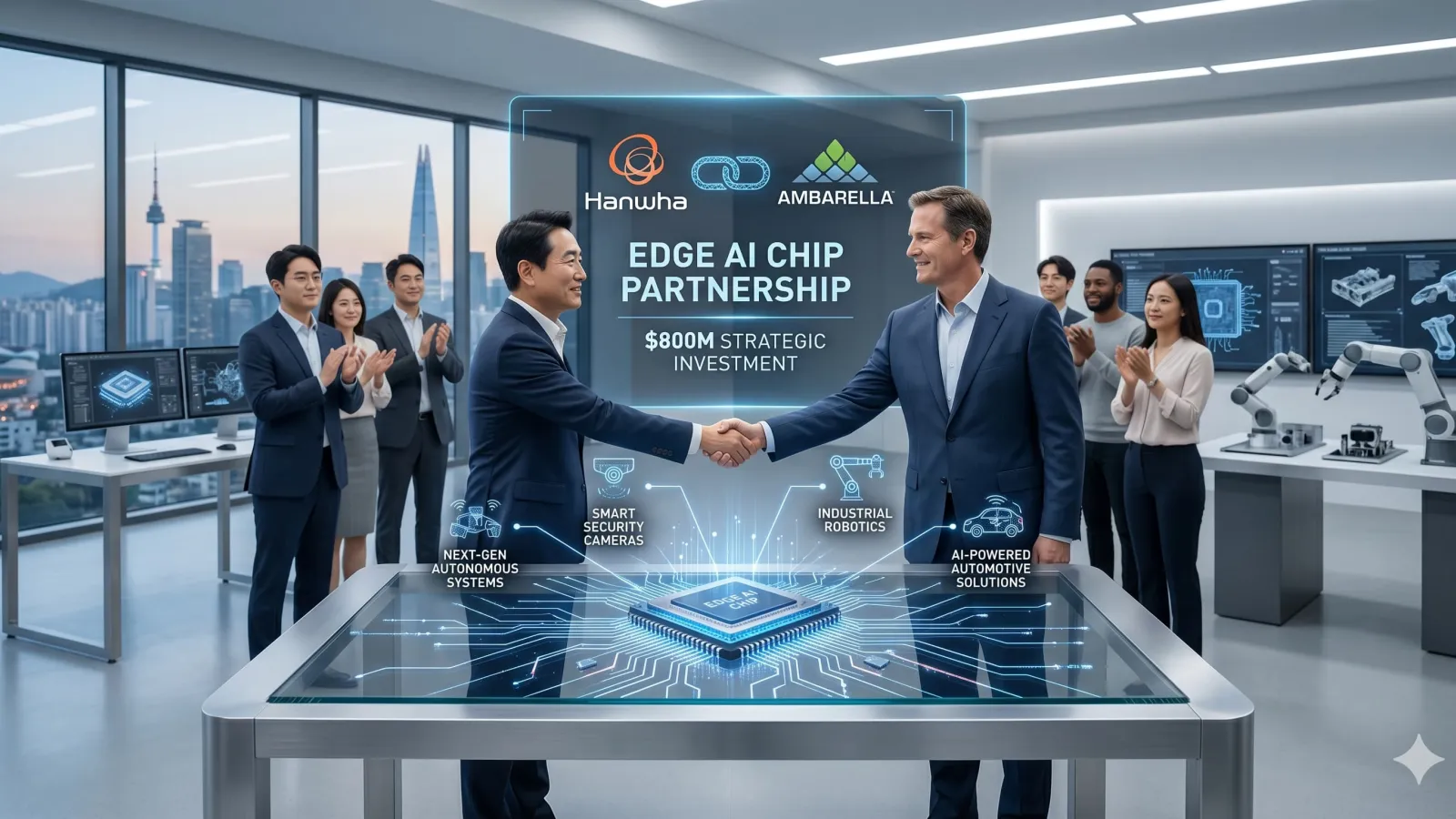
Hanwha Group and Ambarella have formalised a long-term agreement (LTA) for the co-development and sourcing of edge AI semiconductors across Hanwha's product portfolio, with the deal valued at more than $800 million in potential revenue over a period exceeding ten years. The agreement, which converts a memorandum of understanding signed in March, is described by Ambarella as one of the largest partnerships in the company's history and among the first of its kind in the edge AI SoC market.
The LTA covers Ambarella's current and next-generation edge AI systems-on-chip (SoCs) and supporting software, deployed across Hanwha divisions spanning video security — principally through Hanwha Vision — as well as robotics, industrial automation, and life sciences. The multi-generational structure is designed to align the two companies' technology roadmaps across product cycles rather than locking in a single generation of silicon.
What Ambarella brings to the table
Ambarella's edge AI platform is built on the company's proprietary CVflow AI accelerator architecture, which integrates inference processing, image signal processing, and video encoding on a single low-power chip. The installed base stands at more than 46 million units across 12 SoC variants — including the CV72, CV75, CV7 and N1 families — with performance claims reaching hundreds of TOPS of AI inference. The Cooper Development Platform provides an open toolchain for OEMs and software developers building on the silicon.
Ambarella reported fiscal year 2026 revenue of $390.7 million, with IoT revenue growing approximately 50% year-on-year, driven by enterprise security cameras and emerging edge device categories. The LTA, if its revenue potential is realised across the full decade, would represent roughly twice the company's current annual turnover — a significant forward commitment for a mid-cap semiconductor vendor.
Hanwha Vision will retain full in-house control of its Wisenet SoC line, which it has developed since 2010, positioning the Ambarella relationship as complementary rather than a wholesale outsourcing of its silicon roadmap.
Market context and competitive read
The edge AI inference market is consolidating around a small number of SoC platforms capable of running convolutional neural networks, vision-language models, and agentic AI frameworks at sub-10-watt power envelopes — a requirement driven by the constraints of cameras, drones, and industrial sensors. Ambarella competes in this space against Qualcomm's Vision Intelligence platform, NVIDIA's Jetson line at the higher-power end, and a range of domestic Chinese vendors that supply the large Chinese security-camera manufacturers.
The Hanwha deal is strategically significant because it anchors a major non-Chinese integrator to Ambarella's platform for the foreseeable future, at a time when Western buyers in physical security and industrial automation are actively diversifying supply chains away from Chinese-origin silicon. Hanwha Vision is a top-five global maker of IP surveillance systems, and design wins in its next-generation camera and robotics products could deliver meaningful volume to Ambarella's IoT segment.
Dr Fermi Wang, Ambarella's president and chief executive, said the partnership "has the potential to accelerate the development and delivery of high-performance, AI-enabled products across multiple industries" and is expected to drive "substantial multi-year revenue growth consistent with our long-term financial model."
Regulatory considerations
Physical security and industrial automation equipment incorporating edge AI inference is increasingly subject to scrutiny under US export-control frameworks administered by the Bureau of Industry and Security, as well as procurement restrictions on equipment from entities of concern. Hanwha Group has faced prior US legislative attention regarding its defence affiliates; buyers and investors will monitor whether the LTA's scope or Ambarella's US listing create any compliance obligations as export-control perimeters continue to expand. Neither company addressed this point in the announcement.