
Nokia opens AI Networking Innovation Lab in Sunnyvale
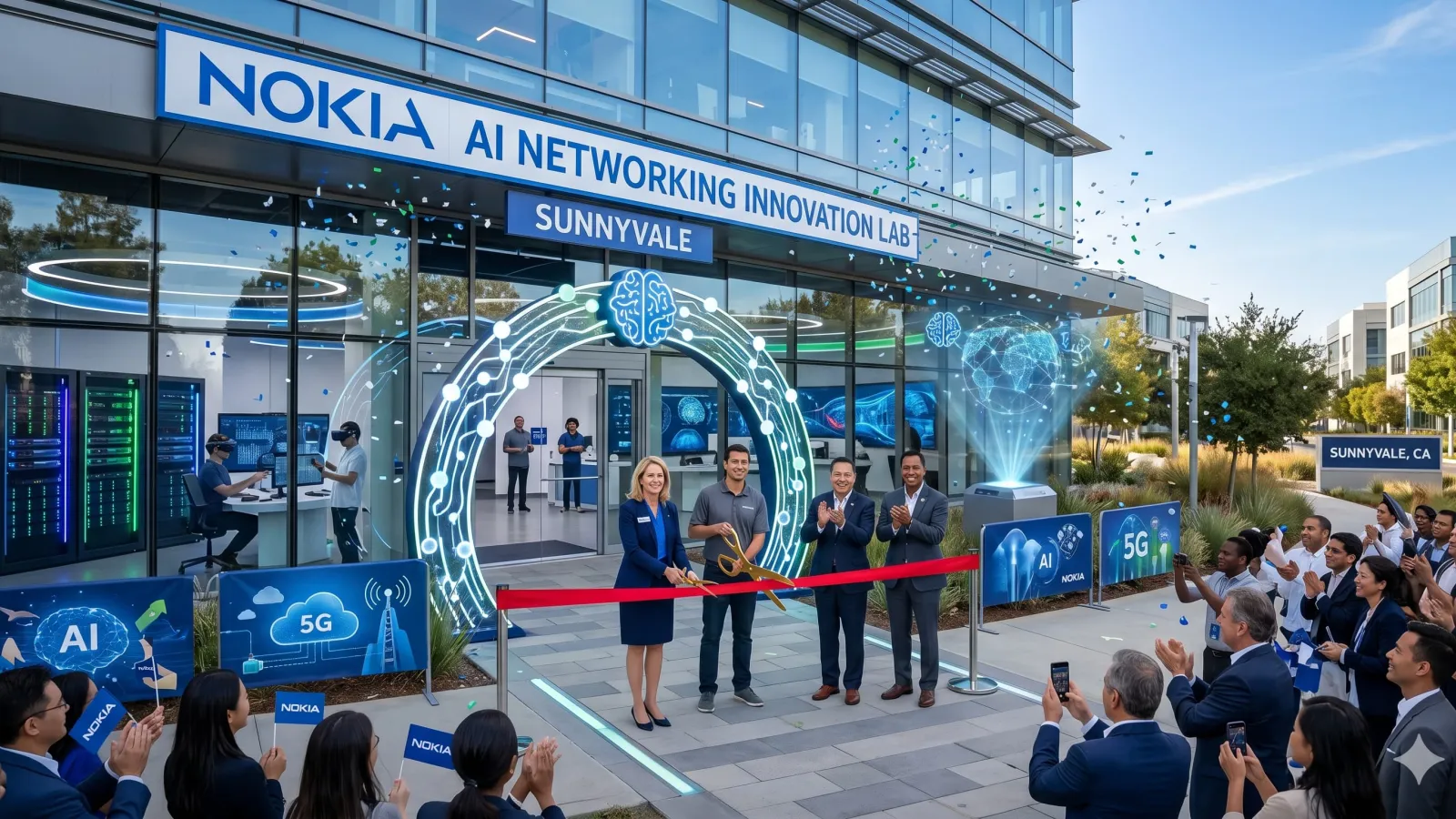
Nokia has opened its AI Networking Innovation Lab at its Sunnyvale, California facility, positioning the centre as a testing ground for next-generation data centre networking architectures purpose-built for AI workloads. The lab brings together Nokia's switching silicon, networking protocols, and hardware platforms alongside a named group of early technology partners — AMD, Everpure, Keysight, Lenovo, Nscale, Supermicro and Weka — to co-develop and validate AI-ready infrastructure under realistic training and inference conditions.
The launch reflects growing industry acknowledgement that legacy data centre networking was not designed for the traffic patterns generated by large-scale AI training clusters and distributed inference. Those workloads demand extremely low latency, high bisection bandwidth, lossless fabric behaviour, and fine-grained congestion control — requirements that have driven a surge of investment in specialised AI networking technologies.
What the lab does
Nokia says the lab is structured around three pillars: technology innovation, ecosystem collaboration, and validation. On the innovation side, the facility provides space to experiment with emerging protocols, congestion-control mechanisms, real-time telemetry and network automation across the full networking stack. The ecosystem collaboration pillar is designed to align roadmaps across silicon vendors, GPU developers, storage providers and cloud platforms, with joint interoperability testing a core activity.
The third pillar — validation — is arguably the most commercially significant. The lab acts as the production floor for Nokia Validated Designs (NVDs): multi-vendor reference architectures that customers can deploy with a degree of confidence that failure scenarios, congestion behaviour and operational automation have already been stress-tested. Arno van Huyssteen, Vice President of Global Telecommunications at Nscale, said that "the depth of hardware, software and failure testing behind those blueprints is what will give operators the confidence to deploy complex AI environments faster, with fewer integration risks and less operational disruption."
Ram Periakaruppan, Vice President and General Manager of Network Applications and Security at Keysight, noted that the partnership had allowed his team to emulate AI training workloads at scale across multiple transport options — including Ultra Ethernet Consortium (UEC) and RoCEv2 fabrics — providing operators and hyperscalers with validated deployment data.
Market context
Nokia enters the dedicated AI networking lab space at a moment of intense competitive activity. Arista Networks has been the dominant incumbent in hyperscale data centre switching, while Cisco's acquisition of Isovalent and continued investment in its Nexus line signal renewed intent. A cohort of well-funded startups — including those focused on lossless optical fabrics and in-network compute — are also competing for AI infrastructure budgets that analyst firms estimate will grow significantly through 2028.
The Ultra Ethernet Consortium, in which Nokia participates, is one of the key standards bodies shaping the next generation of AI fabric interoperability. Alongside RoCEv2 and proprietary solutions such as NVIDIA's InfiniBand-based NVLink fabric, UEC represents an industry attempt to deliver open, standards-driven high-performance networking — a goal AMD's Travis Karr explicitly endorsed, noting that "an open, standards-driven approach empowers customers to integrate seamlessly across heterogeneous environments, avoiding lock-in."
Nokia's Rudy Hoebeke, Vice President of Software Product Management, framed the lab as central to the company's AI-native connectivity strategy, describing it as giving customers "early access to new technologies, deeper collaboration with the world's leading AI ecosystem players, and the confidence that their networks are validated under more realistic AI conditions."
For enterprise buyers and hyperscalers evaluating AI infrastructure partners, validated multi-vendor designs carry growing weight. The gap between a vendor's benchmark claims and production-grade performance under mixed workloads has become a meaningful procurement risk — one that Nokia is explicitly positioning this lab to close.