
Quantum Metric: AI referrals boost loyalty but spike abandonment
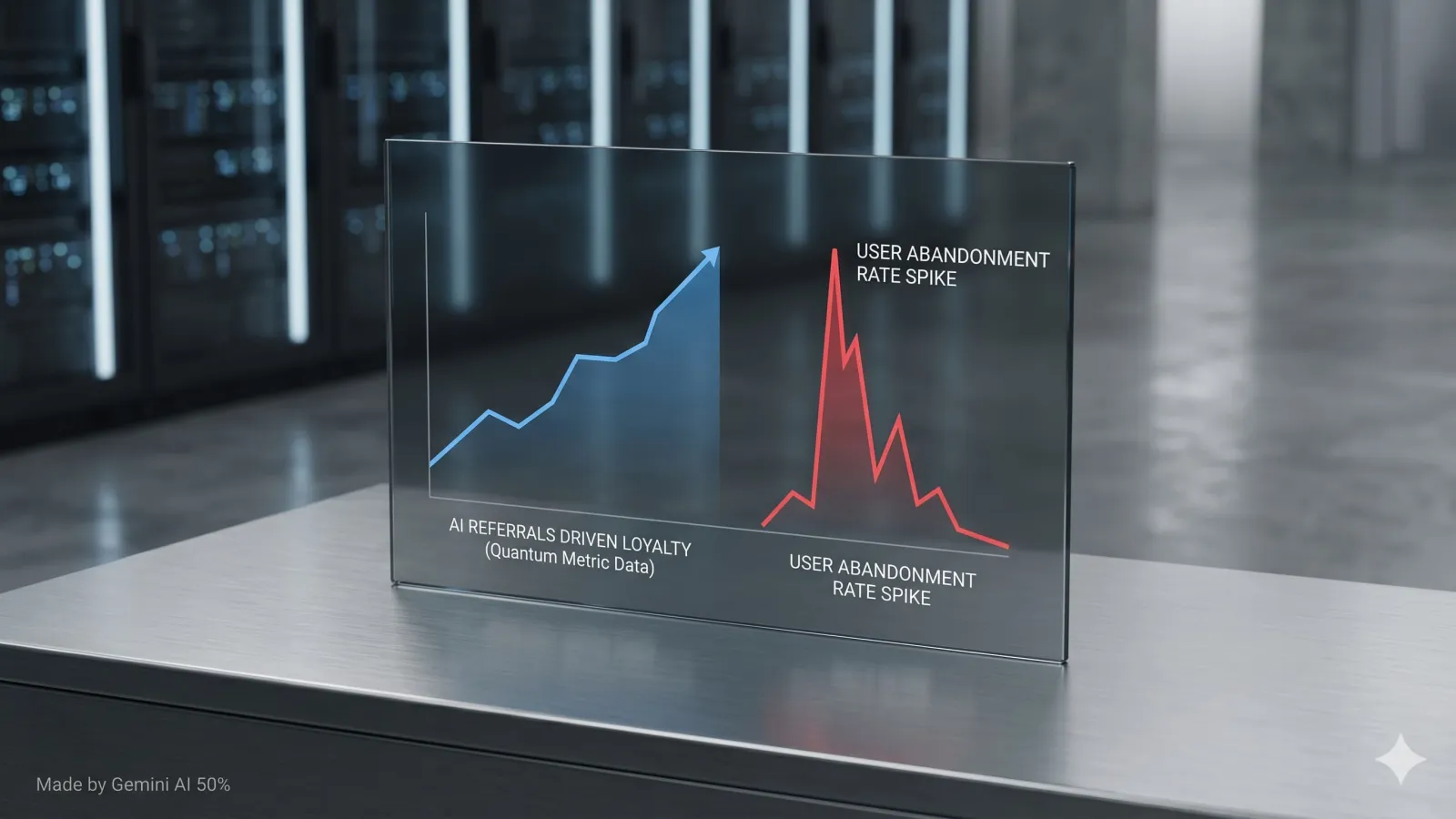
Quantum Metric has published its 2026 AI Experience Benchmark Report, drawing on a survey of 1,500 consumers and 750 digital leaders across the US and UK, combined with aggregated behavioural data. The headline finding is striking in its duality: 98% of consumers will make repeat purchases from a brand they discovered via an AI recommendation following a positive experience, yet they are twice as likely to abandon after encountering a single point of friction — and 81% will not return at all.
The report also tracks a 111% year-on-year growth in AI-referred traffic — sessions arriving directly from tools such as ChatGPT, Gemini, Perplexity and Google Overviews — framing this cohort as a qualitatively different type of visitor. Unlike a browser arriving via search or a social feed who expects to compare and browse, an AI-referred customer has already been given a recommendation; their intent is higher and their patience is lower.
The investment misalignment problem
The data surfaces a pointed disconnect between what consumers want from AI and where digital teams are spending. Nearly half of consumers (46%) say better search and discovery is their priority, yet the majority of digital teams (56%) are focused on automating customer support. That gap matters commercially: if AI-referred customers arrive expecting a seamless discovery experience and encounter a friction-heavy site, the trust the AI model extended on the brand's behalf evaporates immediately.
A separate confidence problem runs parallel. Only 34% of digital leaders say they trust the data powering their AI decisions, and 62% express concern about misinterpreted outputs. This internal data-quality deficit creates a structural difficulty: teams are being asked to deliver reliable AI-powered experiences to customers while harbouring significant doubt about the accuracy of the signals driving those experiences.
Quantum Metric is using the report as a launch vehicle for Felix Agentic, described by the company as an autonomous digital experience analyst. The product is positioned to continuously monitor digital journeys, identify friction and explain revenue impact — what the company says is powered by a dataset it claims is "2,700 times richer" than traditional analytics platforms, though the basis for that comparison is not defined in the release.
Market context and competitive landscape
The digital experience analytics market is well established, with players including Contentsquare, Medallia, Glassbox and FullStory offering session replay, funnel analysis and behavioural intelligence. The differentiation Quantum Metric is now staking is around agentic AI — autonomous analysis that surfaces insight without requiring an analyst to formulate the query. That framing tracks a broader industry move: several vendors in the category have added large-language-model layers to existing datasets over the past 18 months, and the race is now to demonstrate that autonomous agents can act on findings, not merely surface them.
The report's methodology — a four-day survey window in early April — is relatively compressed, and the behavioural data is drawn from Quantum Metric's own customer base, which means it reflects digital-native enterprise clients rather than a fully representative cross-section of retail or financial services. Editors and readers should weigh the findings accordingly.
Chief executive Mario Ciabarra framed the stakes plainly: "AI-driven customers arrive with higher intent and built-in trust, creating a major opportunity for brands to win new customers. At the same time, they come with higher expectations for a seamless experience, and if a brand can't deliver, they immediately abandon for a competitor."
The practical upshot for enterprise digital teams is that AI-referred traffic demands the same operational rigour as any high-value acquisition channel: instrumentation, real-time alerting, and fast remediation. The report positions Quantum Metric's own tooling as the answer, but the underlying data point — that a new class of high-intent, low-tolerance customer is arriving via AI — will shape product roadmaps and analytics investment across the sector through 2027.