
ST launches AI-embedded MEMS vibration sensor for industry
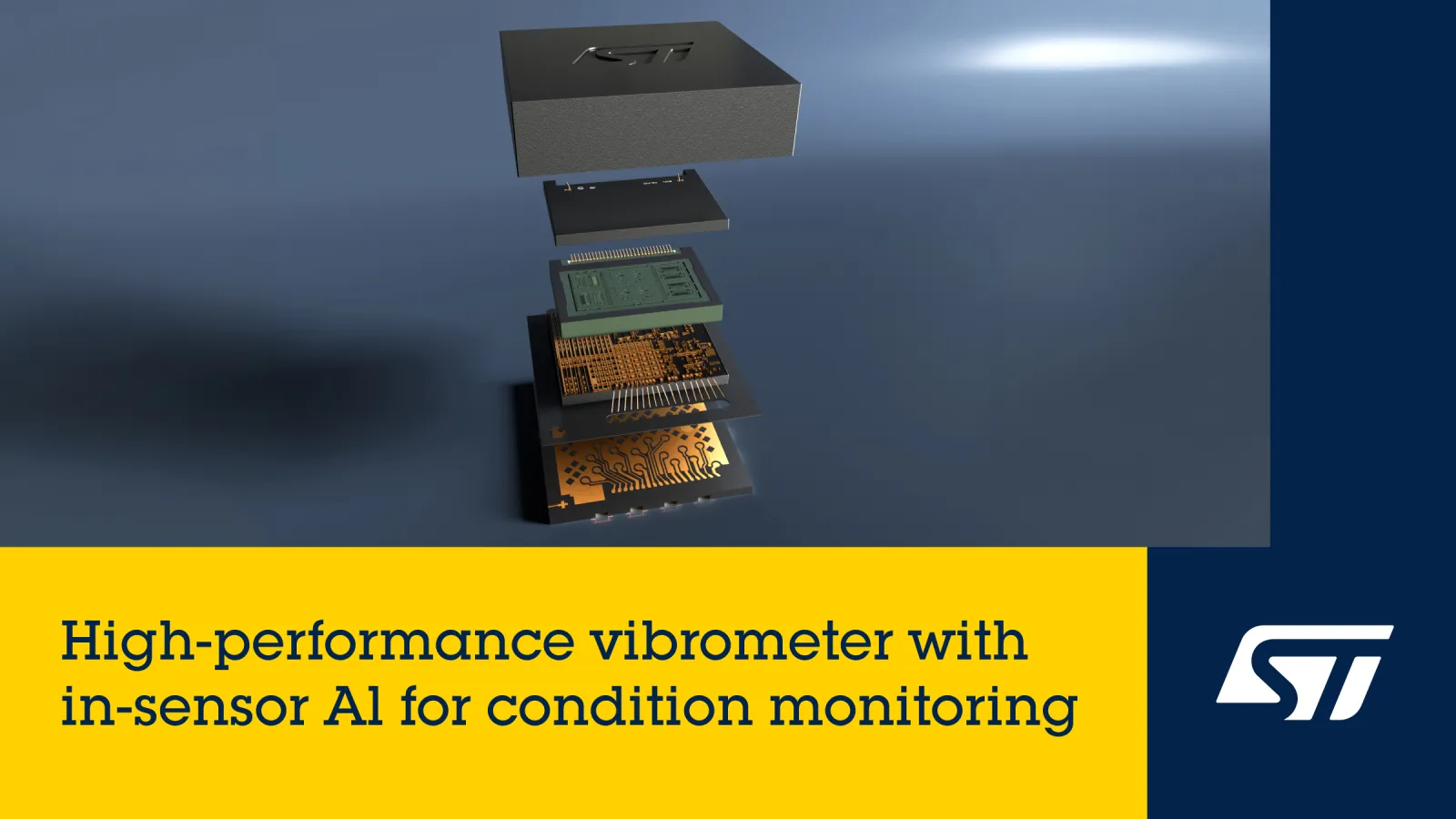
STMicroelectronics has introduced the IIS3DWB10IS, an industrial-grade MEMS vibration sensor that integrates an on-chip AI inference engine — the ISPU 2.0 — to bring edge signal processing directly to the sensing element. The device is scheduled for availability in July 2026, priced from $25 for orders of 1,000 pieces.
The sensor measures vibrations and shocks up to 200g at frequencies exceeding 10 kHz, with a noise floor of 35 µg/sqrt(Hz) that the company says is comparable to traditional piezoelectric sensors. It operates across temperatures up to 125°C, ships in a compact 4.5 mm × 4.5 mm × 1.5 mm LGA package, and is backed by ST's ten-year industrial longevity programme — a meaningful commitment for infrastructure operators who cannot afford frequent component redesigns.
What the ISPU 2.0 adds
The second-generation Intelligent Sensor Processing Unit introduces hardware accelerators for real-time fast Fourier transforms, envelope analysis, filtering, velocity severity scoring, and anomaly detection. ST says the ISPU 2.0 delivers four times the processing throughput of its predecessor — 40 MIPS and 40 MFLOPS — and supports a six-times faster data-transfer interface to the MEMS circuitry. The core is C-programmable and carries on-chip program and data RAM, alongside a 2,048 × 80-bit FIFO register and an integrated temperature sensor.
Simone Ferri, executive vice-president of the APMS MEMS sub-group at ST, said the ISPU 2.0's hardware accelerators "sharpen equipment-wear recognition while reducing latency and power consumption", and described the device as "the first compelling alternative to piezosensor" capable of battery-powered operation.
Andrea Torcelli, chief technology officer at Italian power-transmission specialist Bonfiglioli, confirmed the company has already replaced incumbent piezoelectric sensors with the IIS3DWB10IS, citing the device's dynamic range, bandwidth, high-temperature tolerance, and simplified circuit design as the deciding factors.
Market context
Condition monitoring — using sensor data to predict bearing failures, gear-mesh faults, and imbalance in rotating machinery — is a well-established but rapidly expanding market. Fortune Business Insights puts the global market above $5 billion by 2032 at a compound annual growth rate above 9 per cent. The traditional incumbent is the piezoelectric accelerometer: mature, accurate, but typically analogue, bulky, and power-hungry. Digital MEMS alternatives have long promised smaller form factors and lower integration cost, but the bandwidth and dynamic-range gap has kept piezosensors dominant in high-end industrial applications.
ST's positioning here is squarely at that premium segment. Competitors including Analog Devices and Bosch Sensortec have shipped industrial MEMS accelerometers, but the integration of a programmable AI inference core at this bandwidth and temperature rating is relatively uncommon in a single-chip solution. The device's wettable-flank LGA package is also a practical concession to high-volume surface-mount assembly lines, where automatic optical inspection is standard.
Edge AI and regulatory read-across
The broader push to run inference at the sensor node — rather than aggregating raw data to a gateway or cloud — aligns with the IEC 61499 distributed-control standard and with the EU Machinery Regulation (effective January 2027), which tightens safety requirements for predictive-maintenance systems on industrial equipment. Customers designing condition-monitoring solutions for CE-marked machinery will need to document the AI decision logic embedded in the sensor, a requirement that ST's C-programmable ISPU and software library ecosystem is intended to support.
ST enters the second half of 2026 with a device that addresses a clear industrial need, a named reference customer in Bonfiglioli, and a price point designed for volume deployment. Near-term milestones to watch include the availability date confirmation in July, any additional named system integrators, and whether ST publishes independent benchmark comparisons against named piezoelectric sensor alternatives.