
ThoughtSpot deepens Snowflake integration with agentic analytics suite
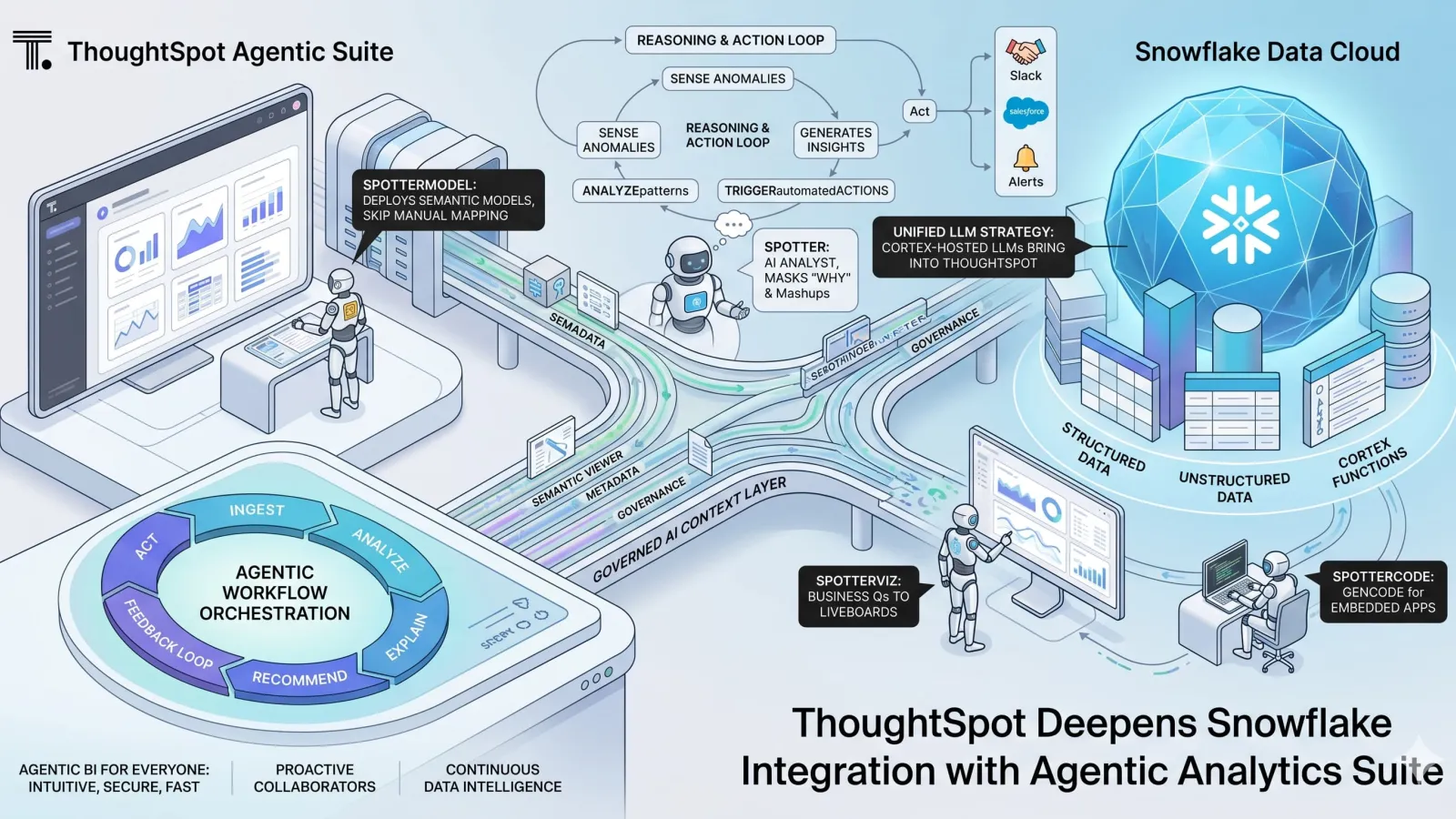
ThoughtSpot has announced a broad expansion of its integration with Snowflake at the cloud data vendor's annual Summit conference, tying its Spotter intelligence engine directly into Snowflake Cortex AI and Snowflake Semantic Views. The move is designed to let enterprise analytics agents operate entirely within the Snowflake security perimeter, removing the need to move sensitive data outside a customer's existing governance controls.
The announcement, made on 2 June 2026, covers four named agents — Spotter, SpotterModel, SpotterViz and SpotterCode — each targeting a distinct point in the analytics workflow, from natural-language querying and semantic modelling through to dashboard assembly and embedded application development. All four are available today via the Snowflake Marketplace and can be deployed against existing Snowflake credits.
What the integration delivers
The centrepiece of the announcement is a "Bring Your Own LLM" capability that allows enterprises to route ThoughtSpot queries through Snowflake-hosted large language models they have already vetted and tuned for their own business vocabulary. Francois Lopitaux, SVP of Product Management at ThoughtSpot, argued that grounding agentic AI in governed semantic context — rather than relying on general-purpose AI agents — is the differentiator that will separate winning enterprises from those that merely pilot AI. "By further integrating Spotter with Snowflake Cortex AI and allowing customers to bring their own fine-tuned Snowflake LLMs, we are giving enterprises the accuracy, control, and data sovereignty they need to operationalize trusted AI at scale," he said.
Also notable is bi-directional semantic management via an integration with Snowflake CoCo. Customers can now import semantic definitions from Snowflake into ThoughtSpot and export ThoughtSpot models — enriched with AI context — back into Snowflake. Josh Klahr, Director of Product Management for Analytics at Snowflake, described the combination of Snowflake Semantic Views and ThoughtSpot's Spotter Semantics as "a massive leap forward for data governance and analytics." A forthcoming feature will extend this further by rendering Cortex-generated text answers as interactive charts and Liveboards, closing the gap between LLM reasoning and visual business intelligence.
Market context
The integration is well-timed relative to a broader shift in enterprise data tooling. The business intelligence market is undergoing a structural transition from static dashboards toward conversational and agentic interfaces, with incumbents such as Tableau, Power BI and Looker all adding natural-language and AI-assisted layers. ThoughtSpot's strategic bet — positioning semantic governance as the core value proposition rather than visualisation breadth — differentiates it from hyperscaler-native BI tools but requires it to maintain deep partnerships with cloud data platforms to stay competitive on distribution.
Snowflake's Marketplace has become an increasingly important channel for ISV analytics vendors; deploying against existing Snowflake credits lowers procurement friction for joint customers and strengthens platform stickiness for both parties. The partnership dynamic here is symbiotic rather than purely reseller-led, which adds some durability to the integration.
Regulatory and governance read-across
Data sovereignty is an explicit selling point in the announcement, with ThoughtSpot emphasising that sensitive data never leaves the Snowflake security boundary. That framing is directly relevant to European enterprise buyers operating under GDPR and, for financial-services customers, DORA's operational resilience requirements, both of which place obligations on how AI-generated insights interact with regulated data. Enterprises in highly regulated verticals — banking, pharmaceuticals, critical infrastructure — will scrutinise whether the "Bring Your Own LLM" architecture satisfies their specific data-processing agreements with Snowflake before committing production workloads.
ThoughtSpot counts Lyft, Unilever, Roche and HubSpot among its named reference customers. The company did not disclose revenue figures, customer counts or pricing for the expanded capabilities in the release. The next milestones to watch are general availability of Cortex-powered native visualisations and any disclosed customer wins for the bi-directional CoCo semantic sync.