
Turbo Energy deploys AI energy storage with Spanish Army
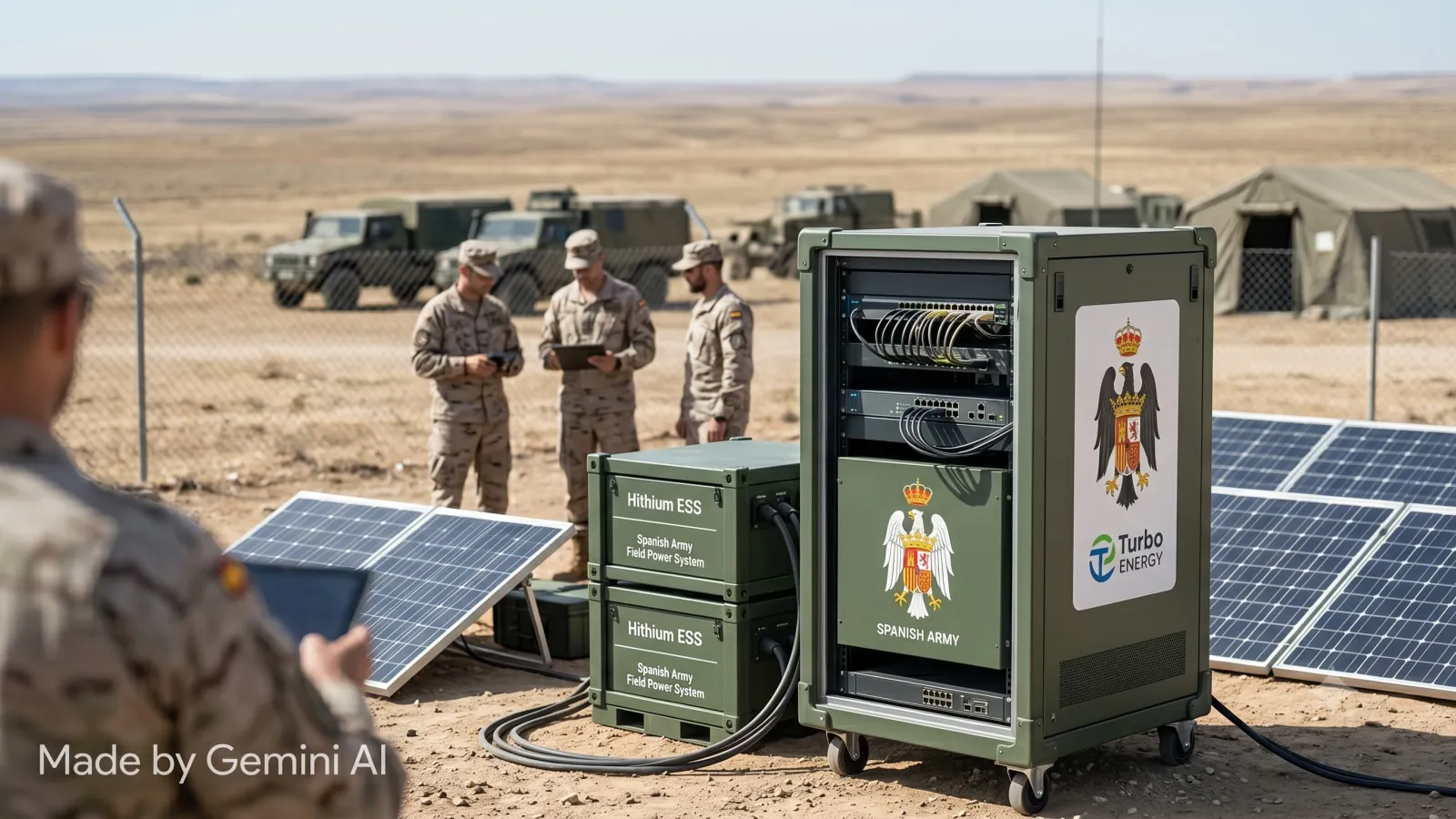
Turbo Energy (NASDAQ: TURB) has confirmed an active deployment of its AI-driven energy storage and management platform in Spanish Army overseas operations, marking what the Valencia-based company describes as its first live engagement in a defence context. The system — branded Sunbox Industry — forms part of a hybrid, off-grid power solution currently fielded in an unspecified international mission.
The containerised unit integrates photovoltaic generation, battery storage and auxiliary generation into a single, transportable package compatible with standard military logistics channels across land, air and sea. Turbo Energy says the system reaches full operational status within ten minutes of arrival on site, supplying continuous power to command-and-control nodes, communications networks and mission equipment.
The technology
At the platform's core is a proprietary AI energy management layer that Turbo Energy says dynamically orchestrates generation, storage and consumption in real time. Predictive analytics — drawing on weather forecasting and demand profiling — are used to automate energy-flow optimisation, maximising renewable utilisation and minimising supplementary fuel draw under variable field conditions.
Chief executive Mariano Soria framed the deployment in strategic terms: "Energy is no longer a supporting function in operations — it is a strategic capability. This deployment demonstrates how our AI-driven platform enables real operational autonomy, transforming energy infrastructure into an intelligent, adaptive system capable of performing under the most demanding conditions."
The company did not disclose contract value, mission duration, geographic theatre, or the number of units deployed. It also did not name an independent third-party that has verified the platform's performance benchmarks in field conditions.
Market and competitive context
The intersection of renewable energy storage and defence logistics is attracting increasing commercial interest. Reducing the fuel-convoy burden — historically one of the highest-casualty risks in expeditionary operations — is a well-documented priority for NATO member states. Several European and US vendors, including established defence-electronics integrators and a growing cohort of cleantech startups, are pursuing similar off-grid, software-managed microgrid concepts for military and emergency-response customers.
Turbo Energy's differentiator, as presented in the release, is the software intelligence layer rather than the hardware itself; photovoltaic-plus-battery containerised systems are not novel. The durability of any competitive advantage will depend on how the AI optimisation layer performs against comparable offerings from better-capitalised defence-technology primes and purpose-built military microgrid specialists.
The company, founded in 2013 and listed on NASDAQ, operates across residential, commercial and industrial segments in Europe, North America and Latin America as part of the Umbrella Global Energy group. Defence and emergency response are described as a "natural extension" of the existing platform — a claim that will be tested by the procurement rigour and certification requirements typical of military customers.
Regulatory and export considerations
Deployments in active military operations may engage export-control frameworks depending on the mission theatre, including US Bureau of Industry and Security (BIS) dual-use regulations and EU export-control provisions, given that Turbo Energy is a Spanish-headquartered, US-listed entity. The company made no reference to applicable certification standards — such as MIL-STD environmental requirements or NATO qualification frameworks — in its release.
For investors, the key near-term indicators will be whether this pilot translates into a named, repeatable contract and whether the company can publish independently verified performance data from the field deployment.