
Voltus and Google agree 100 MW virtual power plant deal for PJM grid
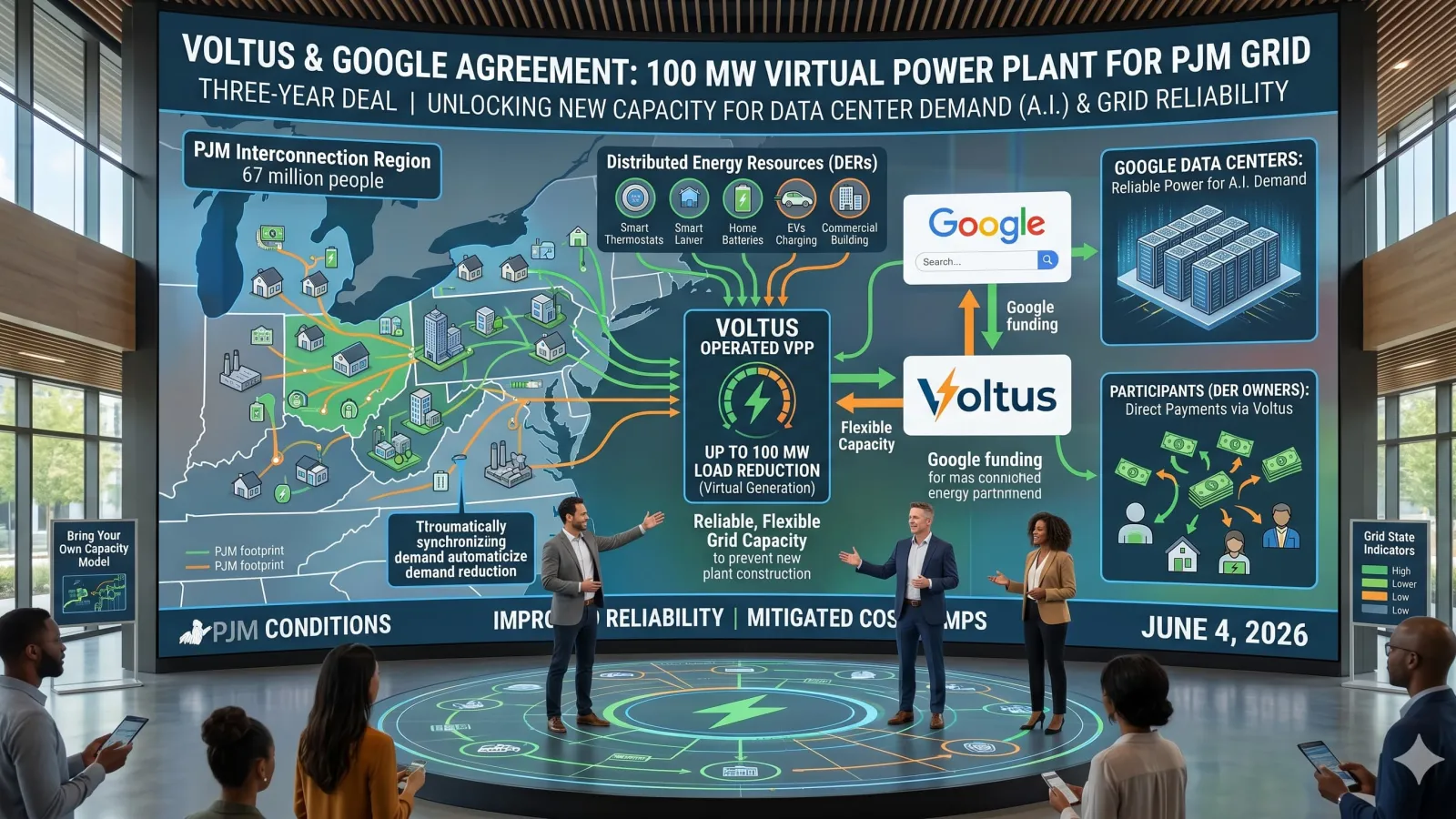
Voltus has signed a three-year "Bring Your Own Capacity" agreement with Google under which the virtual power plant (VPP) operator will aggregate up to 100 megawatts of distributed energy resources (DERs) each year across the PJM grid — the largest US regional transmission organisation, covering the Midwest and Mid-Atlantic. Google funds the capacity; Voltus sources the assets and pays the households and businesses whose batteries, smart thermostats and other flexible devices participate.
The arrangement is structured so Google's data-centre capacity needs are met not by procuring new generation or waiting for grid expansion, but by orchestrating existing, dispersed assets. When electricity demand peaks, Voltus's software simultaneously dispatches thousands of enrolled devices — discharging a battery here, nudging a thermostat setpoint there — in a way that is imperceptible to each individual participant but collectively equivalent to a sizeable generation asset coming online.
The deal
The initial agreement covers PJM and is framed by both parties as a replicable model rather than a one-off transaction. Dana Guernsey, chief executive of Voltus, said the partnership is "pioneering a model that large load customers can follow" and expects it to accelerate DERs as a capacity solution at scale. Google's Global Head of Advanced Energy, Michael Terrell, described it as an addition to a "growing toolkit that can accelerate a robust, flexible energy system."
Google separately disclosed that it is making its own data-centre demand more flexible through agreements with multiple utilities, targeting 1 gigawatt of demand-response capacity across US power systems. The Voltus deal complements rather than replaces that programme, broadening the company's demand-side toolkit beyond its own facilities to third-party DER aggregation.
The release cited a Brattle Group analysis suggesting US consumers could save more than $100 billion over the next decade by making better use of existing grid infrastructure through VPP-style solutions, though that figure represents a broad industry estimate rather than a projection specific to this agreement.
Market context
The VPP sector has attracted significant investment as utilities and large industrials look for alternatives to capital-intensive grid expansion. Voltus competes with a range of aggregators and demand-response specialists, including AutoGrid, Enerex, and the demand-response divisions of larger energy-management firms. At the same time, hyperscalers — under growing scrutiny for the power intensity of AI training and inference workloads — are increasingly expected to demonstrate proactive grid stewardship as a condition of securing new data-centre permits and utility interconnection agreements.
PJM itself has been under pressure from load-growth forecasts driven by data centres and manufacturing re-shoring, leading the grid operator to tighten capacity-market rules and raise reserve margins. A commercially proven BYOC model that allows large loads to contribute capacity rather than simply consume it could become relevant to PJM's capacity-auction mechanics and inform how other regional transmission organisations approach hyperscaler load growth.
Regulatory and standards read-across
DER aggregation in wholesale markets has been shaped in the US by FERC Order 2222, which requires regional grid operators to allow aggregated DERs to participate in capacity, energy and ancillary-services markets. Voltus's business model depends on PJM's implementation of that order remaining permissive. In the EU, comparable obligations under the revised Electricity Market Design regulation are still being transposed by member states, which may affect any future European expansion of the BYOC model.
The deal terms — including any capacity-payment rates, performance guarantees or penalty structures — were not disclosed. Voltus did not name specific commercial or industrial anchor customers enrolled in the programme at launch.