
Finwave debuts eight GaN-on-Si RF switches at IMS2026
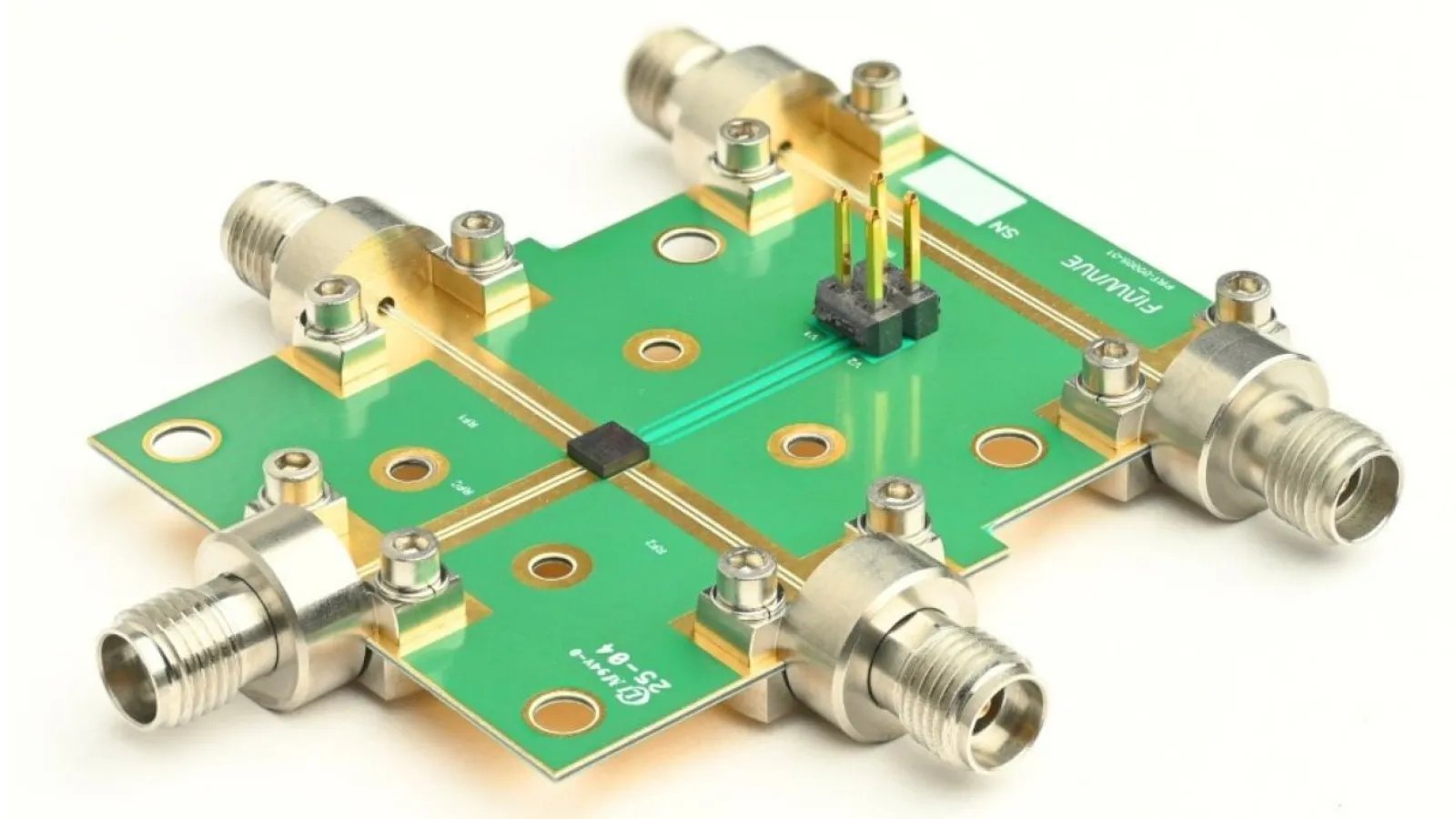
Finwave Semiconductor has unveiled eight new high-power RF switch products at IMS2026 in Boston this week, expanding a portfolio built on its GaN-on-Silicon platform. The Waltham, Massachusetts-based company is demonstrating the devices at booth #12076 through 12 June alongside a newly announced partnership with RF prototyping specialist X-Microwave.
The eight additions span single-pole double-throw (SPDT) and single-pole four-throw (SP4T) configurations, covering frequency ranges from 300 MHz to 18 GHz and continuous-wave power handling from 6 W to 40 W. Headline parts include the FW2109, an ultra-broadband SPDT rated for electronic warfare and wideband communications applications; the FW2124, targeting X-band radar and satellite communications with 8 W CW and 16 W pulse handling; and the FW2110, an ultra-low-loss switch supporting 40 W CW and 80 W peak pulse. All devices are packaged in a 4×4 mm QFN form factor designed to meet aerospace and defence SWaP-C (Size, Weight, Power and Cost) constraints, and incorporate integrated driver circuitry to reduce external component count.
Partnership and availability
Through the X-Microwave partnership, three existing Finwave switches — the FW2001, FW2002 and FW2003 — are now available as pre-characterised X-MWblocks, modular building blocks that plug into X-Microwave's prototyping ecosystem. The FW2001–2003 support power handling up to 30 W and frequencies to 12 GHz. The eight new devices announced this week are available directly from Finwave; broader distribution through RFMW is also noted for existing products.
Chief executive Pierre-Yves Lesaicherre said the company's aim is to combine high power handling, fast switching — demonstrated in the 30-nanosecond range at IMS — and broadband operation in compact packages, while partnerships such as the one with X-Microwave shorten the path from evaluation to production deployment.
Market context
The RF switch market for defence and aerospace applications has tightened considerably as platform designers push for higher integration and lower insertion loss in phased-array radar, electronic warfare and satellite communications payloads. GaN-on-SiC has historically dominated high-power RF switching owing to its thermal conductivity advantage, but GaN-on-Si approaches — Finwave's differentiation — promise lower wafer cost through compatibility with standard silicon foundry lines, a meaningful benefit as defence electronics programmes face pressure to reduce unit costs at volume.
Finwave competes in this space against established suppliers including pSemi (a Murata company), Qorvo and Analog Devices, as well as a number of GaN-focused fabless startups. The company's GaN FinFET process heritage, originating from MIT research, is cited by management as a differentiator in transistor density and switching speed, though independent benchmark comparisons were not included in the release materials.
The broader context of US defence technology spending is also relevant: ongoing demand for counter-drone systems, satellite communications and electronic warfare platforms has sustained investment in RF component supply chains. Export-control considerations under US Department of Commerce BIS rules apply to any RF components destined for dual-use or foreign military customers, and buyers will need to assess Finwave's export compliance posture as they qualify parts for programme-of-record use.
Finwave was founded by MIT researchers and is privately held