
HERE WeGo adds predictive traffic routing for North American soccer fans
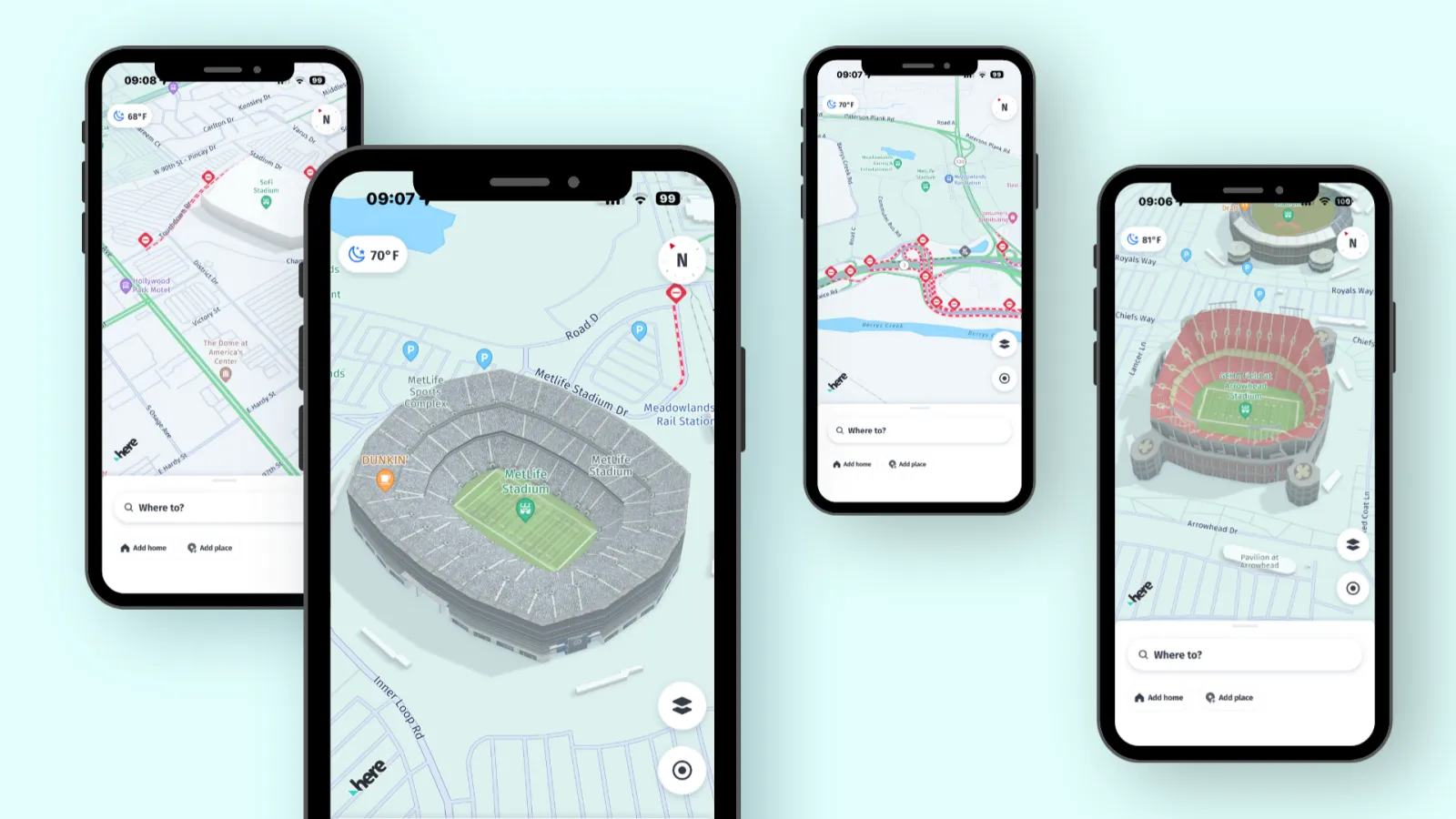
HERE Technologies has positioned its free WeGo navigation app as a match-day travel tool for the large-scale soccer tournament drawing millions of visitors across North American host cities this summer. The app combines real-time road-closure feeds from local authorities, predictive congestion modelling and multi-modal routing to help fans travel by car, public transit, bike or on foot.
The company says its AI models blend historical traffic patterns, live signal data and event-specific inputs to anticipate congestion before and after matches, rather than simply reacting once jams have formed. The same traffic intelligence layer is also surfaced through the HERE SDK, meaning automakers and enterprise partners with embedded HERE navigation can benefit without separate integration work.
What the app offers
WeGo's feature set is broad for a free, no-registration product. Offline maps, multi-stop routing, EV-charging integration, ride-hailing links and privacy-first local storage of location data are all present in the current build. The app is available across Apple, Google, Huawei and Samsung storefronts.
Andrei Dmitriev, Director of Product Management at HERE Technologies, said: "Moving millions of people efficiently during events of this scale demands more than navigation, it requires intelligence that adapts in real time. By combining live traffic signals with predictive intelligence, HERE helps fans, local communities and partners make smarter decisions and arrive with greater confidence, even in rapidly changing conditions."
HERE did not disclose usage figures, the number of host cities covered, or specific accuracy benchmarks for its predictive models in the release.
Market context
The consumer navigation market is dominated by Google Maps and Apple Maps, both of which carry real-time traffic data and event-aware routing. Waze, owned by Google, has a long-standing focus on community-reported incidents and event congestion. HERE's consumer proposition in this environment is differentiated primarily by its privacy-first, no-account model and its offline-map capability, features that matter in dense stadium areas where mobile signal can be unreliable.
HERE's broader commercial relevance sits in the B2B layer: the company licences its map and SDK to automotive OEMs and enterprise developers, and the WeGo consumer app functions partly as a live demonstration of that underlying platform. The company traces its digital mapping roots to 1985 and counts major vehicle manufacturers among its long-standing SDK customers.
The event also highlights a broader pattern in location technology, where large-scale gatherings stress-test real-time data pipelines and generate concentrated usage spikes. Navigation providers increasingly use high-profile sporting events to validate and publicise platform resilience, making tournament seasons a de facto benchmarking period for the sector.
From a regulatory standpoint, HERE's stated privacy-first architecture, keeping location data on-device and requiring no sign-up, places it in a favourable position relative to EU and UK data-minimisation principles under GDPR, an increasingly salient differentiator as scrutiny of consumer location tracking tightens on both sides of the Atlantic.