
SeoulTech AI framework tracks bridge damage via drone over time
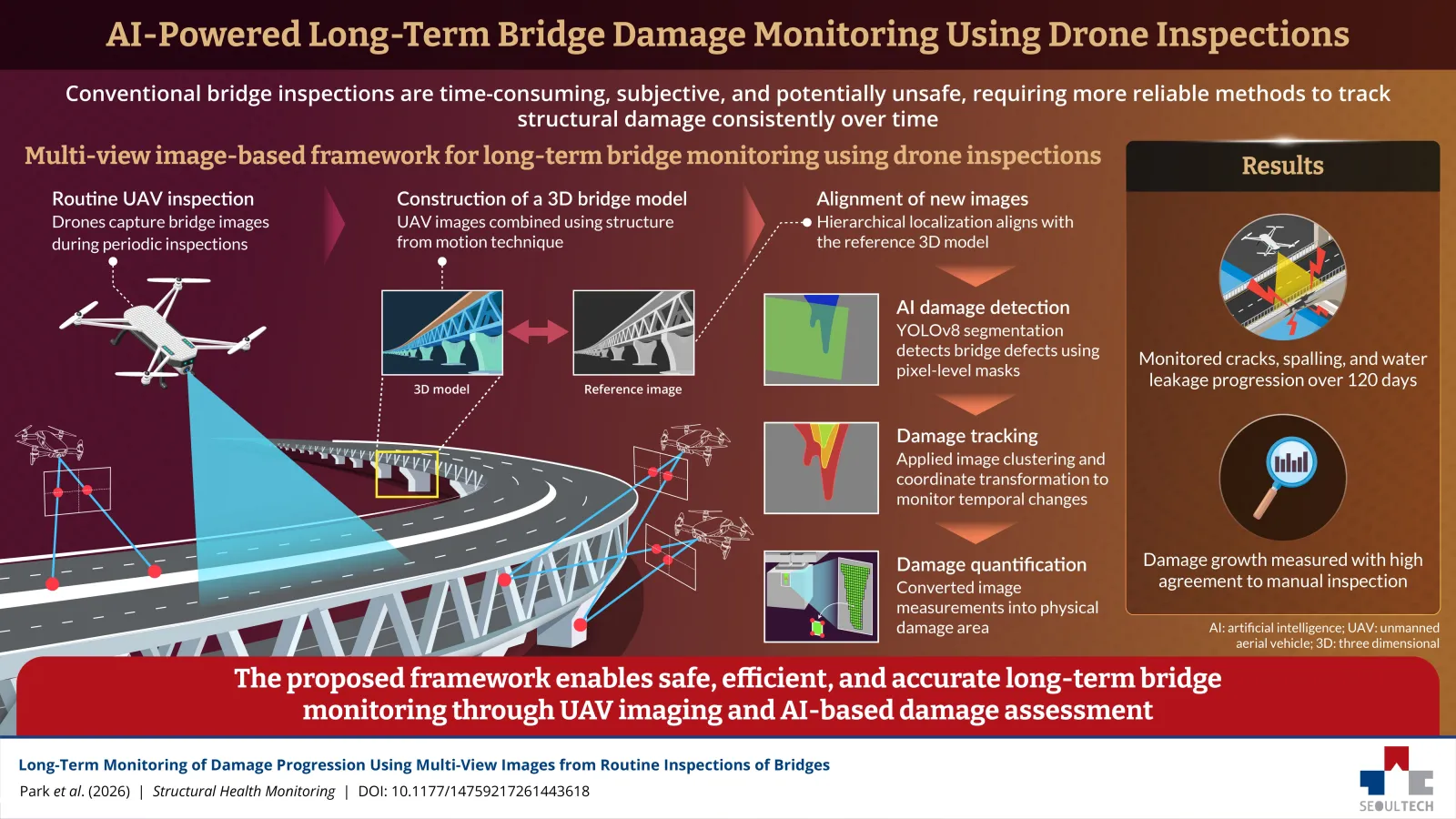
Researchers at Seoul National University of Science and Technology (SEOULTECH) have published an automated computer vision framework capable of tracking structural damage on bridges continuously over time, using photographs collected during standard drone inspections. The study, led by Assistant Professor Hyunjun Kim of the university's Department of Civil Engineering, appeared in the journal Structural Health Monitoring on 27 April 2026.
The system addresses a long-standing limitation in bridge inspection: images taken months apart are rarely from the same camera position or angle, making damage comparisons unreliable. The SEOULTECH approach builds a single 3D reference model of a bridge from initial inspection imagery, then uses hierarchical localisation and image clustering to align all subsequent drone photographs to that model automatically. Global Navigation Satellite System data is used to convert pixel-level measurements into real-world dimensions, giving engineers a consistent spatial reference across inspection cycles.
How the framework performs
The team validated the system over a 120-day monitoring period on an operational prestressed concrete bridge, tracking the progression of cracks, concrete spalling, and water leakage despite varying camera viewpoints across each inspection run. Measured damage areas carried a maximum error of 4.61% against conventional manual measurements, a figure the researchers describe as sufficient for practical maintenance decision-making.
Dr Kim said: "Long-term structural monitoring requires more than simply detecting damage; it requires understanding how that damage evolves. Our framework allows engineers to visualise damage progression and measure its severity using images collected during routine inspections."
Compared with approaches that rebuild a 3D model at every inspection cycle, the single-reference-model architecture reduces computational overhead while improving consistency. The team acknowledges that accuracy may vary on highly curved surfaces, and the current method is best suited to relatively flat structural elements, which nonetheless cover most components encountered in routine bridge inspections.
Market context and wider applications
Infrastructure monitoring is a growing segment within applied AI and computer vision, driven by the ageing asset base across North America, Europe and East Asia. Governments in the UK, US, EU and South Korea have all flagged deteriorating bridge and road infrastructure as a public-safety priority, creating demand for inspection tools that can reduce reliance on manual, rope-access or lane-closure surveys.
A number of well-funded startups and university spin-outs are pursuing similar drone-plus-AI inspection approaches for civil infrastructure, including systems aimed at rail viaducts, port structures, and wind turbine towers. What distinguishes the SEOULTECH framework, according to the published paper, is the continuous tracking capability using a persistent reference model rather than point-in-time assessments, reducing both computational costs and inter-inspection variability.
The team has indicated that the underlying method could be adapted to monitor tunnels, dams, and elevated rail systems, broadening its commercial and public-sector addressable market. Transportation agencies facing mounting maintenance backlogs and constrained inspection budgets are the natural first adopters. Whether the framework will be commercialised through a spin-out, licensed to an existing inspection-services firm, or made available as open research tooling has not been announced. The DOI for the underlying paper is 10.1177/14759217261443618.