
Kratos completes cross-country autonomous truck platooning for NASCAR
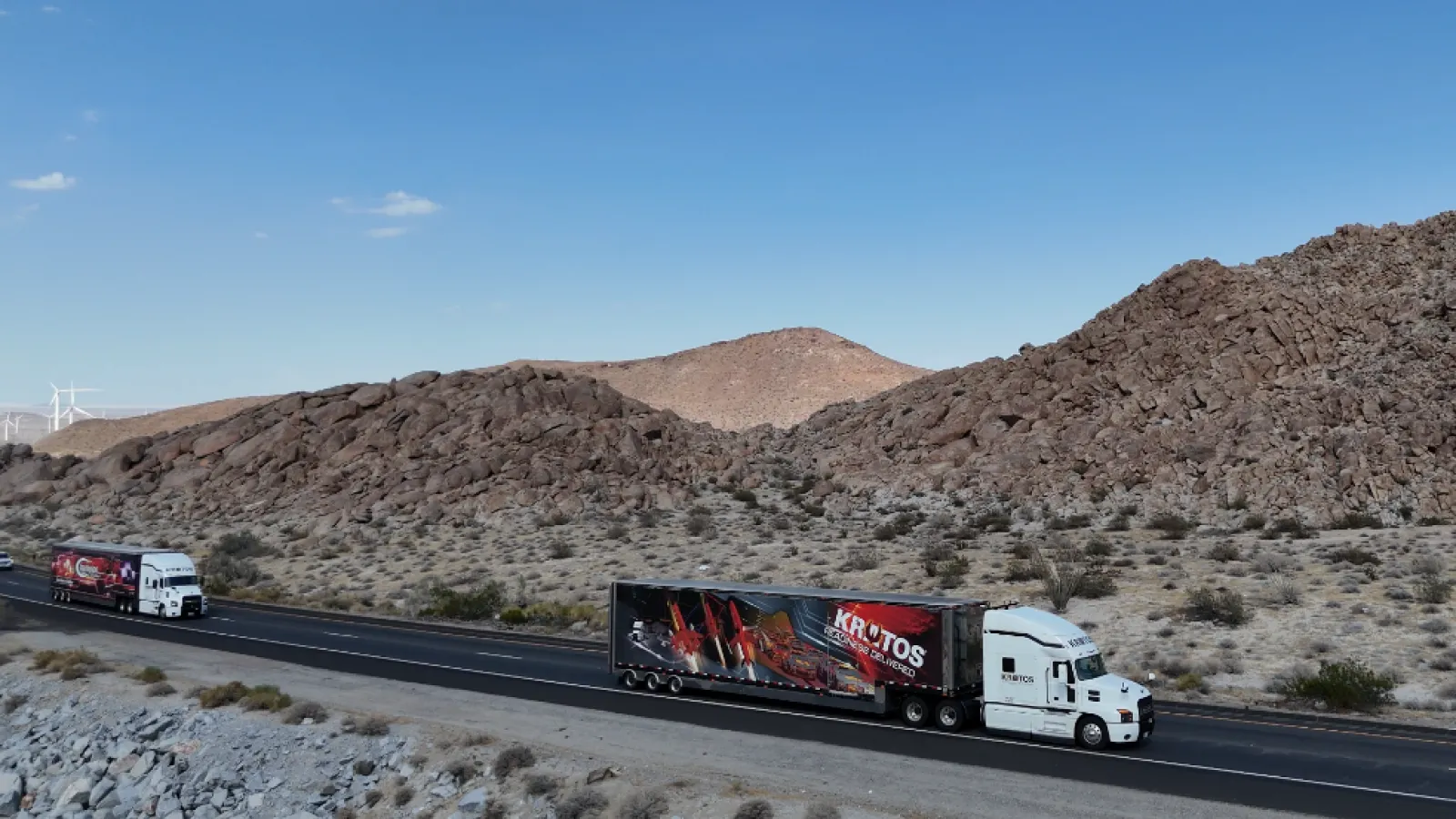
Kratos Defense and Security Solutions has completed a cross-country autonomous tractor-trailer platooning mission, transporting race equipment from Charlotte, North Carolina to Naval Base Coronado in San Diego in support of the NASCAR Anduril 250. The NASDAQ-listed defence and technology company said the deployment was carried out in collaboration with motorsports logistics provider Champion Tire and Wheel.
The mission paired a human-driven lead tractor-trailer with an autonomous follower vehicle supervised by an onboard safety rider. Synchronised steering, braking and speed control allowed the follower to maintain formation across multiple states and varying road conditions. Navigation relied on a layered approach combining GPS, onboard sensors and advanced vehicle control software. Kratos described the operation as an expansion of a proof-of-concept platooning run it completed in 2025 supporting the Brickyard 400 at Indianapolis Motor Speedway, with the 2026 deployment extending the capability into long-haul, multi-state freight territory.
The deployment
Maynard Factor, Vice President of Business Development at Kratos, said the 2025 exercise proved the concept, while 2026 demonstrated scalable execution. "Our autonomous follower tractor-trailer successfully completed a cross-country logistics haul, demonstrating how platooning technology can safely improve efficiency, expand freight capacity, and help address ongoing driver shortages," he said.
The company positions the leader-follower architecture as a practical near-term path to increasing freight throughput without requiring a fully driverless vehicle. A single licensed driver in the lead truck provides oversight for both vehicles, which the company says addresses regulatory and safety concerns while still offering a meaningful capacity uplift per driver employed.
Market context
Autonomous platooning occupies a distinct niche within the broader self-driving freight sector. Unlike fully driverless long-haul programmes, which face significant regulatory hurdles at both federal and state level in the US, leader-follower systems have a more tractable near-term compliance path because a qualified driver remains in the loop. Several well-funded startups and established truck manufacturers have trialled similar two-truck and multi-truck platooning configurations, though many early programmes were scaled back or paused as investors tightened capital allocation to autonomous-vehicle ventures in the early 2020s.
Kratos frames its approach explicitly as dual-use: technology validated in demanding commercial logistics contexts is intended to transfer back into defence supply-chain and battlefield-resupply applications. The US Department of Defense has a stated interest in autonomous ground logistics to reduce personnel exposure in contested environments, and programmes such as the Army's Robotic Combat Vehicle and various contested-logistics initiatives provide a potential institutional market for the technology Kratos is maturing through commercial deployments.
Regulatory read-across
Long-haul autonomous freight in the United States is subject to a patchwork of state-level regulations, with no single federal framework governing platooning operations across state lines. The Federal Motor Carrier Safety Administration has issued guidance on automated driving systems but has not yet promulgated binding rules for multi-state platooning with a safety rider rather than a fully qualified driver in the follower cab. As deployments extend in distance and frequency, Kratos will need to demonstrate compliance across each jurisdiction traversed, a process that could constrain commercial scaling even where the technology performs reliably.
The company did not disclose contract value for the NASCAR logistics work, revenue recognised from the deployment, or any formal commercial agreements with Champion Tire and Wheel beyond this single mission. Named customer wins and signed freight contracts would be the key next milestones for investors assessing how quickly Kratos can convert demonstration runs into recurring commercial logistics revenue.