
Magna AI and Arabic.AI partner on sovereign Arabic LLM in Saudi Arabia
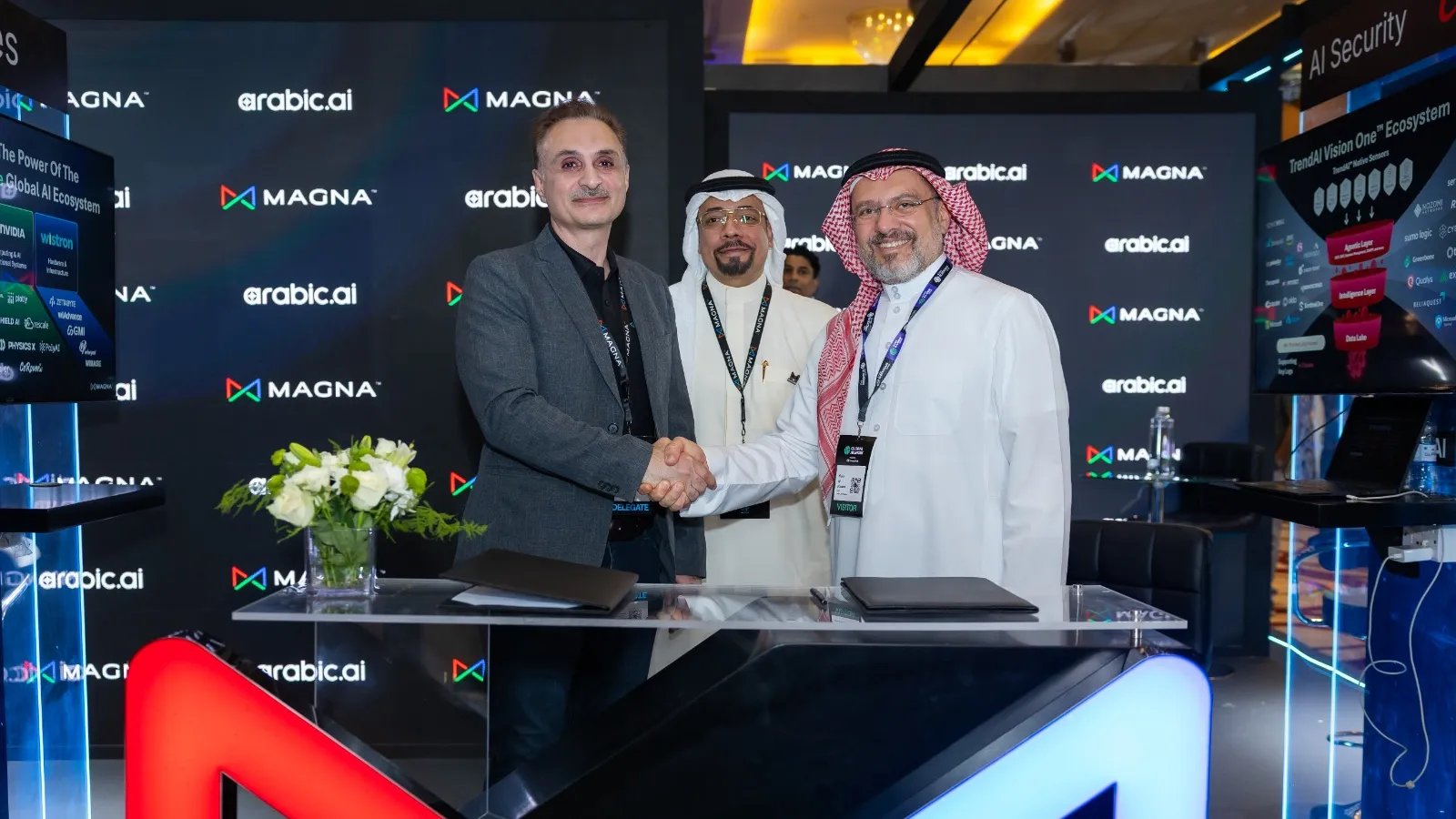
Magna AI and Arabic.AI have signed a strategic collaboration agreement at the Global AI Show 2026 in Riyadh, combining Magna AI's full-stack AI infrastructure capabilities with Arabic.AI's Arabic-native large language model and enterprise language technologies. The partnership targets Saudi Arabia's government and enterprise sectors, with sovereignty and data residency built in by design.
Magna AI was established through a partnership between cybersecurity firm Trend Micro and Wistron Digital Technology Holding Company, and operates with NVIDIA hardware at its core. Arabic.AI is the AI arm of Tarjama, a translation and language technology business with roughly 18 years of Arabic-language expertise. The deal was announced while Magna AI was serving as title sponsor of the Global AI Show 2026.
What the partnership covers
Under the agreement, the two companies will jointly develop and go to market across several areas: sovereign AI infrastructure, Arabic-native AI platforms and applications, secure AI operations, transformation consultancy, and skills development programmes. Arabic.AI contributes what it describes as a sovereign Arabic LLM, alongside agentic AI platforms, translation, optical character recognition and speech tools built specifically for Arabic dialects and cultural context. Magna AI provides the infrastructure layer, encompassing integration, security, governance and operational capabilities required to run AI at production scale.
Dr Moataz BinAli, chief executive of Magna AI, said the infrastructure and intelligence layers must work together to be effective. "Sovereign infrastructure is only one part of the equation. It must run intelligence that genuinely understands the language, context, and need of the communities it serves," he said, framing the collaboration as addressing that gap directly.
Market and regulatory context
The announcement fits squarely within Saudi Arabia's Vision 2030 agenda, which explicitly targets domestic AI capability as a strategic priority. The kingdom has committed substantial public investment to AI infrastructure, and the Public Investment Fund has backed a range of technology initiatives designed to reduce dependence on foreign technology stacks. Data sovereignty requirements in Saudi Arabia are increasingly codified, requiring that government and sensitive enterprise workloads remain on-shore and under national governance frameworks.
Arabic-language AI has historically been underserved relative to English. A number of well-funded research groups and commercial vendors have published Arabic LLMs in recent years, including models from regional technology bodies and major hyperscalers, but purpose-built sovereign deployments combining Arabic-first training with in-country infrastructure remain relatively scarce. That gap is the commercial opportunity Magna AI and Arabic.AI are targeting.
Regulatory tailwinds reinforce the timing. Saudi Arabia's Personal Data Protection Law, which came into full effect in 2023, places obligations on organisations processing personal data locally, and government procurement increasingly favours vendors able to demonstrate data-residency compliance. The EU AI Act, while not directly applicable in the kingdom, is influencing governance frameworks globally and pushing enterprises to require documented model provenance and audit trails, criteria that a sovereign-built Arabic LLM is positioned to satisfy.
The partnership did not disclose financial terms, revenue targets, or named government customers. Investors and buyers will look for concrete contract announcements and published benchmark comparisons against existing Arabic-language models as the clearest indicators of commercial traction.