
ASUS unveils RTX Spark ProArt laptops and mini PC at IFA 2026
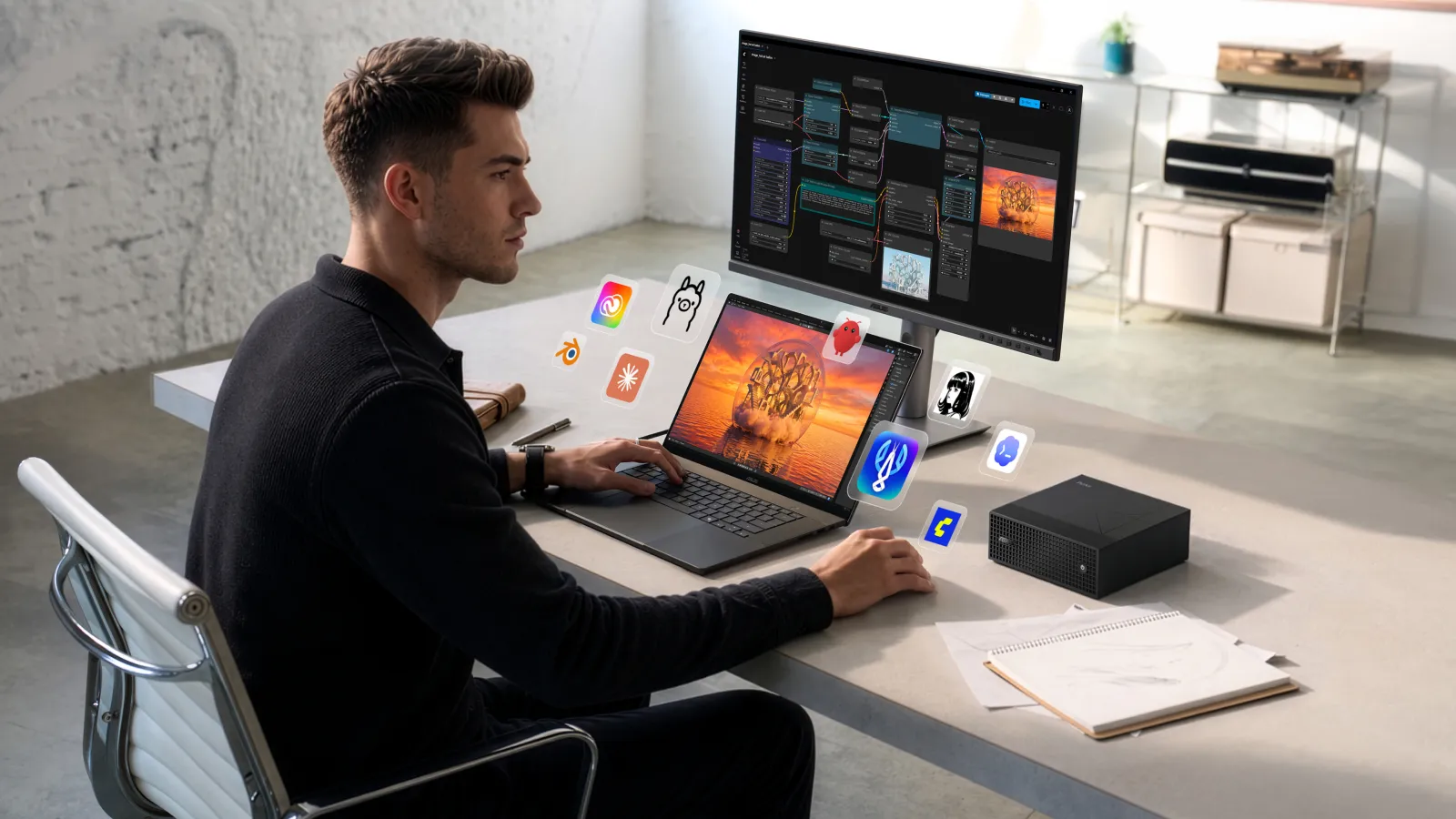
ASUS has announced three new ProArt devices built around NVIDIA's RTX Spark superchip: the ProArt P16 and P14 laptops, and the compact GR1X mini PC. The products were showcased at the ASUS IFA Media Showroom in Berlin from 2–5 September 2026, ahead of the main IFA exhibition. ASUS positions the lineup as purpose-built for AI-heavy creative workflows and local agentic AI, with the GR1X described by the company as the world's first Windows PC designed for personal AI agents.
RTX Spark combines an NVIDIA Blackwell RTX GPU with 6,144 CUDA cores, a Grace CPU with up to 20 cores, and fifth-generation Tensor Cores with FP4 precision, all connected via NVLink-C2C. ASUS says the superchip delivers up to one petaflop of AI performance and supports up to 128GB of high-bandwidth unified memory. The company claims this is sufficient to run models of up to 120 billion parameters locally, render 3D scenes exceeding 90GB, and generate 4K AI video without cloud dependency.
The devices
The ProArt P16 measures 12.9mm thick and weighs 1.77kg, which ASUS says makes it the thinnest 16-inch ProArt laptop to date, 13% thinner and 16% lighter than its predecessor. The P14 comes in at 13.9mm and 1.48kg. Both carry OLED displays with Delta E less than 1 colour accuracy; the P16 supports 4K at 120Hz with NVIDIA G-SYNC, while the P14 tops out at 3K. Battery capacities are 99Wh and 90Wh respectively.
The GR1X mini PC occupies a 150 x 150 x 51mm footprint with a dual-fan cooling system featuring 218 fan blades and seven-level fan control for sustained 24/7 operation. Connectivity includes 10GbE wired networking, Wi-Fi 7, Bluetooth 5.4, and support for up to four 4K displays.
ASUS also showed the Zenbook 14, available with Snapdragon X, Intel Core Ultra Series 3, or AMD Ryzen AI 300 processors, and the ExpertBook Ultra, a sub-1kg business laptop featuring Intel Core Ultra X9 Series 3 with Intel Arc Pro graphics and post-quantum cryptography firmware security aligned to NIST SP 800-193.
On the software side, ASUS bundles its MuseTree application, integrating the FLUX and WAN image-generation models locally, and StoryCube, an AI-powered media organisation tool. The company is also extending support for ComfyUI, a widely used open-source generative AI workflow platform, as part of its agentic creation strategy.
Market context
The local AI PC market is heating up considerably. Intel's Core Ultra and Qualcomm's Snapdragon X Elite already carry dedicated neural processing units targeting the same segment, while Apple's unified-memory architecture on M-series silicon has set a benchmark for on-device model inference that Windows OEMs are now actively working to match or exceed.
NVIDIA's entry into the thin-and-light PC superchip market via RTX Spark represents a significant broadening of its addressable market beyond discrete desktop and data-centre GPUs. For ASUS and other OEM partners, the architecture's high unified-memory ceiling is a genuine hardware differentiator: 128GB of shared GPU-CPU memory exceeds what most consumer or prosumer AI PCs currently offer, enabling larger model weights to reside fully in memory without quantisation trade-offs that degrade output quality.
The privacy and cost arguments for local inference are well established among AI developers, and they are now migrating into the creative professional segment. Buyers evaluating these systems will look beyond headline petaflop figures to sustained thermal performance, battery life under AI load, and the breadth of model support in the software ecosystem. ASUS has not released independent benchmark results or per-unit pricing in this announcement; those details will be critical for purchase decisions. The ExpertBook Ultra's NIST-compliant post-quantum firmware is also worth noting for enterprise buyers navigating the early stages of PQC migration ahead of federal mandates scheduled for 2030.