
Black Hills Corp signs $1.8bn deal to power Google data centre
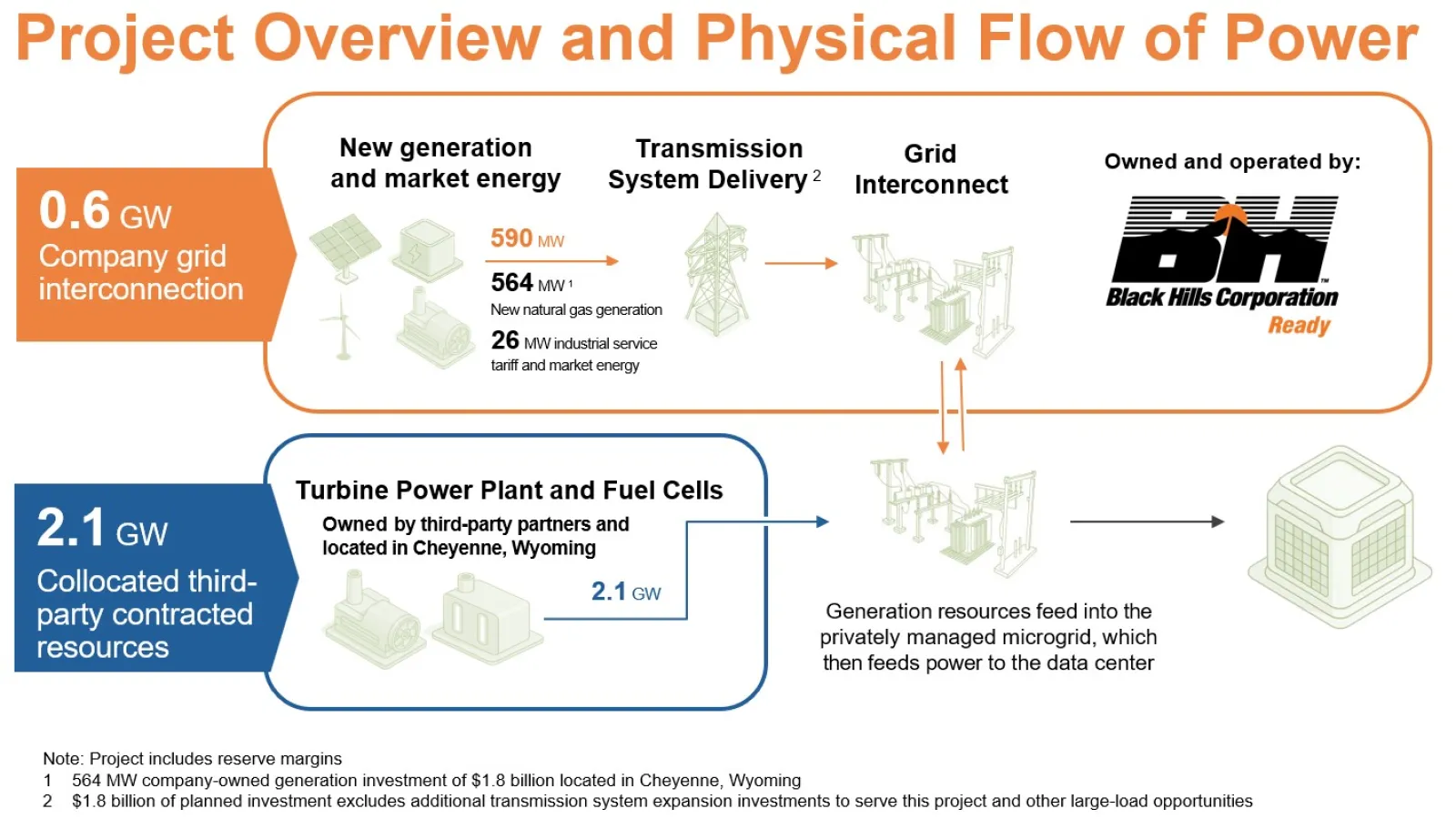
Black Hills Corp has signed definitive agreements with Google to supply energy to a planned data centre in Cheyenne, Wyoming, committing $1.8 billion in new natural gas generation and managing a private microgrid that will ultimately deliver up to 2.7 gigawatts of combined capacity, including reserve margins. The contracts, which became effective 30 September 2026 and run through 2048, represent one of the largest utility-to-hyperscaler power deals announced in the US this year.
Under the terms of the Large Power Contract Services Agreement and a separate Generation Facilities Agreement, Black Hills will provide up to 590 MW of grid-connected energy through company-owned generation and market purchases. It will also coordinate approximately 2.1 GW of Wyoming-based, third-party contracted resources through a privately managed microgrid, earning a negotiated microgrid management fee for doing so. Energy service is due to begin in late 2027, with the project ramping to peak load by 2030.
The deal
To support its grid-connected commitment, Black Hills plans to build 564 MW of nameplate natural gas generation capacity at its existing Cheyenne Prairie Generating Station site. Construction is scheduled between 2027 and 2029, with the company beginning to earn a return on its investment as soon as construction commences. The company projects the arrangement will contribute approximately $150 million of net income in 2030 and deliver around $2.4 billion of unlevered free cash flow through 2048, net of the $1.8 billion capital outlay.
Google has already provided $399 million in refundable advances to secure procurement of long lead-time equipment. Black Hills expects to reimburse those advances by 30 June 2027. The utility plans to finance the broader investment through project-generated cash flow, debt, and other alternatives, with a stated focus on preserving its investment-grade credit ratings.
Linn Evans, president and chief executive of Black Hills Corp, said the agreements "demonstrate how innovative energy solutions can support economic growth while ensuring existing customers are protected," adding that Google will bear all costs associated with serving the data centre throughout the life of the project.
Market context
The deal is a significant example of the growing direct utility-to-hyperscaler contracting model, in which large cloud operators bypass standard tariff structures to secure dedicated generation capacity at scale. Hyperscalers including Google, Microsoft and Amazon have been signing long-term power agreements across the US as data centre load growth strains regional grids and standard utility procurement timelines prove too slow for AI infrastructure buildout.
Wyoming is an increasingly attractive location for large-load data centres given its relatively low land costs, access to existing transmission corridors and a regulatory environment that has moved to accommodate large-customer tariff structures. Black Hills has already obtained key regulatory approvals, including a Robinson substation Certificate of Public Convenience and Necessity in May 2026 and an air quality permit for the generating station expansion in August 2026. Further transmission expansion filings are in progress, with an additional Wyoming CPCN expected in the fourth quarter of 2026.
For enterprise infrastructure buyers, the contractual protections embedded in this structure are worth noting: the agreement includes cost pass-through mechanisms, stranded-asset recovery provisions, early termination protections and credit assurance requirements, all designed to ring-fence Google's load from Black Hills's existing 1.37 million retail customers. That ring-fencing structure is likely to attract regulatory scrutiny in other states where utilities seek to replicate the model, particularly where existing customers have raised concerns about cost socialisation in similar large-load proceedings.