
Navitas and NVIDIA co-develop 24 kW 800 V-to-12 V AI power board
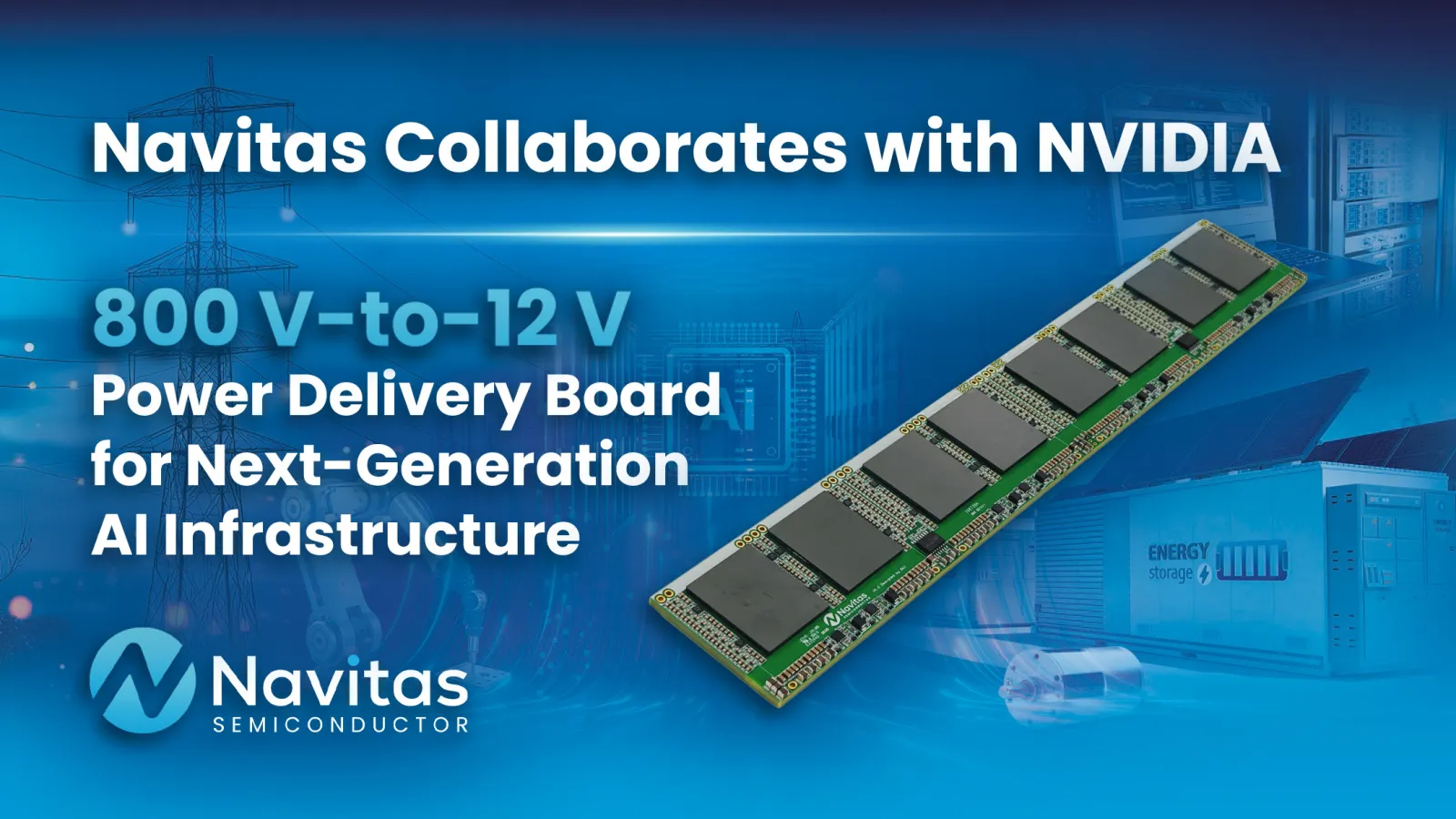
Navitas Semiconductor (Nasdaq: NVTS) has unveiled a 24 kW power delivery board (PDB) developed in collaboration with NVIDIA, designed to convert 800 VDC directly to 12 VDC in a single conversion stage for AI data-centre compute trays. The board is built around Navitas' GaNFast gallium-nitride technology and is intended to support NVIDIA's MGX ecosystem of modular AI server components.
The new PDB builds on an earlier 20 kW, 800 V-to-6 V board that Navitas previously announced alongside NVIDIA. The latest design targets a full-load efficiency of 97% and a power density exceeding 2,000 W per cubic inch, housed in NVIDIA's 400 mm by 60 mm form factor so it can be mounted directly onto a compute motherboard close to the accelerator units.
Technical architecture
The board's single-stage topology is a meaningful departure from conventional rack power delivery. Traditional designs convert high-voltage DC to an intermediate 50 V bus and then step down again to 12 V through an intermediate bus converter (IBC). Navitas eliminates that second conversion hop, delivering 12 V directly to the voltage regulator module (VRM) that feeds the GPU or other accelerator. The company says this reduces conversion losses, board space and overall system complexity.
The primary side uses 16 NV6034 GaNFast field-effect transistors, each rated at 650 V with an on-resistance of 18 milliohms, arranged in a stacked half-bridge topology. The package uses Navitas' dual-cooled DFN 8 by 8 mm format, which the company says supports the thermal demands of high-density rack configurations.
Chris Allexandre, President and Chief Executive of Navitas, said the collaboration is "breaking the AI infrastructure power wall by reimagining power delivery from 800 VDC to the GPU." The board is scheduled to appear on NVIDIA's AI Factory MGX Wall partner display at OCP Global Summit 2026 later this month.
Market context and competitive landscape
The shift to 800 VDC power distribution in AI data centres is accelerating as rack densities climb past 100 kW for GPU-heavy configurations. Higher bus voltages reduce cable losses at a given power level, making the case for 800 V architectures compelling as accelerator clusters scale. The Open Compute Project (OCP) ecosystem, where this board will be showcased, is a key standards forum shaping rack power architecture for hyperscale and enterprise AI factories.
Navitas competes in the power semiconductor space against established players including Infineon, STMicroelectronics and ON Semiconductor, each of which has its own GaN and SiC product lines targeting data-centre power conversion. The differentiator Navitas is pressing is system-level integration: by packaging gate drive, control and protection circuitry alongside the GaN power stage in a single IC, the company aims to reduce the design effort for board makers and shorten qualification cycles.
The 800 V architecture also has regulatory tailwinds. The EU's Energy Efficiency Directive and US Department of Energy standards for server power supplies continue to tighten minimum efficiency thresholds. A verified 97% conversion efficiency at full load would comfortably exceed current 80 Plus Titanium benchmarks and position the board well for future regulatory requirements. Navitas has not yet disclosed independent third-party certification of the efficiency figure, however, and the company's forward-looking statement caution in the release notes that actual results may differ from projections.
Navitas reports more than 450 patents issued or pending across its GaN, SiC and integrated voltage regulator (IVR) portfolios. Investors and infrastructure buyers will be watching for volume production timelines and customer design wins beyond the NVIDIA collaboration as the company continues its stated "Navitas 2.0" pivot toward AI infrastructure applications.