
Digital Realty buys Blackstone stake in Virginia data centres for $3.5bn
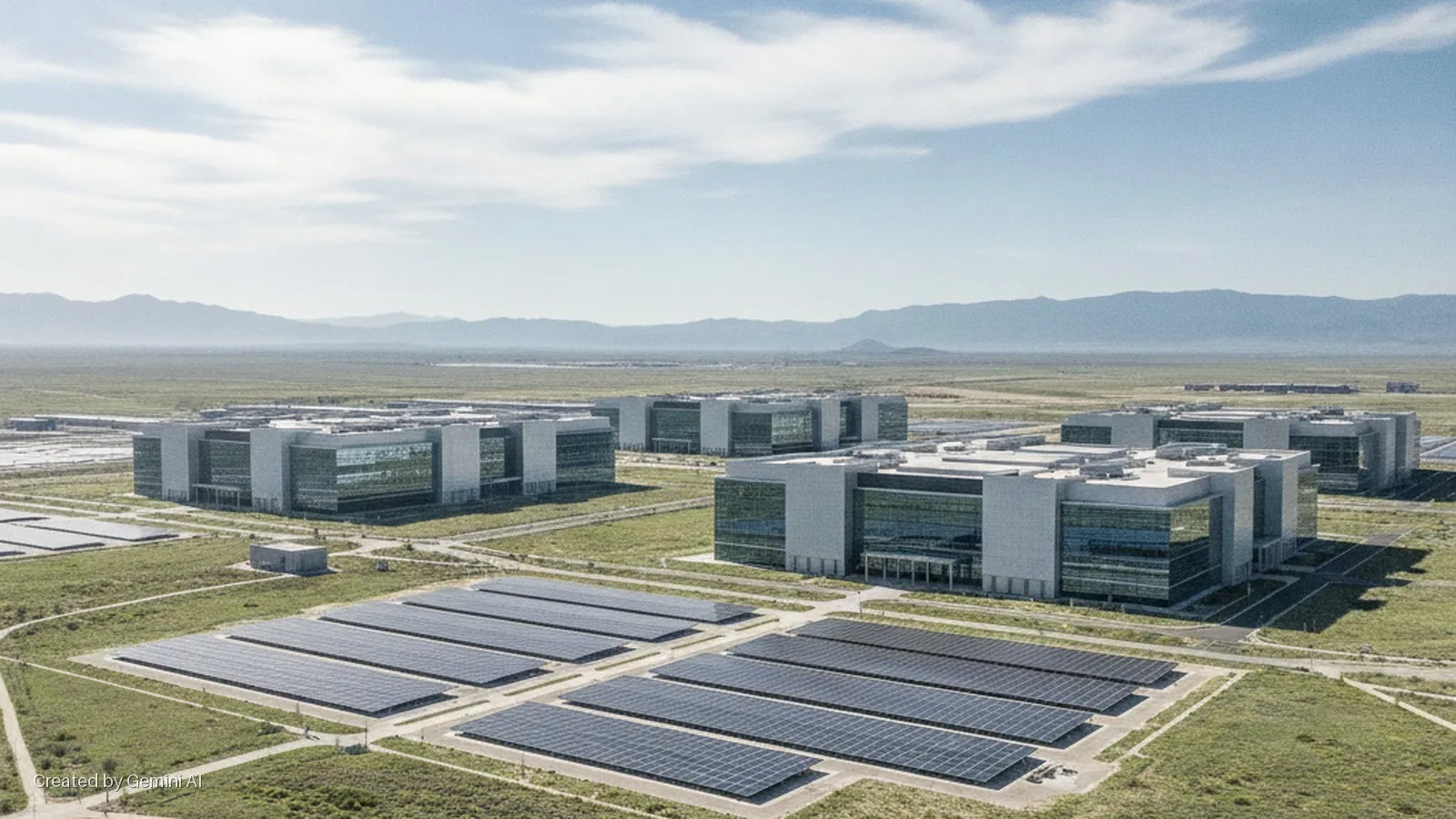
Digital Realty (NYSE: DLR) has agreed to purchase Blackstone's equity interest in three fully leased hyperscale data centres in Northern Virginia for total consideration of $3.5 billion, structured as $1.2 billion in cash and $2.3 billion in Digital Realty stock. The portfolio carries a gross valuation of $7.8 billion, reflecting an expected initial stabilised capitalisation rate of just over 6.5%.
The three assets comprise two 96-megawatt data centres in Manassas, Virginia, in which Blackstone held an 80% stake, and one 96-megawatt facility on the Digital Dulles campus in Sterling, Virginia, in which Blackstone held a 50% interest. Combined, the portfolio delivers 288 megawatts of IT capacity. All three sites are 100% leased to three unnamed investment-grade hyperscale customers on 15-year terms, with a blended average tenant credit rating of AA- and annual rent escalators of 3.6%. Two of the assets are expected to reach stabilisation in the first half of 2027, with the third following in the first half of 2028. Digital Realty said the transaction is expected to close on 30 June 2026.
The deal
Greg Wright, Chief Investment Officer of Digital Realty, said the transaction "reflects the next phase" of the company's joint-venture relationship with Blackstone, which was established in 2023, and extends the firm's pipeline of product for its strategic private capital platform. Digital Realty and Blackstone retain co-investment positions in other Northern Virginia joint ventures, as well as in Paris and Frankfurt.
Matt Mercier, Chief Financial Officer of Digital Realty, said the acquisition is expected to be accretive to Core FFO per share in both 2027 and 2028, as development completes and contracted rents begin flowing. The equity-heavy consideration structure limits near-term cash outflow, though it does dilute existing shareholders.
Market context
Northern Virginia, often referred to as Data Centre Alley, is the largest data centre market in the world by installed capacity, and demand from hyperscale cloud providers continues to outpace supply of purpose-built, high-density facilities. Power availability has become the primary constraint on new development across the region, with utility queues stretching multi-year for large loads. Acquiring fully permitted, near-complete or recently stabilised assets is therefore increasingly attractive relative to greenfield development.
The $7.8 billion gross valuation represents a significant data point for market pricing in the region. At a blended 288 megawatts and a 6.5% cap rate, the deal implies substantial per-megawatt values that reflect both the scarcity of ready-to-serve capacity and the credit quality of the underlying tenants. Digital Realty's main listed peers, including Equinix and Iron Mountain, have similarly pursued hyperscale joint ventures and subsequent buyouts as a capital-recycling mechanism; this transaction consolidates ownership ahead of what Digital Realty expects to be a prolonged demand cycle.
Regulatory and financial read-across
The deal is structured partly in Digital Realty shares, which subjects closing to standard securities and stock-exchange requirements rather than the lengthier antitrust review that an all-cash acquisition might invite at this scale. Blackstone's continued involvement in the remaining joint-venture assets in Virginia, Paris and Frankfurt also signals that the two firms are managing a deliberate portfolio rotation rather than a full exit by the private equity group.
For enterprise customers and co-location buyers, the ownership consolidation under a single listed REIT simplifies counterparty risk assessment. Digital Realty's expanded balance-sheet exposure to Northern Virginia will nonetheless increase its concentration risk in a region where power-grid constraints and regulatory scrutiny of data centre land use are both intensifying. Investors will be watching whether the company's stated growth trajectory can be maintained as interest-rate conditions and data centre power costs evolve through 2027 and 2028.