
Budgyt targets nonprofit finance teams with FP&A platform at $399/month
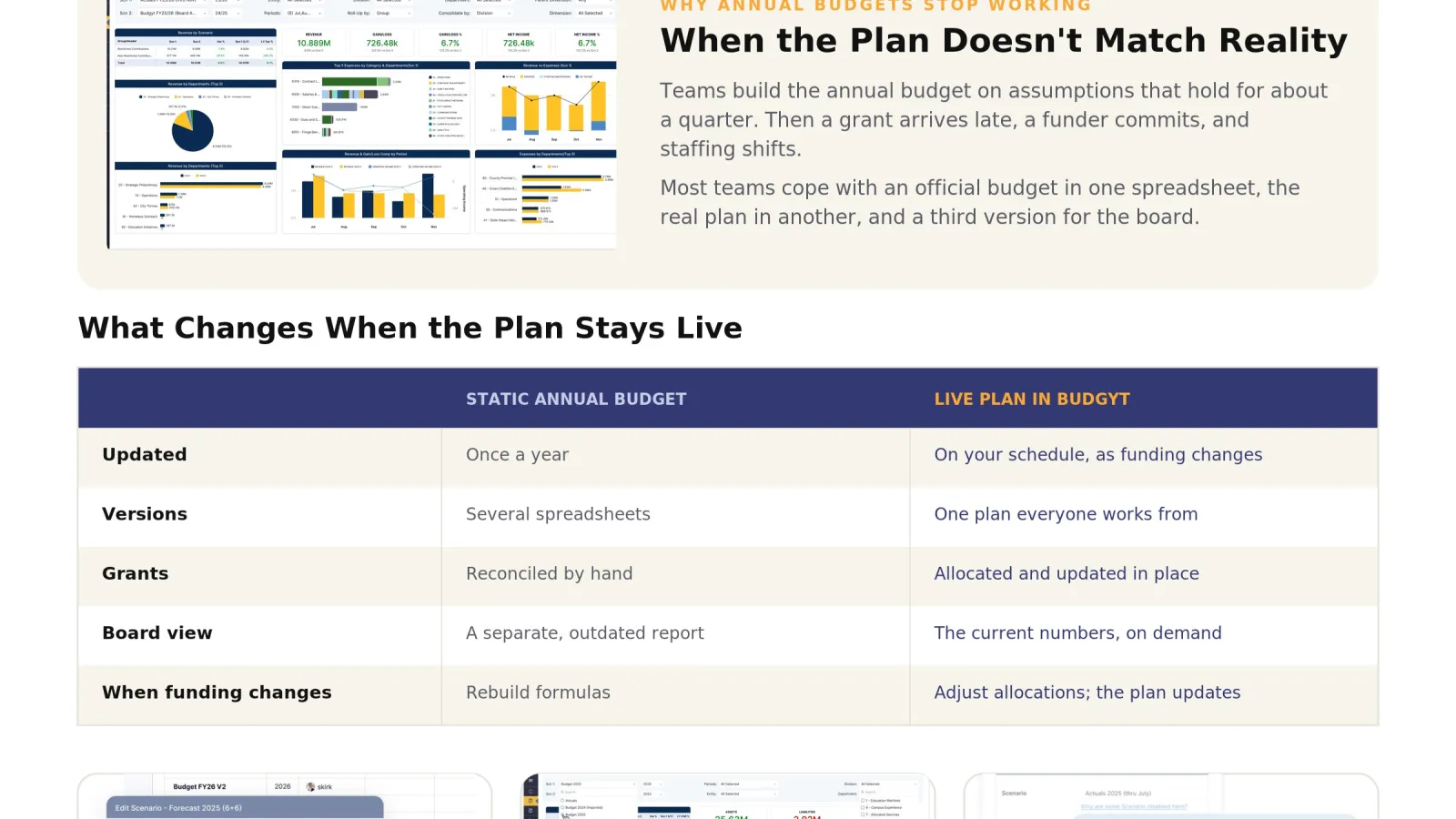
Budgyt, a New York-based cloud budgeting and financial planning vendor, has published new positioning material aimed squarely at nonprofit finance teams of three to five people, arguing that those teams already carry out rolling forecasts, scenario planning, variance analysis and board reporting, but lack software built for their scale. The platform is priced from $399 per month with unlimited users included, and the company says a typical implementation takes around two weeks via a read-only API connection rather than a multi-month professional-services engagement.
The release, issued 26 June 2026, includes a direct quote from founder and chief executive James McCoy: "Most nonprofit finance teams are already doing FP&A; they just don't have software that matches their scale. They need rolling forecasts and scenario planning without an analyst bench or a six-month rollout, and that gap, between spreadsheets and enterprise platforms, is exactly what we built Budgyt to fill."
Product positioning
Budgyt's stated feature set includes rolling forecasts that refresh as actuals and funding shift, unlimited parallel scenarios, percentage-based grant allocation described as audit-defensible, role-based collaboration across departments, and board-ready dashboards with variance commentary. The platform integrates with QuickBooks, NetSuite, Sage Intacct and Microsoft Business Central, covering the accounting back-ends most commonly found in small-to-mid-size nonprofits.
The company draws an explicit contrast with enterprise FP&A platforms, which it characterises as requiring dedicated analyst headcount, implementation cycles of three to six months, and annual software budgets commonly starting around $25,000. Budgyt does not name specific enterprise competitors in the release, though the market includes Anaplan, Adaptive Insights (now Workday Adaptive Planning), Planful and Oracle EPM, all of which carry pricing and complexity well beyond the reach of lean nonprofit finance functions.
On third-party review platforms, Budgyt reports a 4.8-out-of-5 rating on G2 across 103 reviews and 4.9 out of 5 on Capterra across 68 verified reviews, as well as Top Rated recognition on TrustRadius. These figures are as reported by the company; the underlying reviews are on the named platforms and were not independently audited for this article.
Market context
The nonprofit FP&A software segment has attracted growing vendor attention as cloud delivery and database-backed architectures have lowered the cost of building collaborative planning tools. A number of mid-market-focused vendors, including Vena Solutions, Jirav and DataRails, have made similar capability-versus-cost arguments to finance teams in the 50-to-500-employee range. The nonprofit vertical adds a layer of complexity around restricted-fund accounting and grant-allocation audit trails that generic FP&A tools do not always handle natively, which creates a genuine product-differentiation opportunity for vendors that address it directly.
Regulatory pressure is also a factor. US nonprofit organisations subject to Uniform Guidance (2 CFR Part 200) must maintain documentation that can support a federal audit of payroll and cost allocations across grants. Software that automates and locks audit-defensible allocation calculations has a compliance argument that resonates with finance directors who would otherwise manage that process in spreadsheets. It is a structural tailwind for the segment, though Budgyt did not reference any specific compliance framework in its release.
The company did not disclose annual recurring revenue, total customer count, or headcount in the announcement, which limits independent assessment of its scale. The release is structured primarily as content marketing rather than a product launch or funding event, and carries the characteristic of a search-optimised positioning piece rather than a hard news announcement. Editors may wish to note that context when assessing reader value.