
EXE and Ipsos launch GCC workforce sentiment tracker
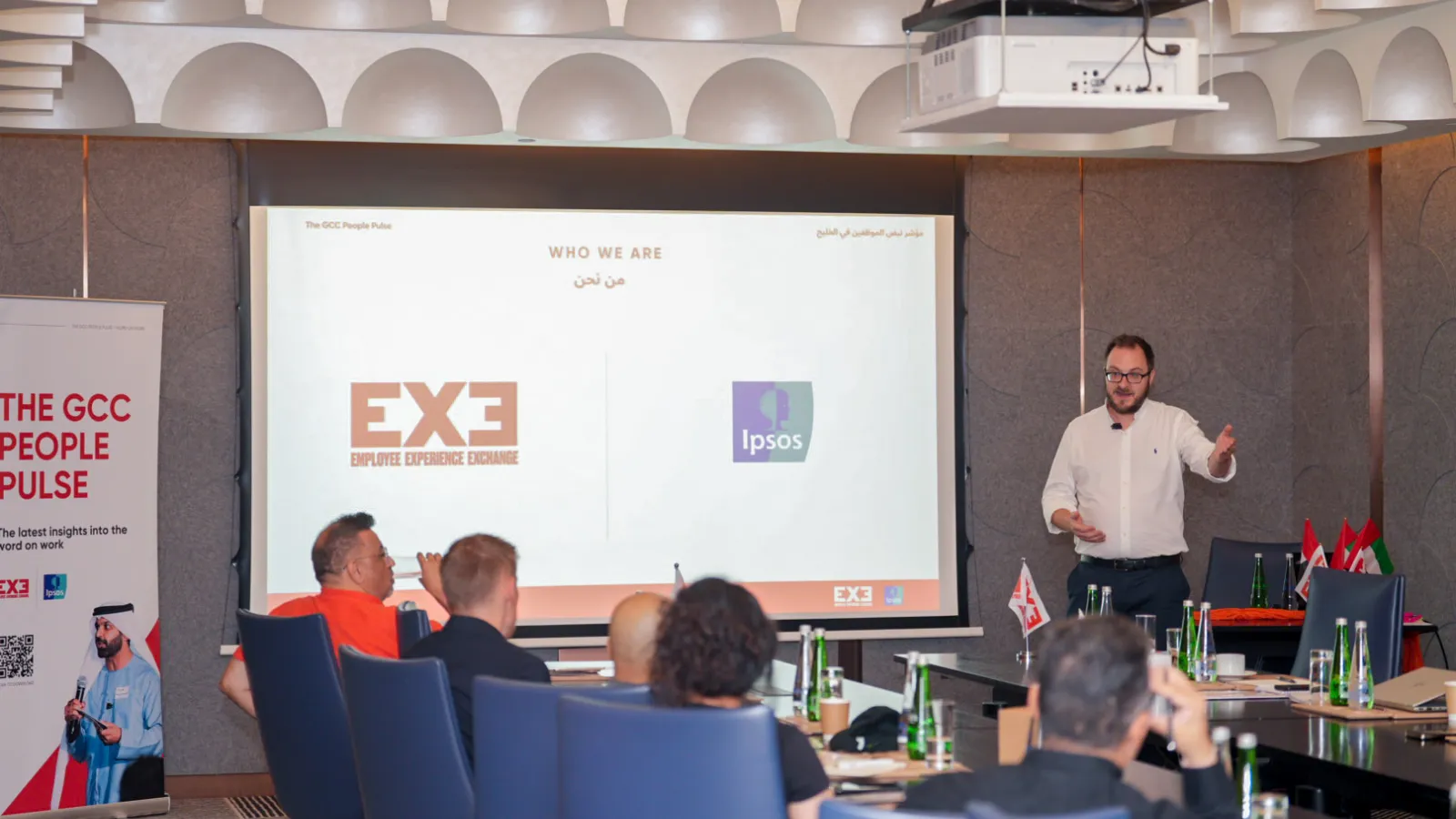
EXE: Employee Experience Exchange and Ipsos have launched the GCC People Pulse, a monthly workforce sentiment tracker covering employees in the UAE, Saudi Arabia, Kuwait, and Qatar. The first wave, covering Q2 2026, draws on a representative sample of 1,500 adults in full or part-time employment, surveyed online across 11 questions and five themes: advocacy, confidence, wellbeing, inclusion, and AI readiness.
The headline finding is a paradox. Eighty-one per cent of GCC employees say they would recommend their organisation as a great place to work, nine points above the global benchmark. Yet 54% report feeling under constant strain at work in recent months, a figure the report says is 17 percentage points above the global average. High advocacy and elevated burnout are coexisting, a dynamic the authors describe as unsustainable.
Attrition risk and the AI anxiety gap
Retention data compounds the concern. While 76% of respondents plan to stay with their current employer for at least three years, that figure sits six points below the MENA benchmark, and 24% indicate they expect to leave within two years. The attrition risk is concentrated among middle-aged employees and in Kuwait and Qatar, where as many as 33% of Qatar-based respondents say they intend to leave within two years. The report flags mid-career employees as a particular vulnerability: they typically occupy management roles where organisational knowledge and capability are densest, and losing them carries both operational and commercial cost.
On artificial intelligence, the data reveals a gap between optimism and readiness. Seventy-three per cent of GCC employees believe AI will make their organisation more competitive, but 49% are concerned about what it means for their job security. The report cross-references Ipsos and Google research showing that only 14% of US workers have received AI training from their employer, and extrapolates that a similar deficit likely applies across the GCC. The authors argue that organisations investing in role-specific AI training now will shift the narrative from threat to capability, rather than leaving anxiety to suppress adoption.
Market context and methodology
The GCC People Pulse enters a market where annual engagement surveys still dominate corporate listening programmes. Ipsos data cited in the report shows that 71% of MENA organisations rate their employee experience programmes as foundational, with only 13% of MENA practitioners currently using people analytics. Regular pulse surveys, which the new tracker is designed to provide, are used by fewer than half of organisations globally. EXE positions the product as addressing this measurement gap in a region undergoing rapid structural change driven by national Vision 2030 programmes, labour market reforms, and accelerating AI adoption.
Confidence in organisational direction is notably strong across the GCC, with 77% of employees feeling positive, 22 points above the global benchmark, though Kuwait and Qatar lag behind. The report finds that employees who are confident in their organisation's future are nearly twice as likely to advocate for it, with advocacy scores of 93% among the confident group compared with 42% among those who are not. Employee voice shows a similar multiplier effect: employees who feel their organisation genuinely welcomes feedback are twice as likely to advocate for it and significantly more likely to intend to stay.
The People Pulse is published quarterly, with underlying data collected monthly. EXE is a UAE-based HR consultancy and professional community; Ipsos operates across 90 markets and employs approximately 19,000 people. The report does not disclose the commercial terms of the partnership or the cost of access for subscribing organisations.