
Fergus adds AI assistant to job management platform for trades
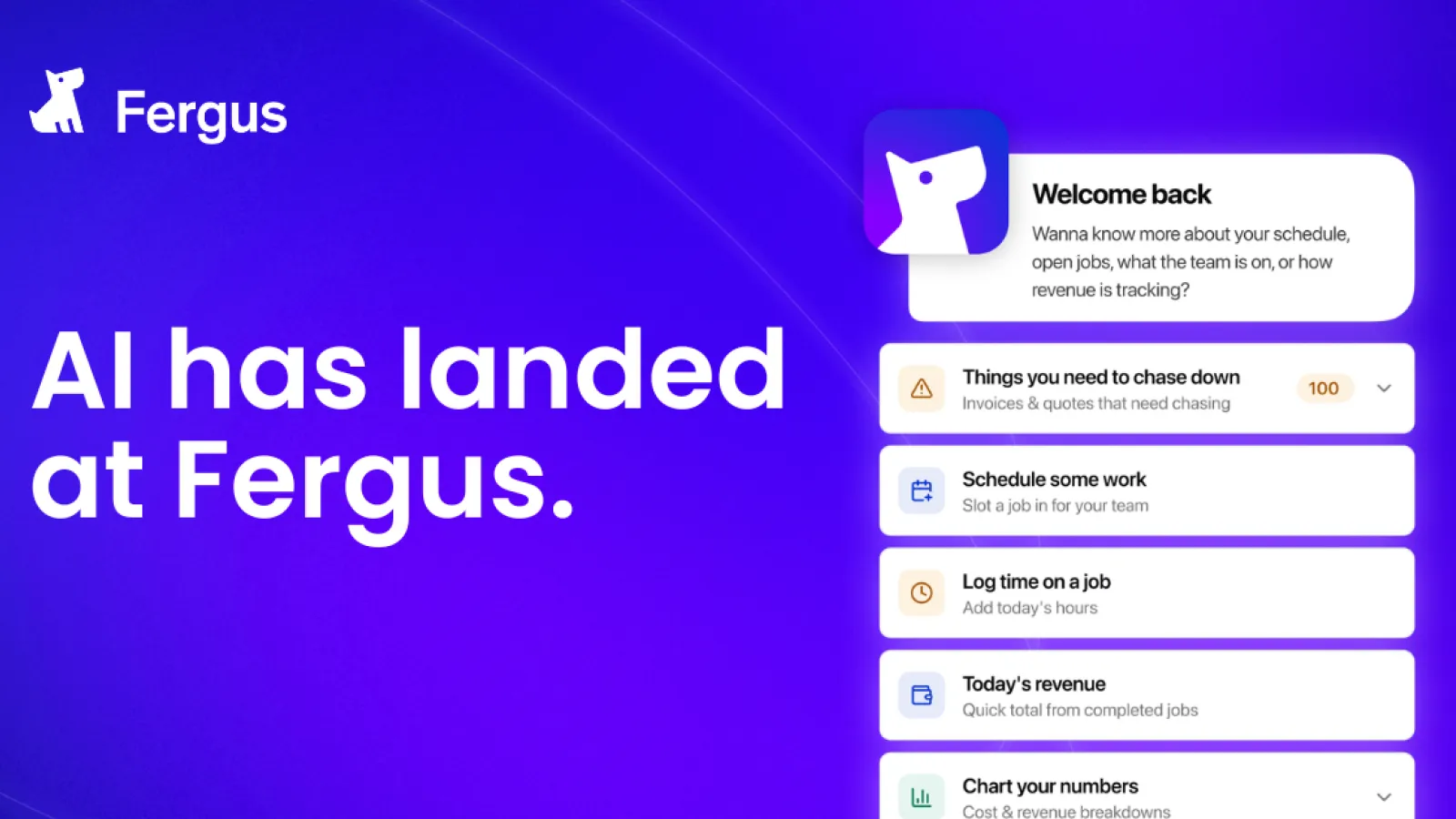
Fergus, the job management platform serving more than 26,000 trade businesses across Australia, New Zealand and the United Kingdom, has launched what it describes as an AI-first approach to job management. The company says the update moves its product beyond a system of record into one that can actively assist with administrative tasks, from initial customer enquiry through to invoicing and payment collection.
The platform now incorporates AI in two layers. Fergus Assistant is embedded in both the existing web product and the mobile app, allowing office teams and field workers to interact with job data via text or voice input. A separate experience called Fergus AI, described as a broader AI-first interface designed to sit alongside the business owner and manage admin end-to-end, is scheduled to roll out across all three markets within the next week of the announcement.
What the AI does
The core proposition is that Fergus already holds the operational data that AI needs to be useful: customer records, job histories, cost data, quotes and invoices built up over 15 years. The company argues this gives its AI a contextual advantage over generic tools that require integration work and prompt engineering.
Practical examples cited in the release include voice capture on site, so a tradesperson can describe what happened at a job immediately on leaving, with that information flowing into quotes or invoices rather than being reconstructed later at a desk. Business owners can also ask natural-language questions such as which jobs were most profitable last month, or why a particular job is losing money, with answers drawn from live job and financial data.
Mark Bartels, chief executive of Fergus, said the company sees AI as a structural shift rather than a feature addition. "Tradespeople should spend less time operating software and more time running profitable businesses. AI changes how job management software can help them do that," Bartels said.
Tom Ryan, owner of Sydney-based Ryelec Automation and an existing Fergus customer, said the AI capabilities had changed how his business operates. "I just ask and it's done, whether that's jobs, invoices or reports. It's saving us hours every week," Ryan said.
Market context
Fergus operates in a competitive but fragmented vertical-SaaS segment. Established rivals including Tradify, simPRO, ServiceM8 and Jobber have all been deepening their own AI feature sets over the past 12 months, with the category seeing increased investment as the broader enterprise-software industry responds to pressure from AI-native startups targeting white-collar workflows. The trade and field-service segment has historically lagged office-centric software in AI adoption, partly because the user base skews toward mobile and voice rather than keyboard-first interaction.
The launch of voice-driven data capture on mobile is a notable product direction. A number of well-funded startups are pursuing voice-first interfaces for field workers across construction, utilities and facilities management, and the category is attracting attention from both vertical-SaaS players and hyperscalers building industry-specific AI solutions.
Regulatory exposure is relatively modest at this stage. As Fergus AI handles business financial data, including cost analysis and invoice generation, data-residency and privacy obligations under the Australian Privacy Act, New Zealand's Privacy Act 2020, and UK GDPR will apply. The company has not yet published detail on how AI-generated outputs are handled, stored or auditable, which enterprise buyers and larger trade businesses will likely raise during procurement.
Fergus did not disclose pricing changes associated with the AI features, the underlying model infrastructure it is using, or any commitments on AI accuracy or error rates. Editors should note that the customer testimonial comes from a named individual but has not been independently verified.