
Lucid Group pushes Air UX 3.0 OTA update with smarter EV routing
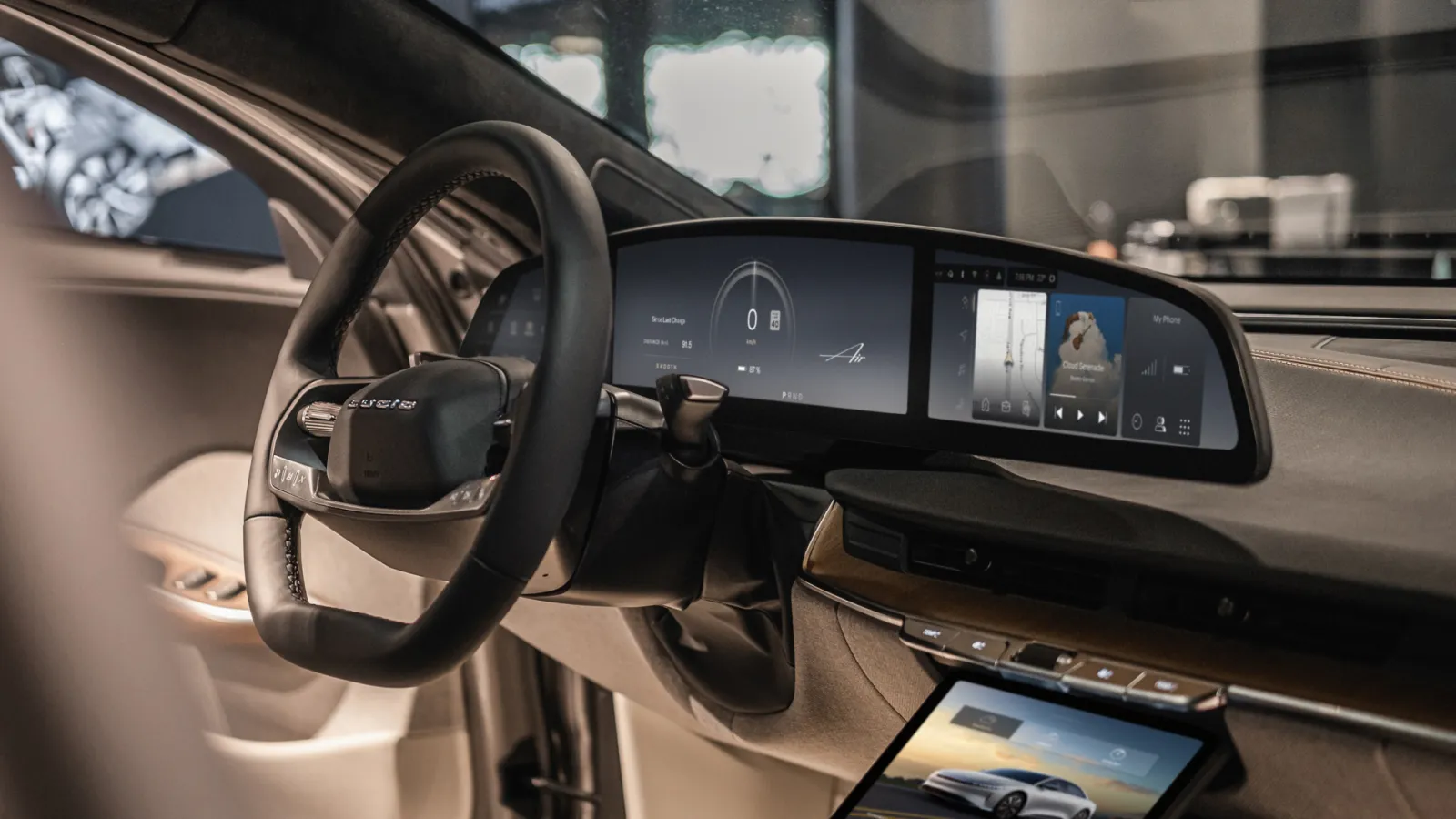
Lucid Group (NASDAQ: LCID) has released Air UX 3.0, a significant software update for its Lucid Air electric saloon, rolling out over-the-air as part of Software Version 2.11.0 from 29 September 2026. The update redesigns the in-cabin interface, improves EV-specific routing, and expands Apple CarPlay and Android Auto across a wider portion of the cockpit display.
Model year 2025 and newer vehicles receive the update automatically at no extra cost. Owners of model year 2022, 2023, and eligible 2024 vehicles can access Air UX 3.0 via an infotainment processor hardware upgrade, priced at $950 in the United States including installation, with international pricing to follow.
What the update delivers
The centrepiece of Air UX 3.0 is a reworked Home screen on the Left Cockpit Panel, featuring swipeable cards for media playback, vehicle controls, calls, saved destinations, and nearby charging stops. A new Quick Controls panel, accessed by swiping down from the top of the Pilot Panel, brings frequently used settings within easy reach without navigating away from the primary view. Profile management has also been tightened: faster profile switching, tighter Primary profile controls over linked keys, and a PIN-protected Guest profile exit now come as standard.
On navigation, the update introduces driver-configurable EV routing, allowing owners to filter charging stops by preferred network, connector type, and minimum state-of-charge on arrival. Dual-screen navigation gains Favourites support and an Auto Dark Mode. For Apple CarPlay and Android Auto, the update expands both environments across the full right side of the Cockpit Display, supporting both wireless and USB connections.
Marc Solsona Palomar, VP of Software at Lucid, said the update reflects "our commitment to the continuous improvement of the customer experience," and that owners "will enjoy more reliable and intuitive experiences."
Market context
Over-the-air software updates have become a central differentiator in the premium electric vehicle market, with Tesla having established the cadence and competitors including BMW, Mercedes-Benz, Rivian, and Polestar following with their own OTA programmes. For Lucid, whose Air competes in a narrow luxury segment against the Mercedes EQS and the high-end Tesla Model S, the ability to ship meaningful feature improvements to existing vehicles without a dealer visit carries direct retention and residual-value implications.
The software-defined vehicle architecture Lucid promotes places it in a growing category of automotive companies as much as technology companies. The Air UX 3.0 rollout is notable for the hardware upgrade tier: at $950, the infotainment processor upgrade for older model years is a revenue opportunity for Lucid at a time when the company continues to work towards profitability. Lucid did not disclose what proportion of its installed base is on eligible older model years, nor did it provide an estimate of potential hardware upgrade attach rates.
The broader competitive picture for in-vehicle digital experience is shifting rapidly. Google's Android Automotive OS has gained traction as an embedded platform across a number of manufacturers, while Apple is reportedly developing a more deeply integrated successor to CarPlay. Lucid's dual-panel approach and its choice to support both CarPlay and Android Auto alongside its own native interface positions it as platform-agnostic, a stance that avoids lock-in risk for owners but may dilute the distinctiveness of the native experience over time.
Lucid has not announced a comparable OTA software roadmap beyond Air UX 3.0, though the company noted the update was inspired by the interface introduced in the newer Lucid Gravity SUV, suggesting a degree of platform convergence across its model line.