
Bosch North America posts $18.8bn in 2025 sales, bets on AI and SiC
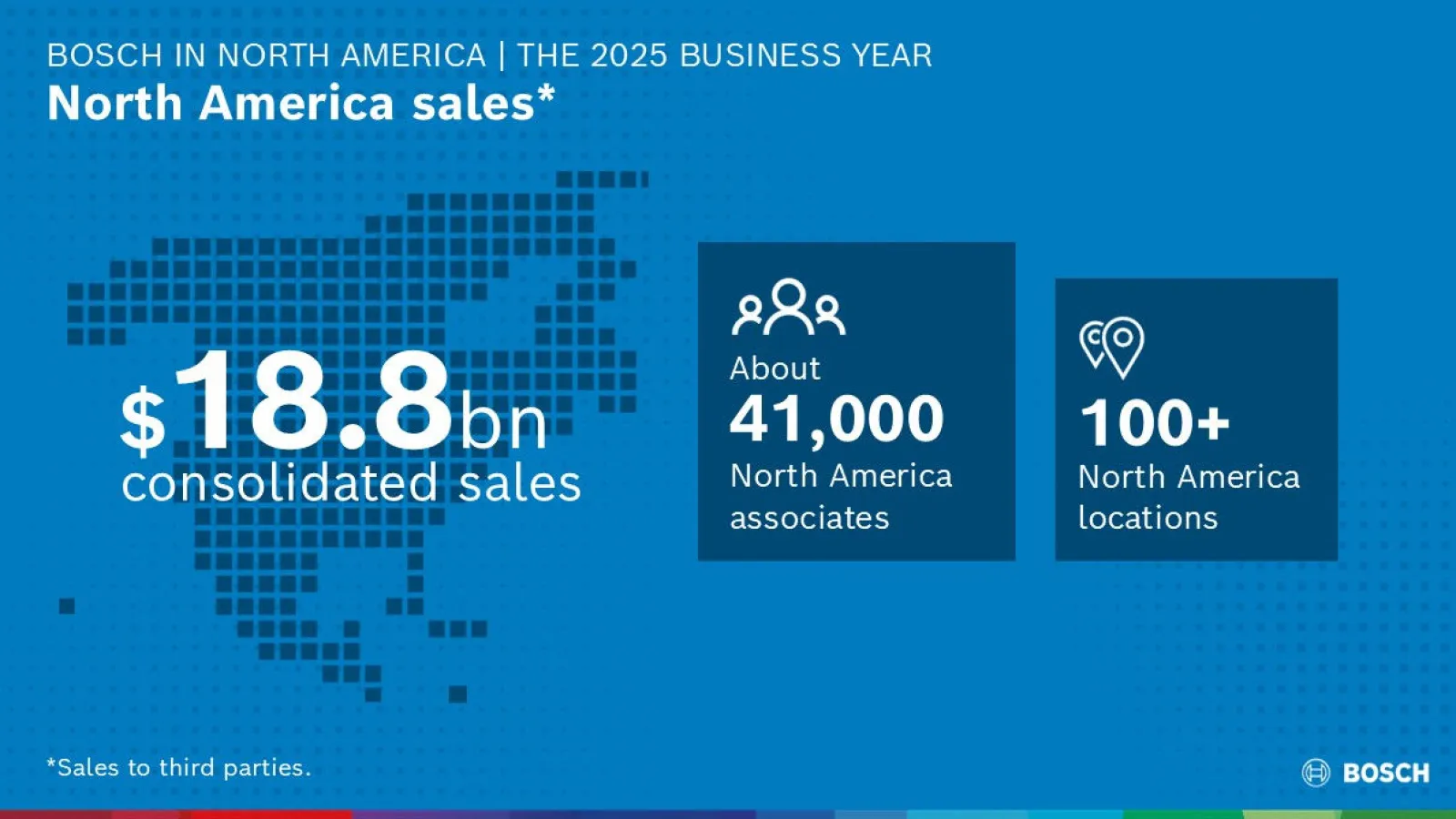
Bosch has reported $18.8 billion in North American sales for the full year 2025, a roughly four percent increase on the prior year's $17.3 billion, as the German industrial conglomerate marks its 120th year of operating in the United States. All four of its business divisions, Mobility, Consumer Goods, Energy and Building Technology, and Industrial Technology, posted year-on-year gains in the region, with the company employing around 41,000 people across 20 US manufacturing sites.
The headline figure sits within a broader global result of 91 billion euros in group revenue for 2025, up modestly from 90.3 billion euros in 2024. The global EBIT margin from operations came in at 2 percent, below the 3.5 percent recorded the prior year, with the company absorbing 2.7 billion euros in restructuring provisions. For 2026, Bosch is guiding for group sales growth of 2 to 5 percent and an EBIT margin from operations of 4 to 6 percent.
Mobility and semiconductors lead the technology agenda
The Mobility division, Bosch's largest North American segment at $11.4 billion in 2025 sales, is positioning AI-embedded software as its primary differentiator. In December 2025 the company introduced an AI extension platform that it says allows original equipment manufacturers to add advanced cockpit functions to existing vehicle architectures without full system redesigns, reducing the hardware cost of an upgrade cycle. At CES 2026, Bosch followed with a self-described "AI cockpit" that applies scene understanding, a voice assistant and contextual navigation to personalise the in-vehicle experience.
The division also introduced a comfort-stop braking feature built on its Vehicle Motion Management software stack. Bosch says the feature delivers up to a 90 percent reduction in end-of-stop jerk compared with conventional braking, citing internal test data from the same vehicle and driving manoeuvre. The stack supports over-the-air software updates, a capability that automakers are increasingly demanding as vehicles become software-defined platforms.
Further down the technology roadmap, construction continues on a $1.9 billion conversion of the Bosch site in Roseville, California, into a silicon carbide semiconductor manufacturing and test facility. SiC devices are a core component in the power-conversion electronics of electric and hybrid drivetrains, and demand for them is expected to increase substantially as electrification penetration rises across global vehicle fleets.
Market context and competitive positioning
Bosch's dual focus on automotive software and compound semiconductors places it in direct competition with a wide range of specialist players. On the automotive software side, Tier 1 suppliers including Continental, Valeo and ZF are pursuing similar software-defined vehicle strategies, while pure-play software vendors and chipmakers such as Qualcomm and NVIDIA are investing heavily in automotive-grade system-on-chip platforms. Bosch's competitive argument rests on its ability to integrate across hardware and software from a single supplier relationship, which it describes as a cross-domain advantage.
In the SiC semiconductor space, the Roseville investment puts Bosch alongside a small number of vertically integrated producers. Onsemi, Wolfspeed and STMicroelectronics are the principal independent SiC suppliers, and several are expanding capacity aggressively. The competitive dynamics of the SiC market are being reshaped by US CHIPS Act incentives and EU strategic autonomy policy, both of which favour domestic or near-shore production. Bosch's California facility is well positioned to benefit from that policy environment, though the company has not disclosed which vehicle OEMs or Tier 1 customers have committed to offtake.
Paul Thomas, president and chief executive of Bosch in North America, said the company aims for the North American region to represent 20 percent of global Bosch turnover by 2030, up from roughly 18 percent at current run rates. Bosch Group chairman Stefan Hartung framed the 2026 outlook as "a year of progress," citing around 6,300 patent applications in Europe in 2025 as evidence of continued innovation throughput. Investors and OEM procurement teams will focus on whether the Roseville ramp and the software platform deals translate into contracted revenue before the end of the decade.