
Himax launches HE Series iToF depth decoder ICs for robotics vision
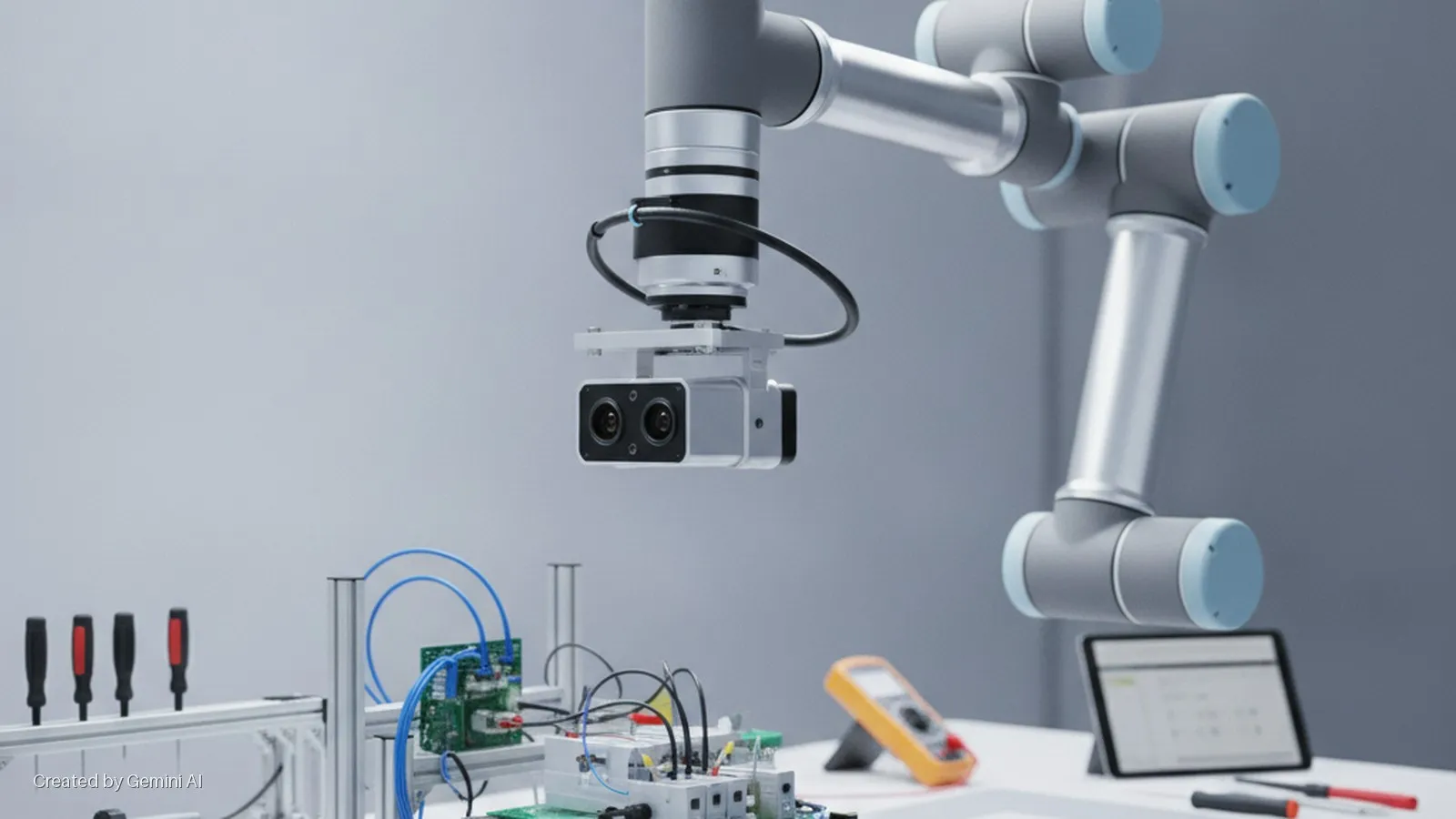
Himax Technologies has launched its HE Series indirect Time-of-Flight (iToF) Depth Decoder ICs, targeting robotics, industrial automation and AI vision systems that require real-time 3D sensing. The Taiwan-based fabless semiconductor company said the chips use a hardware-based depth processing architecture to reduce latency compared with software-based alternatives, supporting up to 640x480 RAW data input at 240 fps and simultaneous 2D and 3D output at up to 120 fps over MIPI and USB interfaces.
The series comprises two variants. The standard HE-1 handles depth decoding with advanced enhancement features including depth noise reduction, flying pixel removal and temporal filtering. The higher-specification HE-2 adds a built-in RGB image signal processor, MJPEG encoder and an RGB-D alignment engine that fuses colour and depth data for the host system without additional processing overhead. The HE-2 also incorporates an edge AI neural processing unit capable of eye tracking, gesture recognition and broader AI vision inference, positioning it as a single-chip platform for human-machine interaction and AIoT applications.
Pen-Hsin Chen, Vice President of the Image Processing SoC Business Unit at Himax, said the growing adoption of robotics and smart manufacturing was driving demand for low-latency depth sensing. "The HE Series iToF decoder IC combines a high-speed depth processing architecture with advanced image enhancement capabilities to deliver a highly accurate, low-latency, and easy-to-integrate 3D sensing solution, helping customers shorten development cycles and accelerate time-to-market."
Optical module manufacturer OFILM has already integrated the HE Series IC into its RoboVision product, which is targeting object picking, obstacle avoidance, environment mapping and autonomous navigation use cases.
Technical foundations
Himax said the HE Series is validated for compatibility with leading VGA-resolution iToF sensors, reducing integration friction for system designers. The company supplies a Software Development Kit and an iToF Calibration Library covering Fixed Pixel Phase Noise correction, Wiggling Compensation, Thermal Compensation, camera intrinsic calibration and lens distortion correction. These tools are intended to reduce the engineering burden for customers building depth-sensing systems from scratch, a common pain point in the robotics supply chain where software integration can account for a significant share of development time.
The chips connect to the broader Himax portfolio, which already includes display drivers, timing controllers, ultralow-power AI image sensors and diffractive optics used in AR and VR systems. Himax holds 2,564 granted patents worldwide as of March 2026.
Market context
The machine vision and 3D sensing market is expanding rapidly on the back of accelerating robotics deployment in warehouses, factories and logistics networks. Himax competes in depth-sensing silicon against a fragmented set of players, including specialist iToF sensor vendors such as Sony and STMicroelectronics, and vertically integrated system suppliers building custom silicon for their own platforms.
Hardware-based depth decoding, as opposed to running depth algorithms on a host CPU or GPU, is increasingly attractive to system integrators managing bill-of-materials costs and thermal budgets in embedded platforms. The edge AI NPU on the HE-2 also positions Himax to benefit from the broader shift toward on-device inference in industrial and collaborative robotics, a segment where export-control scrutiny of AI chips has grown following successive rounds of US Bureau of Industry and Security (BIS) restrictions. Companies sourcing compute for robotics applications are paying close attention to how those restrictions evolve, and fabless suppliers headquartered in Taiwan are navigating compliance requirements alongside product development.
Himax did not disclose pricing, volume shipment timelines beyond confirming partner adoption, or whether the HE Series will be sampled through distributors or sold direct to system integrators.