
Exascale and EnergyBank sign MOU for offshore wind-powered AI compute
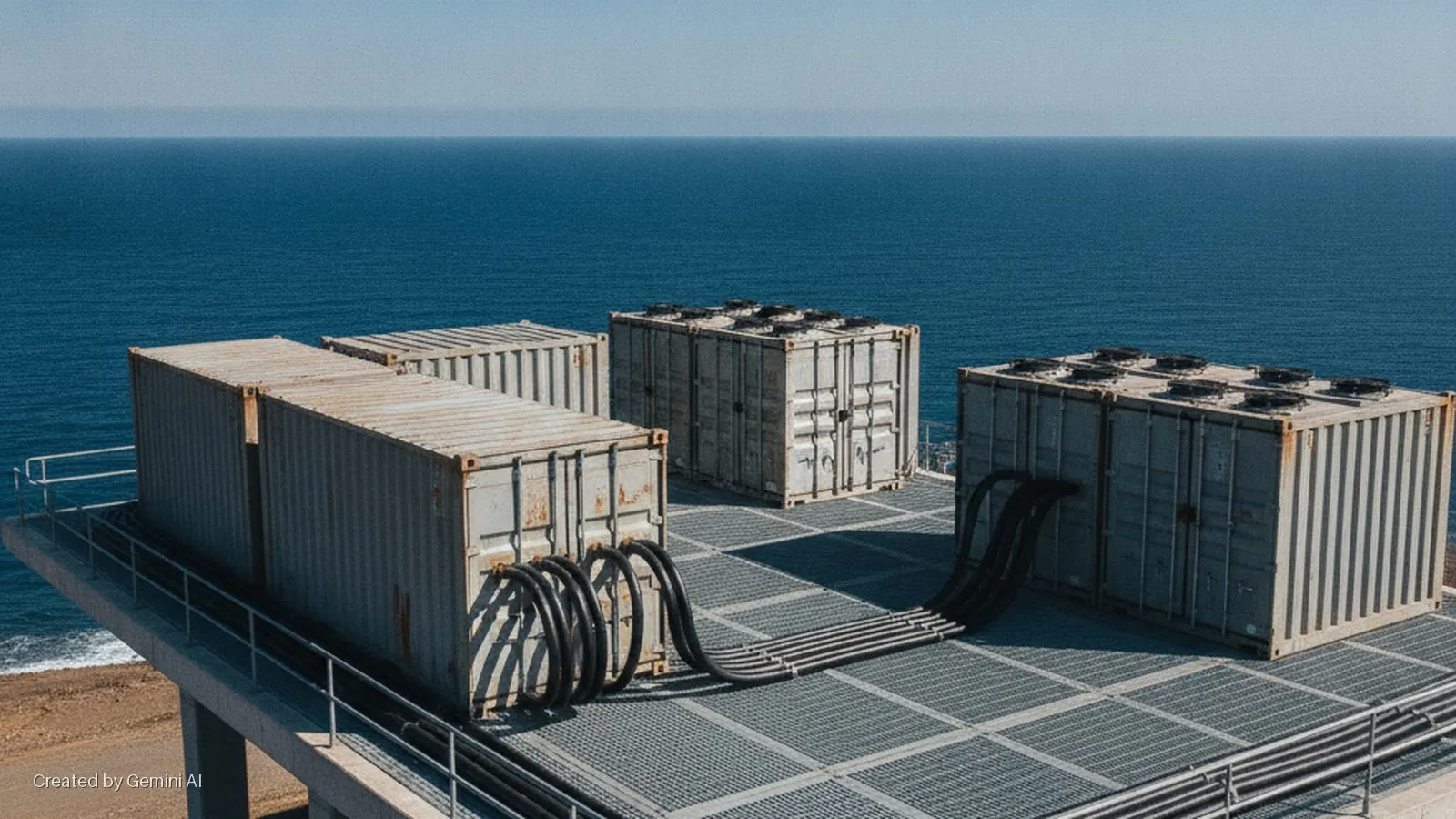
Exascale Labs Holdings (Nasdaq: XLAB) and EnergyBank have signed a non-binding memorandum of understanding to explore grid-independent AI compute infrastructure powered by floating offshore wind and long-duration energy storage. The initial pilot, contemplated to deliver up to 800kW of compute-ready capacity, would be co-located with Zephyros-One, described as the world's first floating offshore wind turbine and operated by Sustainable Energy Norway. EnergyBank is expected to fund the pilot through a mix of private capital and potential public grants.
The two companies intend to develop a repeatable reference architecture for multi-turbine, multi-module deployments that could, in principle, deliver up to 10MW of firm compute capacity per turbine. Exascale would contribute its factory-built modular data centre, high-density cooling, and HVDC power systems; EnergyBank would supply its offshore energy storage technology. The MOU does not commit either party to proceed, and any pilot remains subject to definitive agreements, financing, regulatory approvals and further technical evaluation.
The power-constraint argument
Hoansoo Lee, chief executive of Exascale, framed the collaboration around a structural bottleneck in AI infrastructure build-out: "GPUs ship in weeks, and the facilities to house and power them take months or years to build." The premise is that bypassing conventional grid connections could unlock stranded offshore generation capacity and turn it into firm, schedulable compute power.
EnergyBank chief executive Tim Hawkey reinforced that logic: "By taking floating wind off-grid and integrating generation, storage and modular data centres into a single system, we can turn variable offshore power into firm, high-value compute without waiting years for a grid connection." The argument is commercially coherent, though the execution challenges for offshore data centre operations, including marine logistics, corrosion, latency to terrestrial networks, and offshore maintenance costs, are not addressed in the release.
Market and regulatory context
The power-supply constraint on AI infrastructure is a well-documented pressure point across the industry. Hyperscalers and specialist GPU cloud providers are increasingly competing for grid capacity, with interconnection queues in the US and Europe stretching years. Offshore or stranded-power approaches are attracting genuine investment interest, and a small number of companies are exploring nuclear microreactors, modular gas turbines and dedicated renewable assets for similar reasons.
The floating offshore wind angle adds a distinct layer of regulatory complexity. Any commercial deployment in Norwegian, UK or US waters would engage marine environmental permitting, offshore construction regulations, and in Europe, the EU's revised offshore renewable energy strategy. The UK's Crown Estate leasing regime and Norway's offshore regulations would each impose their own conditions on permanent compute infrastructure attached to or co-located with energy assets.
From a data-centre-standards perspective, offshore modular deployments are not yet covered by established certifications such as the EU Code of Conduct for Data Centres or Uptime Institute tier classifications. Buyers needing contractual SLAs for uptime and data sovereignty would require bespoke frameworks.
Outlook
The MOU is at an early stage and the release is candid about the range of risks, including the economics of offshore compute, GPU and component availability, and the feasibility of operating data centre equipment in a marine environment. EnergyBank is headquartered in Auckland with operations in Norway and the United States, which suggests an international regulatory threading exercise before any commercial system goes live.
Investors and industry observers will watch for a signed technical feasibility agreement, named financing commitments, and the first published benchmarks from the Zephyros-One pilot as the measures of whether this concept progresses beyond the MOU stage.