
Magna AI and Naver Innovation partner on Saudi sovereign AI
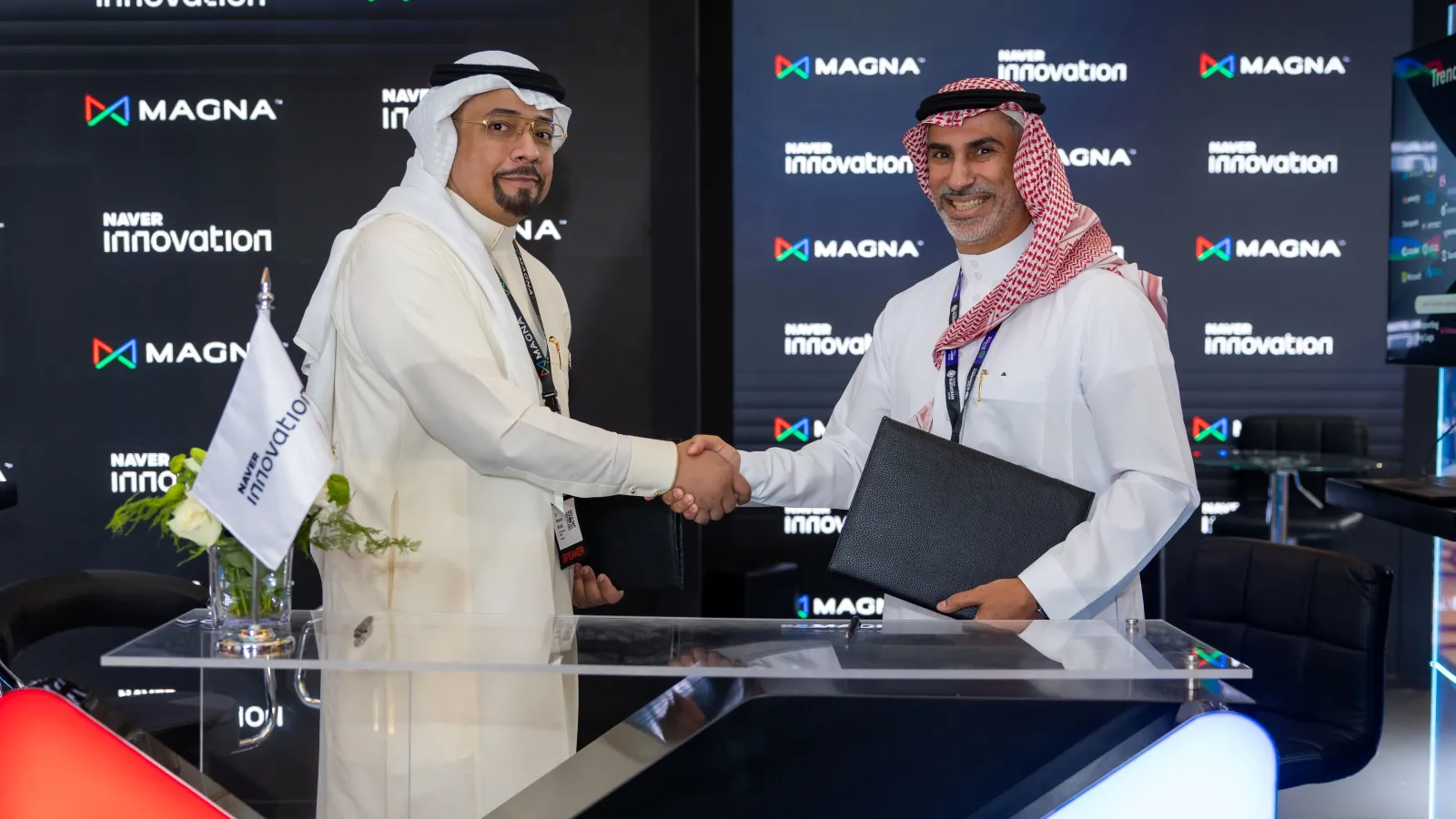
Magna AI, a sovereign AI transformation company established through a partnership between Trend Micro and Wistron Digital Technology Holding Company (WDH), has signed a strategic agreement with Naver Innovation Company to advance Saudi Arabia's AI capabilities across government and enterprise sectors. The deal was formalised at the Global AI Show Riyadh on 2 July 2026, with both chief executives present to sign.
The partnership centres on developing trusted AI infrastructure, secure AI platforms, and sovereign AI capabilities designed to help Saudi government entities and enterprises scale from pilot projects to production-grade deployments. Magna AI brings what it describes as an integrated value-chain approach spanning strategy, engineering, integration, and operations, while Naver Innovation contributes local market knowledge and an existing portfolio of digital twin, smart building, and data-centre capabilities established since the company's founding in 2025 as a joint venture between NAVER Cloud and NHC.
The deal
The agreement does not disclose financial terms, contract values, or a defined delivery timeline. The two companies say they will "explore opportunities" across AI infrastructure and platform development, language that suggests a framework agreement rather than a committed programme of work. Magna AI is itself backed by NVIDIA technology and holds Trend Micro's cybersecurity capabilities within its stack, positioning the partnership as covering both compute infrastructure and security-by-design for AI workloads.
Dr Moataz BinAli, chief executive of Magna AI, framed the deal in broad strategic terms: "Every industrial revolution has been defined by those who built and controlled its critical infrastructure. In the AI era, that infrastructure is intelligence itself."
No named government or enterprise customers were announced alongside the agreement, and no performance benchmarks or certification milestones were included in the release.
Market context
Saudi Arabia has accelerated investment in sovereign AI infrastructure significantly over the past two years, reflecting a broader Gulf-wide push to own the compute, data, and model layers of AI rather than rely solely on US or European hyperscaler services. The Kingdom's Vision 2030 programme has directed capital toward data-centre build-out, national AI strategies, and technology localisation, creating a competitive environment for vendors offering sovereign-stack propositions.
Magna AI is one of several companies targeting this opportunity. Hyperscalers including Microsoft, Google, and Amazon have each announced Saudi data-centre or cloud investments, while regional players such as G42 (Abu Dhabi) are active across the Gulf with comparable sovereign AI positioning. For Magna AI and Naver Innovation, differentiating on integrated security, local governance, and full-stack delivery will be essential given the scale of the competition.
The Stanford HAI AI Index cited in the release, which ranked Saudi Arabia first globally in AI security, privacy, and cryptography, provides external validation the Kingdom is taking regulatory and standards alignment seriously. That context matters commercially: enterprise buyers in regulated sectors such as finance, energy, and public administration will expect any sovereign AI platform to meet local compliance requirements, and Trend Micro's cybersecurity lineage within the Magna AI structure could be a credible differentiator if the partners can demonstrate certified compliance with Saudi CITC and NCA frameworks.
The partnership's near-term test will be whether it converts the framework agreement into named customer wins and disclosed infrastructure deployments. Investors and enterprise buyers will track whether the relationship produces tangible milestones over the next 12 months, particularly as Saudi Arabia's data-centre pipeline accelerates ahead of several large government AI initiatives expected to tender in 2026 and 2027.