
Magna AI and VAST Data team up on Saudi sovereign AI infrastructure
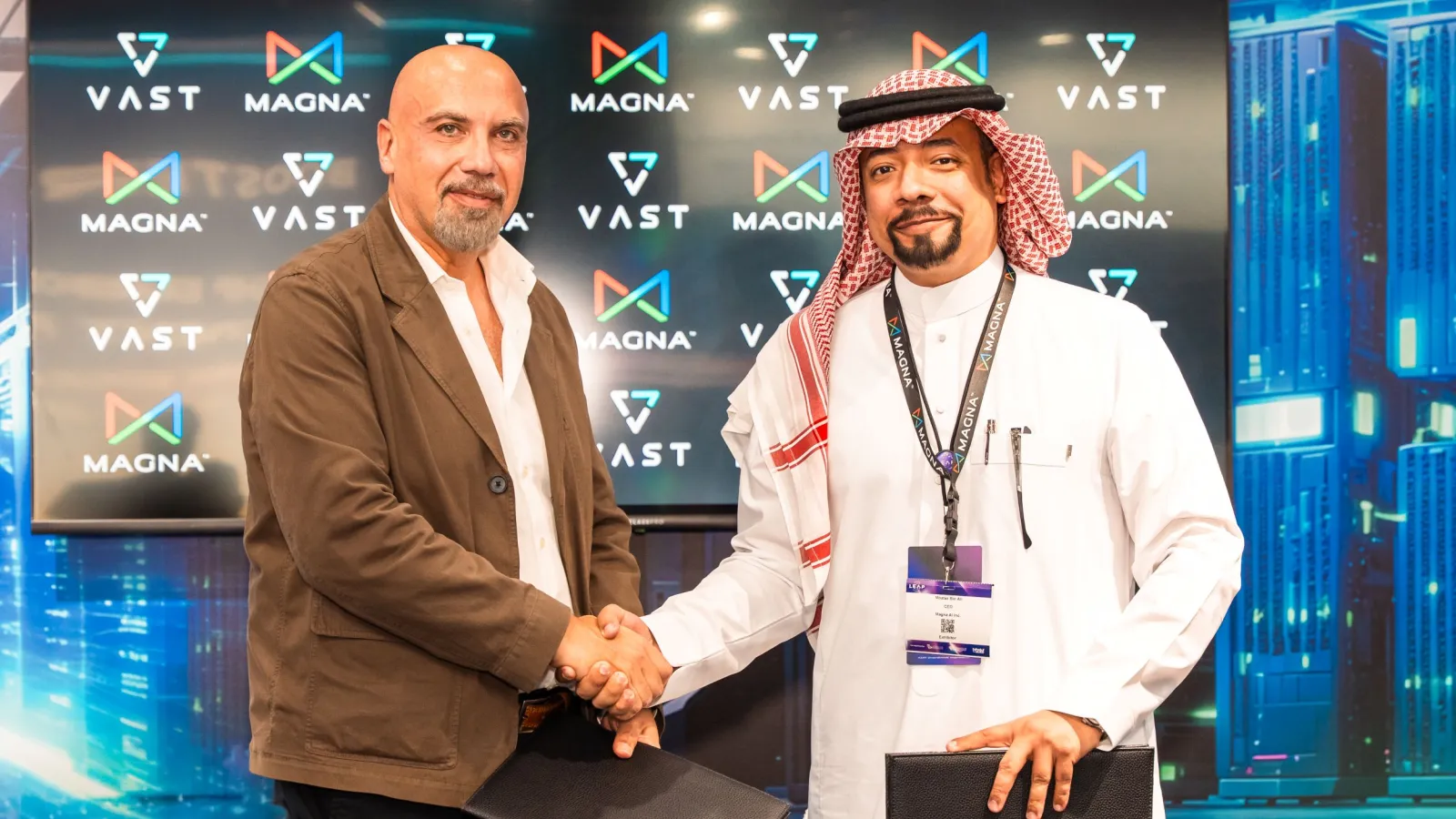
Magna AI and VAST Data have announced a strategic collaboration framework aimed at building sovereign AI infrastructure across Saudi Arabia. The agreement was formalised at LEAP 2026 in Riyadh and brings together Magna AI's full-value-chain services model, which spans strategy, engineering, integration, security and operational transformation, with VAST Data's AI Operating System, a unified software stack covering storage, database and distributed compute.
Magna AI was established through a partnership between cybersecurity firm Trend Micro and Wistron Digital Technology Holding Company, and operates with NVIDIA as a technology backer. The collaboration with VAST Data is structured on an opportunity-by-opportunity basis, meaning precise roles and commercial terms will be determined by individual customer requirements rather than a fixed contractual split.
What the partnership covers
Initial focus areas include government, regulated-industry and enterprise environments, with particular emphasis on workloads that require secure data handling consistent with Saudi data-residency, cybersecurity and regulatory obligations. Potential project types cited in the announcement include AI data centres and AI factory capabilities, data and model pipelines, secure AI platforms and enterprise applications. No specific customer wins, contract values or capacity targets were disclosed.
Dr. Moataz BinAli, chief executive of Magna AI, said the collaboration addresses a structural gap in sovereign AI deployments. "As training, inference and agentic workloads continue to grow, organisations need data infrastructure that can keep pace with how intelligence is stored, accessed, governed and put to work," he said.
Haider Aziz, General Manager for the Middle East, Turkey and Africa at VAST Data, echoed that framing, noting that compute capacity alone does not create production AI. The implication from both parties is that the bottleneck in large-scale AI deployments has shifted from GPU procurement toward data architecture, governance tooling and operational integration.
Market context
Saudi Arabia has emerged as one of the most active markets for sovereign AI investment, driven by Vision 2030 diversification targets and a series of high-profile infrastructure commitments from US hyperscalers and Asian technology integrators. The Kingdom's data-residency and digital-sovereignty requirements create a structural opening for specialist integrators that can demonstrate both technical depth and compliance alignment, which is precisely the positioning Magna AI and VAST Data are pursuing.
VAST Data's DASE architecture, which the company describes as a disaggregated and shared-everything approach, competes in a market that also includes established storage vendors such as NetApp, Pure Storage and Dell, as well as hyperscaler-native data platforms. The AI Operating System framing positions VAST above commodity storage, though enterprise buyers will want to see independently validated performance benchmarks before committing to production deployments at national scale.
The broader sovereign AI infrastructure market is subject to growing regulatory scrutiny. The EU AI Act's extraterritorial reach affects vendors operating in third-country deployments where EU-origin data or EU-linked organisations are involved. Saudi Arabia's own data-protection framework, anchored by the Personal Data Protection Law, adds a domestic compliance layer that any infrastructure partner operating in the Kingdom must navigate.
Near-term milestones to watch include the announcement of a named anchor customer, disclosure of specific data-centre capacity or power commitments, and any formal registration under Saudi Arabia's national AI programme. Until those details emerge, the collaboration remains a framework agreement rather than a contracted delivery programme.