
Presentations.AI opens Presentation Agent to developers via API and MCP
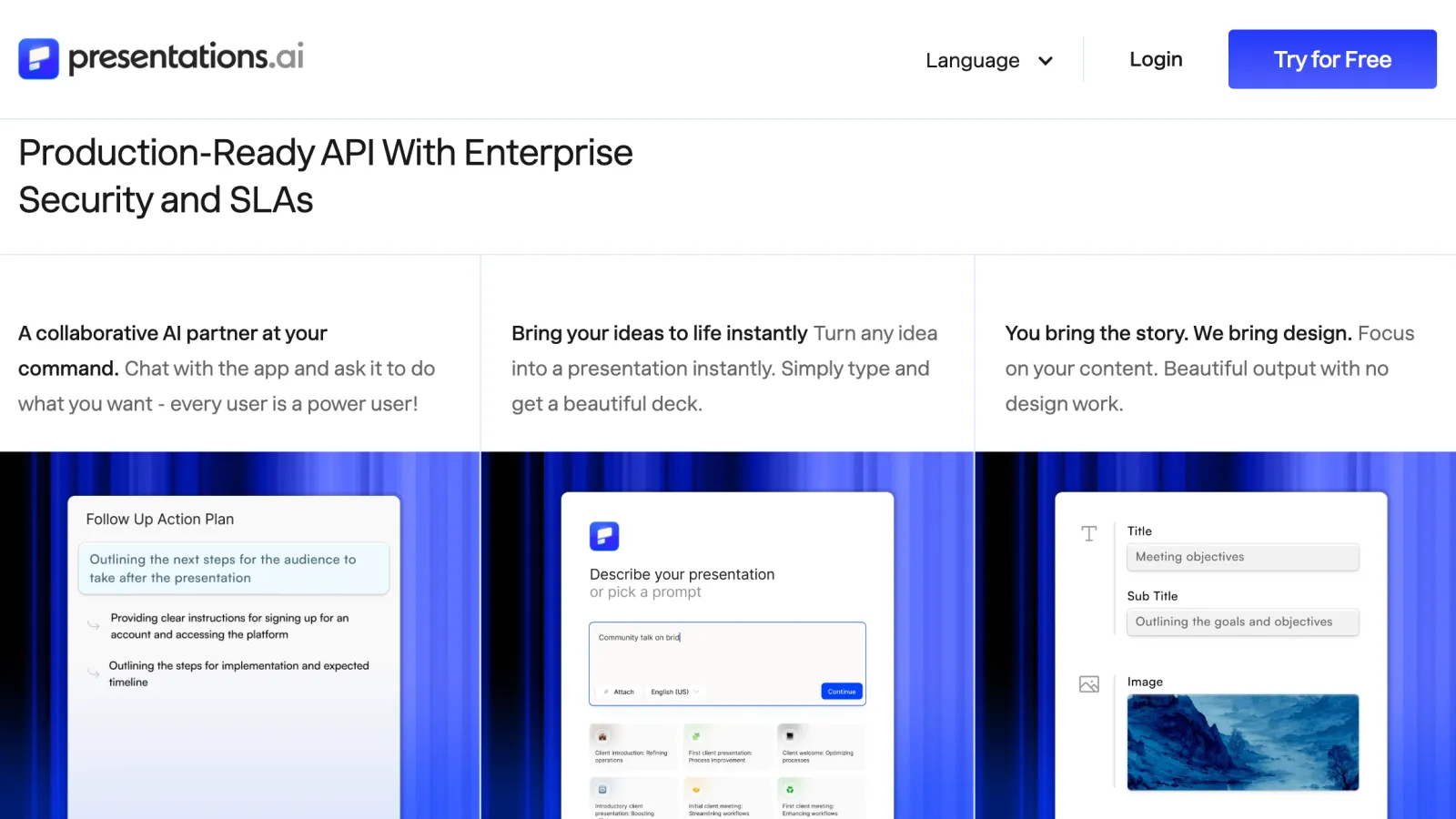
Presentations.AI has launched programmatic access to its Presentation Agent, enabling software applications and third-party AI agents to generate, brand and update business presentations without human initiation. The San Francisco-based company is making the capability available through a REST API and a Model Context Protocol (MCP) server, returning native, editable Microsoft PowerPoint files to the calling system.
The platform, which the company says has more than 12 million registered users, is backed by Accel Partners and Together Fund. Presentations.AI reached one million users within 84 days of its 2023 public beta launch, according to the company's own figures.
How the integration works
The REST API supports OAuth 2.0 authentication, role-based access control and webhook triggers. Developers can pass presentation requirements and business context to the Presentation Agent, apply brand guidelines and receive a finished deck without rebuilding presentation-specific logic inside their own products. The MCP server provides an agent-native interface for the same operations, including creation, revision, audience adaptation and scheduled refresh.
The company points to several workflow scenarios: a Salesforce opportunity could trigger a branded sales proposal; a business-intelligence pipeline could convert Snowflake or BigQuery data into a management deck; a customer-success workflow could produce quarterly business reviews on a recurring schedule. Its Presentation Refresh technology supports daily, weekly or monthly regeneration as well as event-driven triggers. Integrations are listed across CRM platforms (Salesforce, HubSpot, Pipedrive), data and analytics tools (Tableau, Looker, Mixpanel, Google Sheets), and cloud data warehouses.
White-label embedding, which allows software vendors to surface presentation generation inside their own products without Presentations.AI branding, is available at the Growth pricing tier and above, though specific pricing was not disclosed in the release.
Market context
The move reflects a broader architectural shift in enterprise software, where AI capabilities are increasingly exposed as composable services rather than bundled features. The Model Context Protocol, originally introduced by Anthropic in late 2024 as an open standard for connecting AI agents to external tools, has become a de facto integration surface for agentic workflows. A growing number of enterprise software vendors, spanning CRM, data and productivity categories, have published MCP servers to compete for agent-orchestration traffic.
In the presentation-automation segment, Presentations.AI competes against Microsoft's own Copilot-powered PowerPoint generation, Google Slides with Gemini integration, and specialist tools such as Beautiful.ai, Tome and Gamma. The differentiating claim here is architectural: by positioning the Presentation Agent as a delegated intelligence layer rather than a standalone product, the company is targeting developer and AI-platform buyers rather than end users directly, which opens a different commercial motion (API usage and embedded licensing) alongside its existing consumer and business subscriptions.
Standards and enterprise considerations
Enterprise buyers integrating third-party AI services into agentic workflows are increasingly subject to vendor-risk and data-governance obligations. The EU AI Act's general-purpose AI provisions and NIS2's supply-chain security requirements both carry implications for organisations passing business-sensitive data (customer records, financial figures, strategic plans) to external generation APIs. Presentations.AI's release does not address data-processing agreements, regional data residency, or SOC 2 certification status, all of which procurement and security teams are likely to require before approving production use.
The company's 12-million-user figure and named investor backing provide credible scale signals, but the API and MCP launches are early-stage: no developer adoption numbers, pricing tiers, or enterprise customer names were disclosed. The market's willingness to treat presentation generation as a delegated agent capability, rather than a built-in feature of incumbent productivity suites, remains the central commercial test.