
du and QuantumGate deploy post-quantum security on UAE Hypercloud
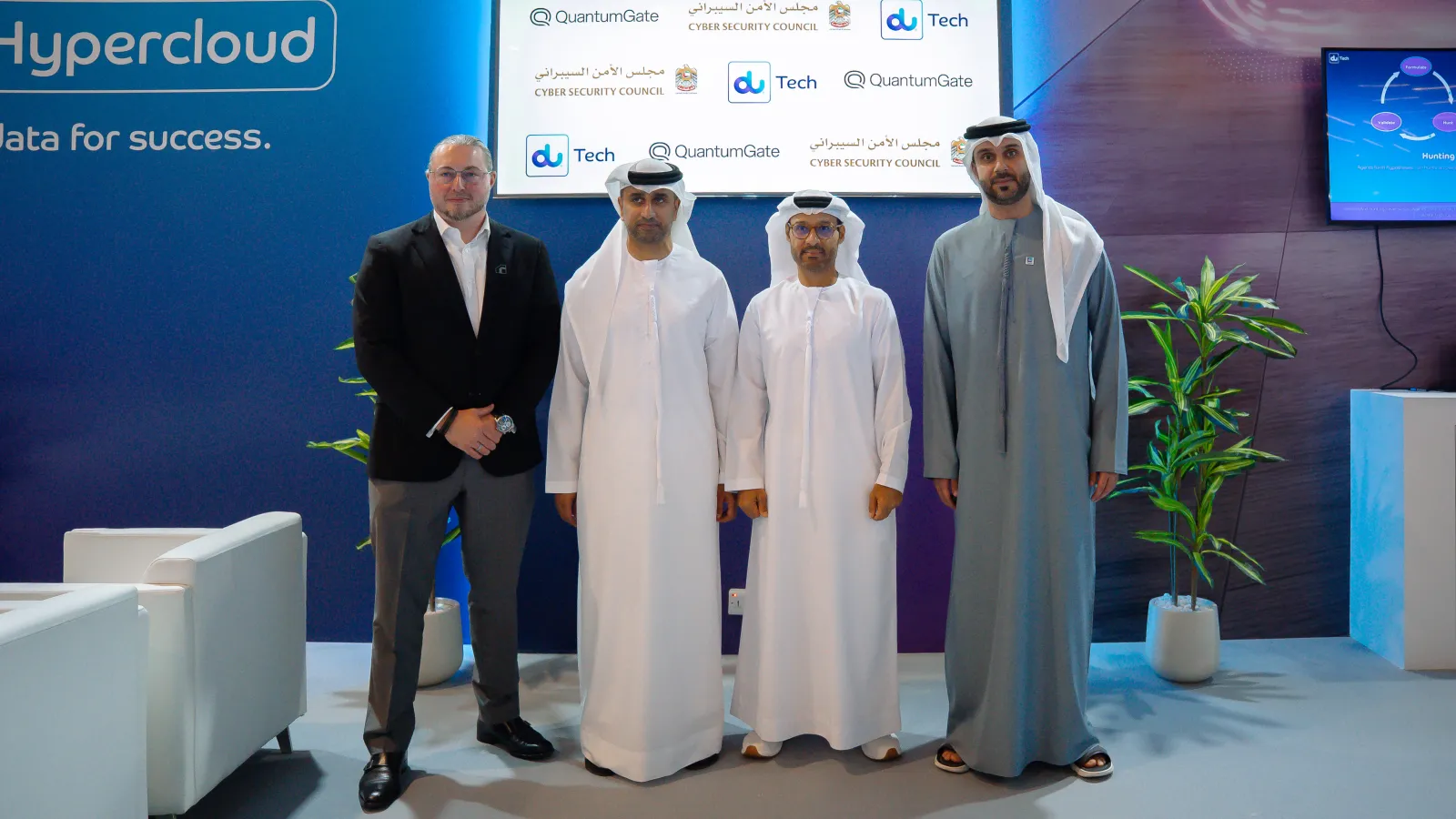
UAE telecom operator du has signed a memorandum of understanding with QuantumGate to deploy the cybersecurity firm's post-quantum capabilities on du Tech's National Hypercloud, with the arrangement formally endorsed by the UAE Cyber Security Council. The partnership was announced at GISEC Global in Dubai on 16 September 2026.
Under the agreement, QuantumGate's quantum-safe products will run on du Tech's sovereign cloud infrastructure, meaning data, cryptographic keys and security controls remain within UAE borders. du will handle commercialisation of the technology to government agencies and critical-infrastructure operators across the country, while QuantumGate provides technical enablement and post-quantum expertise. The release described the collaboration as resting on three pillars: national infrastructure (the Hypercloud), national cryptography (QuantumGate's stack) and national oversight (the Cyber Security Council).
The technology and the threat
QuantumGate, a venture backed by Abu Dhabi's Advanced Technology Research Council through its commercialisation arm VentureOne, draws on research from the Technology Innovation Institute. Its product portfolio spans cryptographic discovery and posture management, a quantum-safe VPN, post-quantum migration advisory, and passwordless identity and access management, covering much of the migration stack a government entity would need to transition away from today's public-key cryptography.
The strategic rationale is straightforward. Sufficiently powerful quantum computers could break RSA and elliptic-curve cryptography, the protocols underpinning most government and enterprise communications today. While no such machine exists at scale, the "harvest now, decrypt later" threat model means adversaries can collect encrypted traffic today and decrypt it once quantum capability matures. Sovereign cloud hosting addresses data-residency concerns but does not, by itself, solve the cryptographic exposure: that requires the algorithmic migration QuantumGate is positioned to provide.
Jasim Al Awadi, Chief ICT Officer of du, said: "Digital transformation requires us to think beyond where data is stored to how it is protected, who controls the security architecture around it, and whether that protection is ready for the threats ahead."
Market context and regulatory backdrop
The UAE is not acting in isolation. The US National Institute of Standards and Technology finalised its first post-quantum cryptographic algorithm standards in August 2024, and the US federal government has mandated agency migration to NIST-approved algorithms by 2030. Gulf and broader Middle East governments are watching that timeline closely, given the shared infrastructure dependencies and trade ties.
Within the region, the UAE Cyber Security Council has been active in driving baseline security standards across government entities, and the endorsement of this partnership signals that post-quantum readiness is now a policy priority rather than a research aspiration. For QuantumGate, the du distribution channel and the Council's backing provide substantial market access without the lengthy procurement cycles that would otherwise apply.
The competitive landscape for post-quantum migration services is consolidating globally around a small number of specialist vendors and large managed-security-service providers. QuantumGate's differentiation is its sovereign positioning: products designed for the Gulf regulatory environment and hosted on infrastructure that satisfies UAE data-localisation requirements. Whether that positioning proves durable depends on how quickly hyperscalers and established cybersecurity vendors build comparable sovereign offerings in the region.
The partnership does not include disclosed contract values, customer commitments, or a timetable for the first live government deployment. Those milestones will be the next signal of commercial traction.