
Tellus Power launches Energy AI model for compute-power scheduling
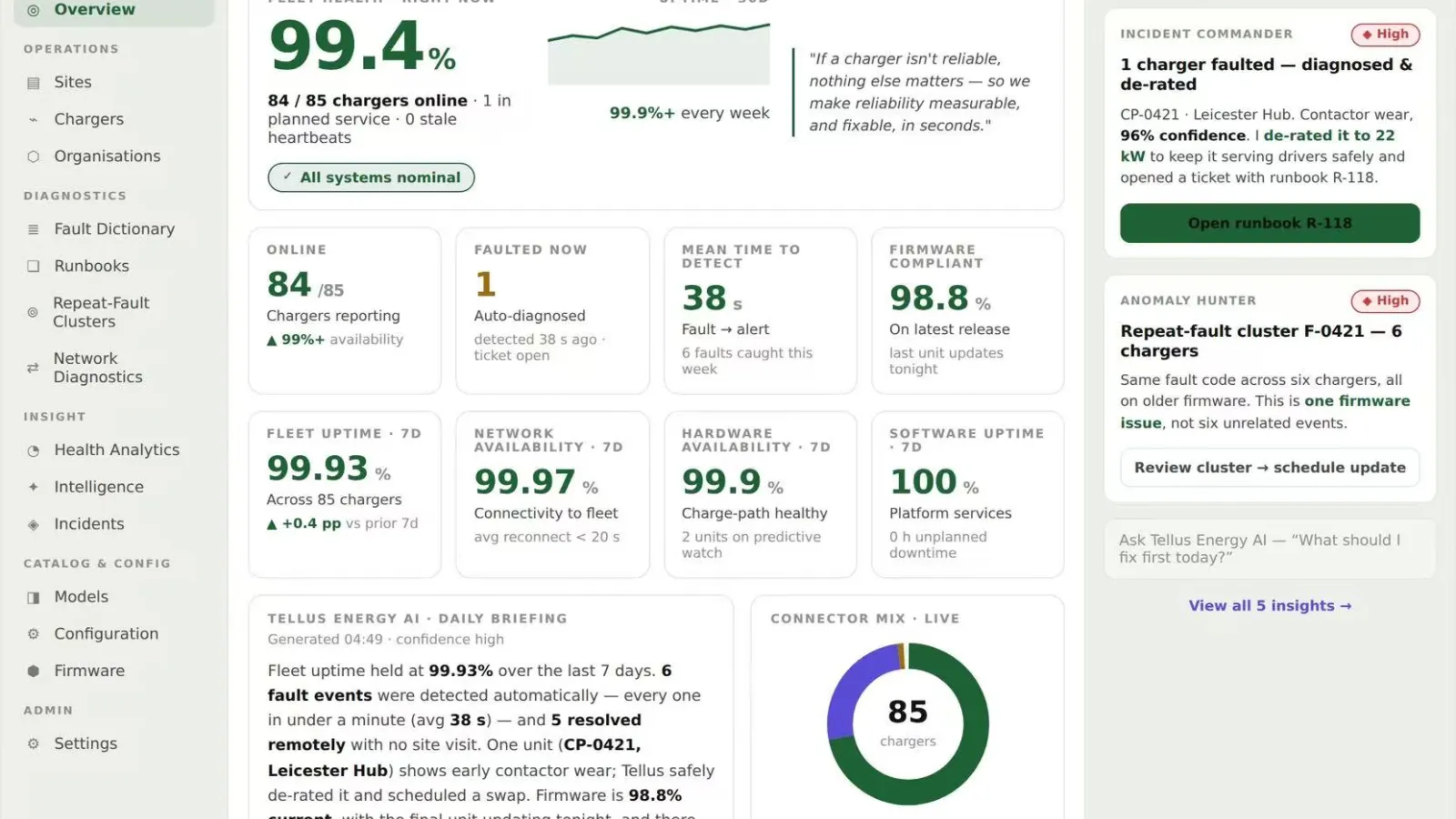
Tellus Power has announced Tellus Energy AI, a purpose-built AI model designed to coordinate compute workloads with real-time electricity pricing, load forecasting and vehicle-to-grid (V2G) assets. The California-based company, which builds bi-directional energy transfer systems, says the model is aimed at AI operators, data centres and new-energy operators seeking to cut power costs and unlock flexible grid capacity.
The model bundles five capabilities: near-real-time wholesale electricity price ingestion, multi-dimensional load forecasting, energy decision support, grid coordination and ancillary-service arbitrage, and an open agent platform built on the company's TPResearch API framework. Tellus Power positions the combination as an integrated "energy plus compute plus AI" stack rather than a standalone software layer, claiming to be among the first vendors to bring multi-directional energy-compute scheduling to market in a single model.
Targets and infrastructure
In early deployments, Tellus Power is targeting electricity-cost reductions of 20–40% against unoptimised operation, a power usage effectiveness (PUE) below 1.1 for data-centre customers, and additional ancillary-service revenue of up to 40%, with full green-power traceability intended to support ESG reporting. The company has not disclosed named customer deployments, independent benchmark validation or contracted revenue figures to underpin those projections.
Alongside the model, the company is assembling four supporting infrastructure components: a V2G-based virtual power plant, a wide-area charging network, liquid-cooled high-density compute clusters, and an advanced energy management system. The stated three-to-five-year ambition is to operate a distributed green-compute network exceeding 1 GW. Chief executive Mike Calise framed the commercial case plainly: "The compute exists, but the power to run it affordably and cleanly is the real constraint on AI's growth."
Market context
The market for AI-workload power optimisation is attracting growing attention as data-centre operators grapple with grid-capacity constraints and rising energy costs. A number of energy management software vendors, hyperscaler sustainability teams and specialist grid-edge startups are pursuing various combinations of demand-response, dynamic workload scheduling and on-site storage integration. Tellus Power's differentiation, at least as presented, lies in coupling V2G fleet assets with compute scheduling inside a single model, rather than treating the data centre and the charging estate as separate systems.
The UK and EU regulatory landscape adds further tailwinds: the EU's revised Renewable Energy Directive and emerging corporate sustainability reporting requirements under CSRD are pushing data-centre operators to demonstrate granular green-power traceability, exactly the use case Tellus Energy AI targets. In the United States, FERC Order 2222, which opened wholesale markets to aggregated distributed energy resources including V2G, creates a commercial framework for the ancillary-service revenue streams the company is projecting.
Standards and verification watch
The 20–40% cost-reduction and sub-1.1 PUE claims in the release are framed as targets for early deployments rather than independently verified results. Buyers and investors will want to see third-party audited PUE figures and verifiable electricity-bill comparisons from named sites before treating those numbers as benchmarks. Green-compute traceability claims will also need to align with emerging standards such as the European Energy Efficiency Directive's data-centre reporting framework or equivalents to carry weight in ESG disclosures.
Tellus Power has three commercial tiers on offer: an Energy Intelligence Agent, a private deployment option and an EMS smart toolkit. Pricing and minimum contract terms were not disclosed in the release.