
ZuriQ raises $25.5m seed to scale 2D trapped-ion quantum chips
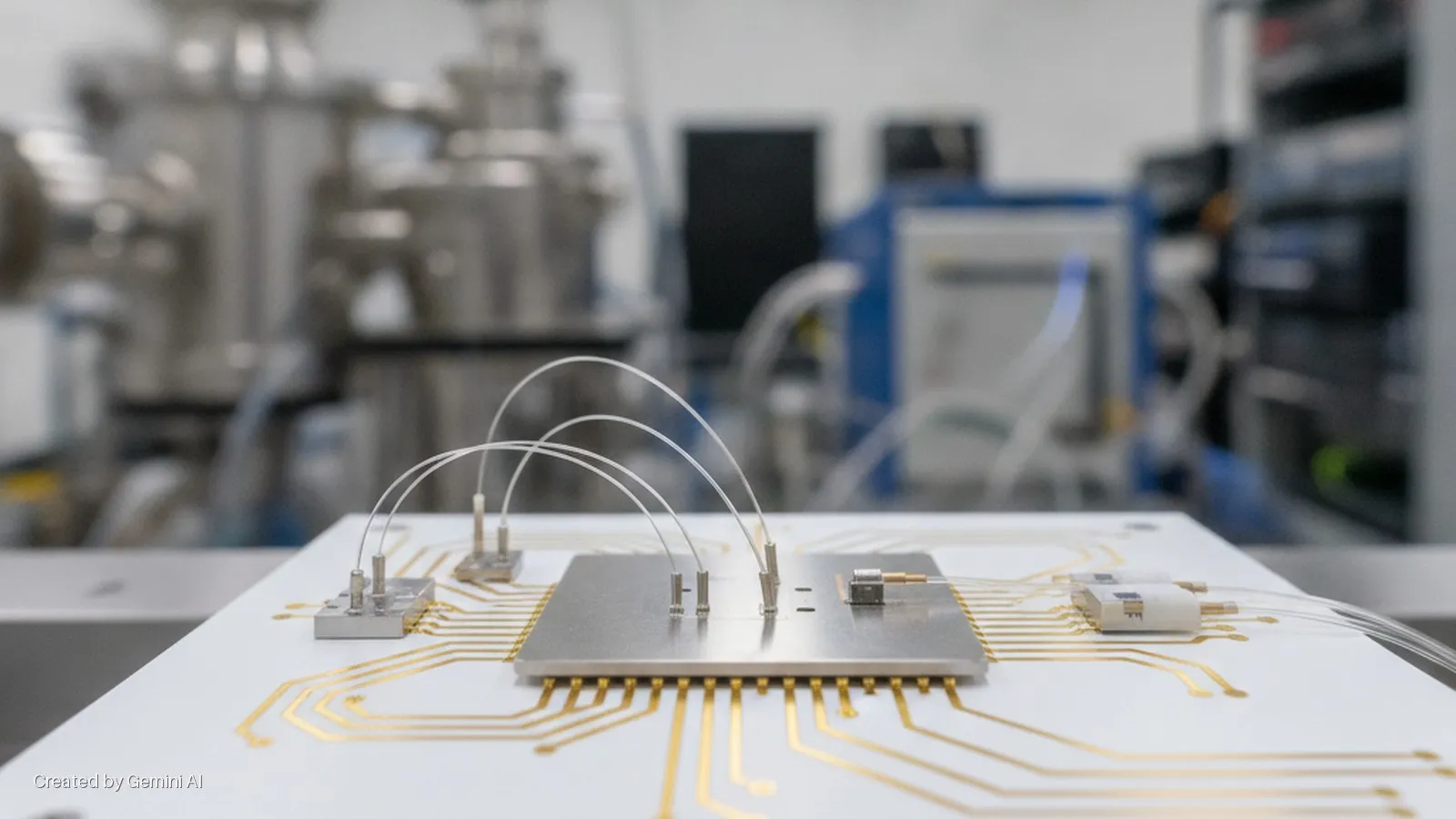
ZuriQ, a quantum computing startup spun out of ETH Zürich, has closed a $25.5 million seed round to accelerate development of its natively two-dimensional trapped-ion processors. The round is led by specialist quantum investor Quantonation, with participation from Forward.one, Extantia, Firgun Ventures, and all investors from the company's $4.2 million pre-seed raise in 2025. The capital will fund further hiring, expanded research and development, and increased chip fabrication capacity.
The Zürich-based company has grown from four to eighteen employees since its pre-seed and says it has recruited talent from IonQ, Xanadu, and Hamamatsu. Three co-founders, Dr Pavel Hrmo, Dr Tobias Sägesser, and Dr Shreyans Jain, established the company as a direct spin-out from the ETH Zürich laboratory of Professor Jonathan Home, who serves as a scientific adviser.
The architecture
Where most trapped-ion systems arrange qubits in one-dimensional chains connected by junctions, ZuriQ uses Penning micro-traps that apply a static magnetic field. This allows ions to move freely in two dimensions across a chip surface without the junction structures that constrain conventional designs. Professor Home explained the scaling advantage: "Hold ions in a line and the count grows one at a time; hold them in two dimensions, and it grows with the area of the chip, on a standard chip, that is the difference between tens of ions and many thousands."
ZuriQ built a working demonstrator within 18 months, comprising a 3x3 array of nine individually controlled ions, which the company describes as the largest two-dimensional trapped-ion array demonstrated to date. Chips for the demonstrator were fabricated in partnership with Infineon, indicating the design is compatible with established semiconductor manufacturing processes rather than requiring bespoke production lines.
Dr Hrmo, co-founder and chief executive, framed the architectural bet explicitly against the incumbents: "The trapped-ion companies that started the race began with one-dimensional designs that were useful stepping-stones, but the real challenge is whether they can successfully pivot to two dimensions as they attempt to scale. We spent longer in the lab, and that time allowed us to identify an alternative route that is inherently easier to scale."
Market context
The trapped-ion segment already includes well-capitalised players. IonQ is publicly listed on NYSE; Quantinuum, the joint venture between Honeywell and Cambridge Quantum, has attracted substantial corporate backing; and several earlier-stage groups are pursuing similar near-term commercialisation timelines. ZuriQ's differentiation rests on the claim that 2D-native architecture sidesteps the scaling bottleneck that one-dimensional systems will eventually hit, rather than requiring a costly architectural pivot mid-roadmap.
Quantonation founding partner Christophe Jurczak pushed back on the notion that the quantum hardware race is resolved: "A common misconception is that the quantum race is already decided, but that is far from reality." The fund has previously backed a range of quantum hardware approaches across Europe and North America, making it one of the few investors with direct technical comparison across competing architectures.
Regulatory and standards context
ZuriQ's roadmap targets industrially useful machines requiring thousands of qubits, a threshold that most analysts place well beyond current demonstrated capability across all hardware modalities. That timeline intersects with NIST's post-quantum cryptography migration schedule, which calls for federal agency adoption of new classical algorithms by 2030, a deadline that does not depend on fault-tolerant quantum hardware arriving on time. Enterprise buyers in financial services and critical national infrastructure are therefore unlikely to delay classical cryptography migration while monitoring quantum hardware progress.
The Infineon fabrication partnership is a meaningful signal for commercial credibility: access to an established semiconductor foundry reduces one of the key production-scale risks that has hampered earlier quantum hardware spin-outs. ZuriQ has not disclosed a target qubit count milestone, a commercial launch timeline, or any named early customer. Those will be the indicators to watch as the company converts its seed capital into demonstrable scale.