
Alipay launches agentic commerce platform for Chinese merchants
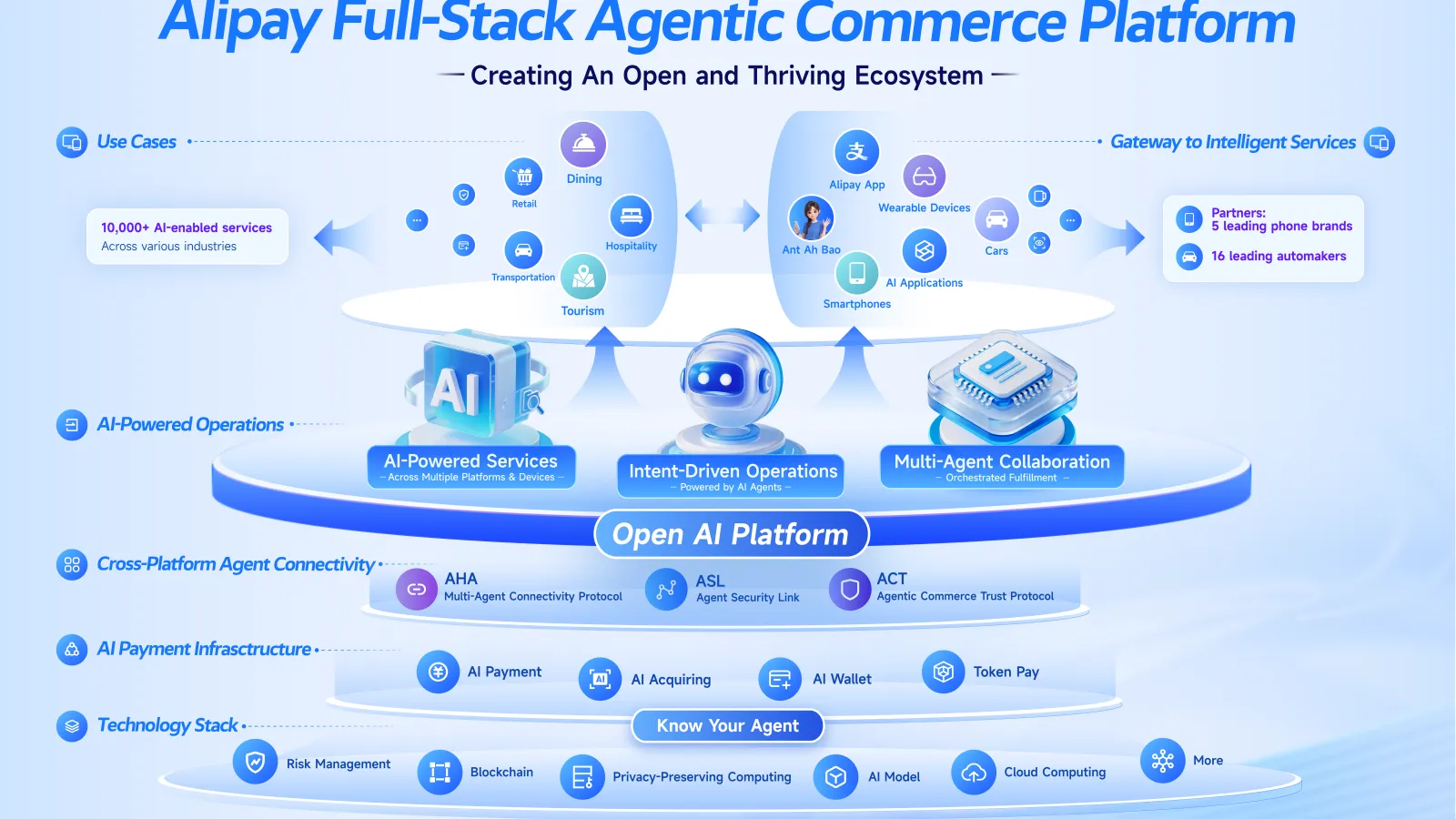
Alipay has launched what it describes as China's first full-stack agentic commerce platform, unveiled at its AI Ecosystem Partner Conference in Hangzhou on 17 August 2026. The platform is designed to help merchants shift from conventional digital operations to AI-powered ones, offering a modular suite of tools that can be adopted independently depending on a merchant's existing capabilities.
For merchants without AI infrastructure, the platform provides a one-stop solution that converts existing pages, products, and service workflows into what Alipay calls "agent-ready Skills and MCP tools." Merchants that have already built AI-enabled services can use the platform for agent creation, skill orchestration, task execution, and operations management, covering use cases from personalised product recommendations to membership programme management.
The Ah Bao ecosystem
Central to the platform is Ah Bao, a super-service AI agent launched by Alipay in June 2026. Ah Bao connects consumers with more than 10,000 AI-powered everyday services, ranging from utility bill payments and food ordering to EV charging station location, all via natural language conversation. Retail brands including KFC, Mixue Bingcheng, and Luckin Coffee have already integrated into Ah Bao, enabling orders and payments to be completed entirely through chat.
The platform's cross-device ambitions are underpinned by Alipay's AHA protocol, which supports interoperability across agents and devices. As of August 2026, Ah Bao is connected to five leading smartphone brands accounting for more than 70% of China's handset market, as well as 16 automakers. A partnership announced with OPPO in July allows that company's Breeno AI agent to call on Ah Bao to fulfil user requests without leaving the originating application. A separate system-level partnership with foundation model company StepFun enables users of StepFun's AI-native terminal to access Ah Bao services through voice commands.
Ant Group chief executive Cyril Han said: "AI agents will become a new interface connecting hundreds of millions of users with tens of millions of merchants, unlocking a new intent-driven commercial ecosystem."
To lower barriers for developers and smaller merchants, Alipay has also launched an AI Business Incentive Program offering 100 million free tokens per user, transaction-based token subsidies, and reduced payment processing fees.
Market context and competitive positioning
Alipay's move positions it squarely in the emerging agentic commerce layer, a space where the competitive dynamics in China differ substantially from those in Western markets. Domestic rivals including WeChat (Tencent), JD.com, and ByteDance's suite of super-apps are all investing in AI-agent capabilities layered over existing commerce and payments infrastructure. The "super-agent" model, where a single conversational interface orchestrates services across multiple domains and devices, is becoming the dominant design pattern in China's consumer-technology sector.
Internationally, analogues exist in Amazon's Alexa+ agentic upgrade and Apple's deeper Siri integrations announced in 2025, though neither has reached the breadth of merchant integration Alipay is claiming at launch. The AHA protocol's cross-device and cross-agent interoperability ambition is broadly comparable to the Model Context Protocol (MCP) gaining traction in Western developer ecosystems, suggesting some degree of emerging industry convergence on open-ish orchestration standards.
From a regulatory standpoint, China's AI governance framework, including the Generative AI Interim Measures administered by the Cyberspace Administration of China, imposes content-moderation and algorithm-transparency requirements that will apply to agent-mediated commerce. Alipay's inclusion of trusted identity and risk management capabilities within the platform appears designed partly to address these obligations, as well as to differentiate on security relative to less established competitors.
The scale of Alipay's existing base, over one billion consumers and 80 million merchants, gives it a structural advantage in seeding the agentic layer with real transaction volume. Investors and partners will be watching for disclosed merchant adoption figures and transaction-level metrics as the platform moves beyond launch.