
Einride partners with NVIDIA to scale autonomous heavy-duty trucking
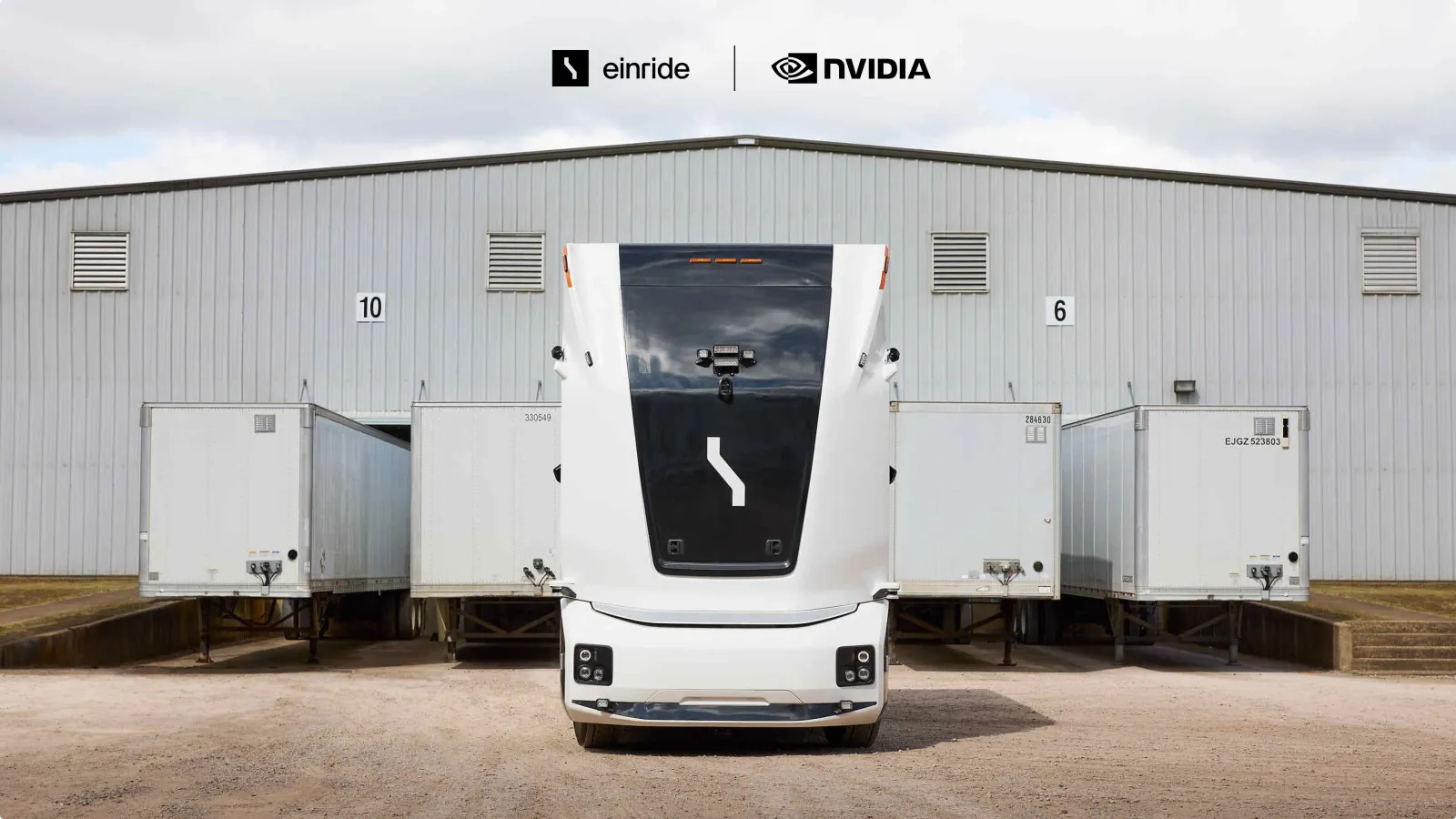
Einride, the Stockholm-founded autonomous freight operator listed on Nasdaq, has announced a strategic collaboration with NVIDIA to accelerate its push into highway and suburban autonomous trucking. The partnership centres on adapting the NVIDIA DRIVE Hyperion platform, a production-ready compute and sensor reference architecture designed for Level 4 autonomy, to the specific demands of heavy-duty freight operations.
Einride currently runs hundreds of electric trucks for major shippers across the US, Europe and the Middle East, including a number of autonomous vehicles already operating under contracted customer deployments. The company says its freight network is expected to scale to between 1,500 and 2,000 vehicles by 2028, driven by demand already captured on its platform. Approximately 80% of that pipeline is considered suitable for automation in the medium term, according to the company.
What the collaboration covers
Under the agreement, Einride will work directly with NVIDIA to extend the Hyperion platform's compute, sensor, software and safety architecture for heavy-duty use cases. The collaboration also integrates the NVIDIA Halos safety system, which the companies say creates a scalable foundation for production-ready autonomous freight operations.
For AI development, Einride plans to deploy NVIDIA's Blackwell GPU architecture at scale through an NVIDIA Exemplar Cloud partner, a cloud provider whose infrastructure NVIDIA has validated for large-scale AI training workloads. The company is also using NVIDIA Cosmos, a platform that enables searching and curating camera data to surface complex edge cases, and augmenting real-world data with photorealistic synthetic scenarios to broaden the training and validation dataset.
Henrik Green, Chief Technology Officer at Einride, said: "We have the customers, the operational experience and the technology. Building the next generation of the Einride Driver on the NVIDIA Hyperion platform will enable us to scale autonomous deployment across a freight network that's already serving customers today."
Rishi Dhall, vice president of automotive at NVIDIA, described autonomous trucking as "one of the clearest opportunities to improve the safety and efficiency of global freight", citing the combination of Hyperion, Halos and Blackwell infrastructure as the core acceleration path.
Market context and regulatory landscape
Autonomous trucking has attracted sustained investment from a range of hardware and software players, including Aurora Innovation, Torc Robotics (a Daimler Truck subsidiary) and Plus.ai. The competitive picture is defined less by raw compute than by the ability to close the loop between fleet operations, safety validation and regulatory approval across multiple jurisdictions. Einride's end-to-end model, covering system design, safety validation, regulatory approval and customer deployment under one roof, is positioned by the company as a differentiator against platform-only or software-only competitors.
On the regulatory side, Level 4 autonomous trucks face a patchwork of national frameworks. In the US, the FMCSA has been developing federal guidance for autonomous commercial vehicles, while several states have enacted their own operating permits. In Europe, the EU's updated General Safety Regulation and the UN's ALKS framework have primarily addressed passenger vehicles; heavy-duty autonomous operations remain subject to member-state discretion in most cases. For Einride, which operates across three continents, navigating this landscape is as much a competitive constraint as a technology one.
The Blackwell infrastructure commitment is also notable for its compute economics. Training and validating autonomous-driving models at scale is GPU-intensive, and access to NVIDIA Exemplar Cloud-validated infrastructure is intended to reduce the time and cost of iterating on edge-case data, a perennial bottleneck for AV developers regardless of the vehicle class.