
CUbIQ and Coherent demo pluggable QKD for AI data-centre links
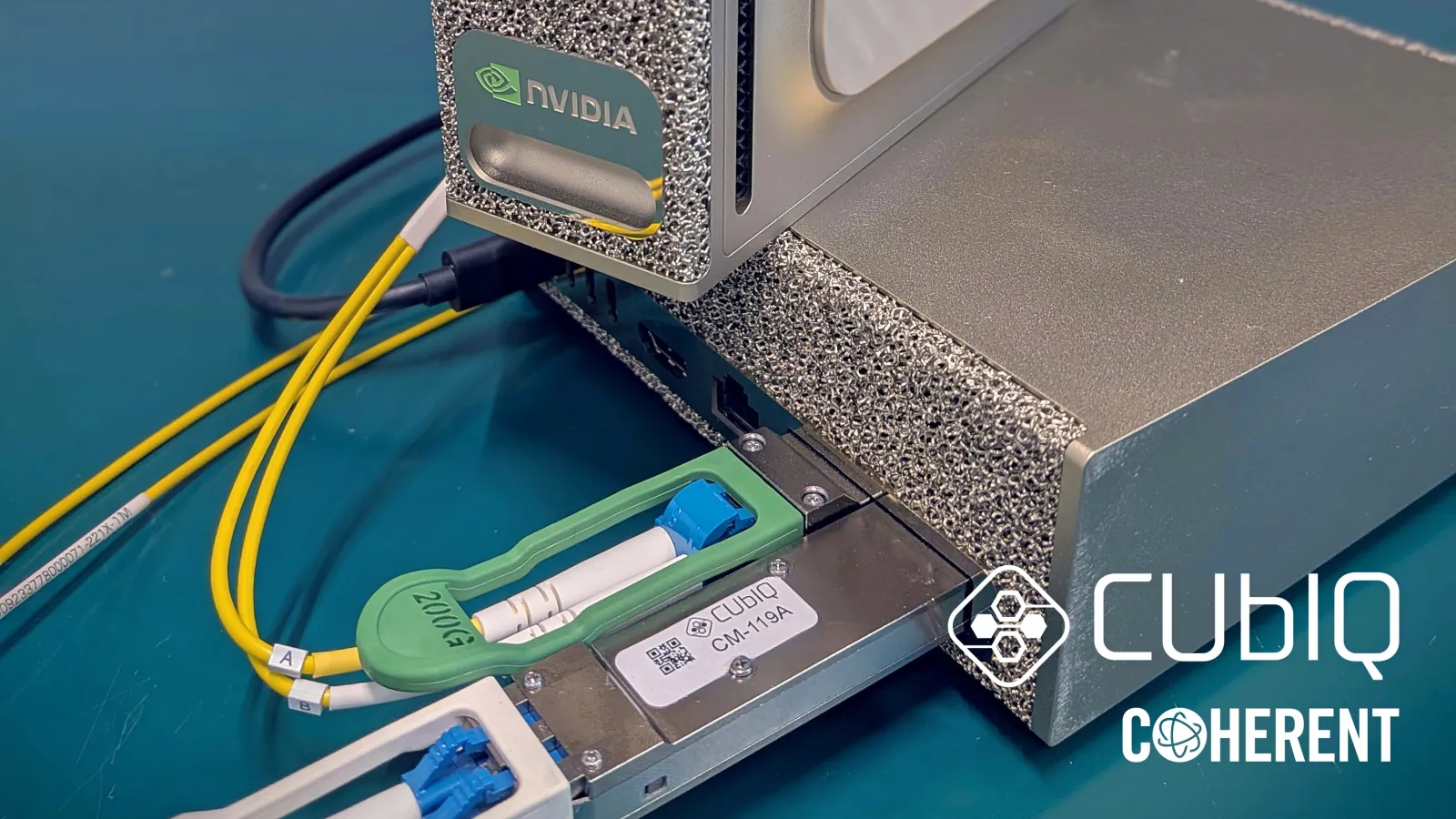
CUbIQ Technologies and NYSE-listed photonics supplier Coherent Corp. have demonstrated a proof-of-concept quantum key distribution (QKD) system designed to secure the optical fibre links that connect AI compute clusters across campuses and colocation sites. The result was shown publicly at ECOC 2026 in Málaga on 21 September and represents the first time, the companies say, that continuous-variable QKD has been packaged into a standard QSFP-28 pluggable transceiver form factor.
The demonstration used CUbIQ's CV-QKD module alongside Coherent's 200G FR4 OSFP56 pluggable optical transceivers and was tested against a commercially available NVIDIA DGX Spark system via its ConnectX-7 interface, with no modification to the host equipment. The companies say the module slots into the same port occupied by conventional optics, eliminating the need for dedicated rack-mounted QKD hardware and its associated space, power and management overhead.
The security problem it addresses
As AI training clusters expand beyond single buildings, the high-speed fibre fabric connecting nodes carries model weights, gradients and training data that are both extremely valuable and potentially exposed to physical interception. Conventional line-rate encryption protects the payload but relies on key-exchange methods that cannot detect whether a link has been silently tapped. CUbIQ's approach derives cryptographic keys from the quantum properties of the optical signal itself. Any interception attempt disturbs the signal in a measurable way, meaning compromised keys are detected and discarded before they are used. The company positions this as a zero-trust physical-layer complement to existing software-defined encryption.
Aaron Albores Mejia, chief executive of CUbIQ Technologies, said the collaboration with Coherent "proves that quantum-safe networking can be demonstrated on the AI infrastructure that operators are already deploying." CUbIQ claims the pluggable form factor reduces power consumption, cost and footprint by a factor of 100 compared with conventional rack-based QKD systems, though independent verification of those figures has not been published alongside this proof-of-concept announcement.
Market context and standards landscape
Physical-layer quantum-safe security sits at the intersection of two fast-moving policy agendas. NIST finalised its post-quantum cryptography (PQC) algorithm suite in 2024 and mandates federal-agency adoption by 2030, creating commercial pull for vendors that can demonstrate compliant key management. QKD and PQC are technically distinct approaches: PQC replaces classical key-exchange algorithms in software, while QKD derives keys from physics. The two are increasingly discussed as complementary layers rather than alternatives, particularly for high-value links in critical infrastructure and defence.
The broader pluggable-optics market is already highly competitive, with Coherent, II-VI (now merged into Coherent), Lumentum, Inphi and a range of Asian ODMs competing on price, wattage and speed. Adding QKD capability to a standard form factor is a meaningful engineering step, but commercial adoption will hinge on whether hyperscalers and co-lo operators are willing to pay a premium for per-link quantum-safe key generation at the physical layer, or whether they judge software-layer PQC upgrades sufficient.
CUbIQ is a pre-revenue startup and the announcement describes a proof-of-concept rather than a generally available product. The companies have indicated they are developing a next-generation secure, high-capacity optical pluggable transceiver, but no timeline, pricing or named customer has been disclosed. For enterprise buyers evaluating physical-layer security roadmaps, the ECOC demonstration is a noteworthy milestone; the distance to production deployment and any regulatory certification path under standards such as FIPS 140-3 or Common Criteria remain open questions.