
Fireflies.ai Voice Agents log 40,000 calls across 2,100 firms
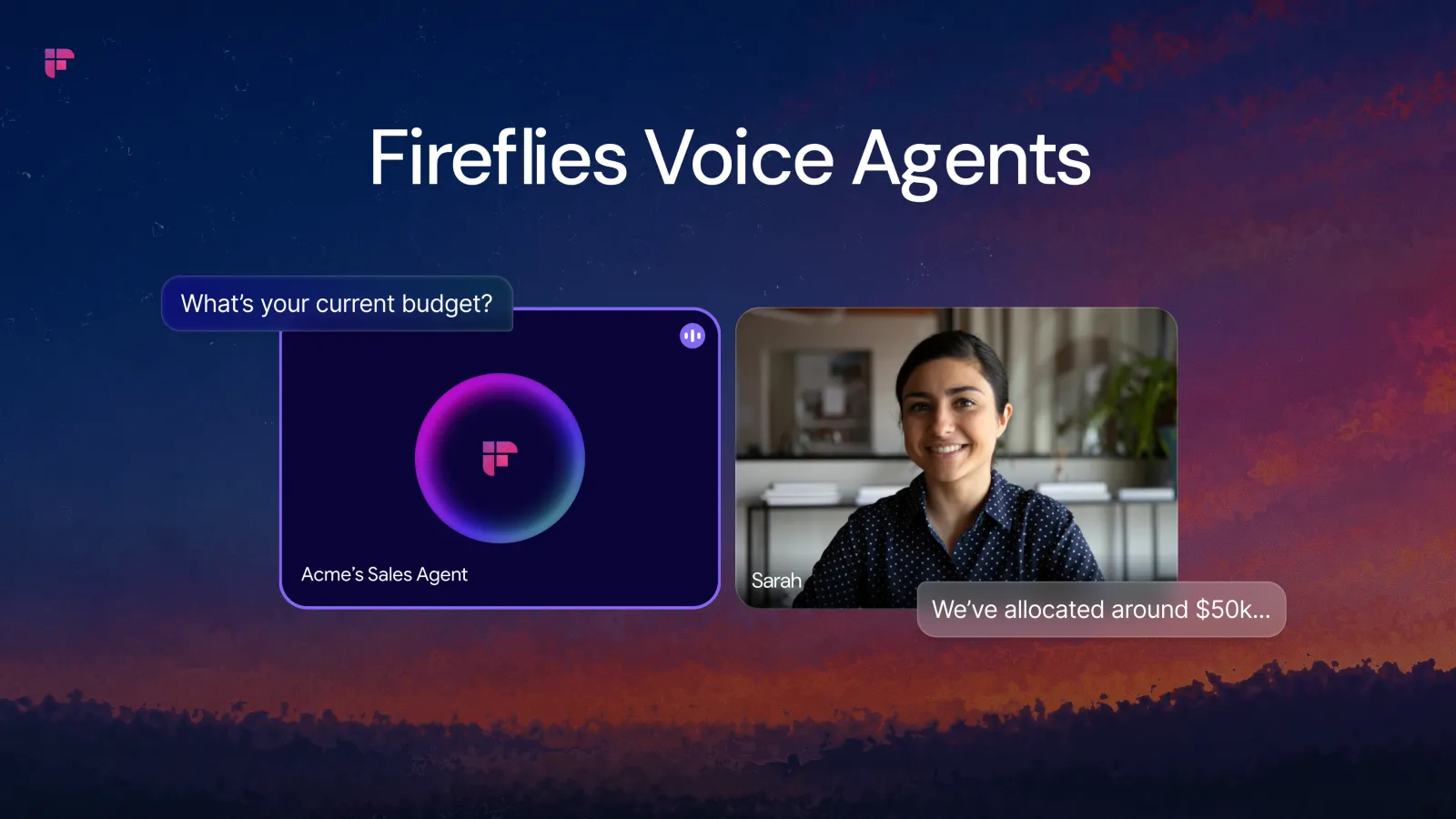
Fireflies.ai has launched Voice Agents, an AI-driven calling product designed to handle repetitive telephone interactions at scale for recruiting, sales, and customer support teams. The company says the feature has already conducted more than 40,000 conversations across 2,100 organisations in 97 countries since its initial rollout, a figure it is presenting as early validation of enterprise demand.
The product represents a material expansion of Fireflies.ai's original proposition as a meeting-notes and transcription tool. Rather than capturing what humans say on calls, Voice Agents conduct the call itself, drawing strictly from a knowledge base provided by the deploying team and not improvising beyond that scope. Once a call ends, a recording, transcript, and summary are generated automatically. The platform's AI Skills layer then routes structured outputs to downstream tools: a screening call produces a candidate scorecard, a sales call produces CRM-ready discovery notes, and a customer conversation can generate a case study ready for publication. The company claims its own recruiting team has saved more than 800 hours using the screening capability, and that the product has already produced more than 20 customer case studies across its user base.
Deployment and pricing
Voice Agents are available immediately on all Fireflies.ai plans under a usage-based credit model, with no separate contract or additional per-seat fee required. Agents can be deployed via link, embed code, QR code, or integration with applicant tracking systems, and calls are surfaced in the platform's existing Meetings tab alongside human-attended sessions. The product supports more than 30 languages, which the company says underpins its penetration across 97 countries.
Laura Passmore, a talent acquisition professional at digital marketing agency WebFX, said the product had changed how her team evaluates applicants. "We've been able to consider a broader range of candidates instead of being stuck on the phone all day," she said. "Nearly 300 screenings later, about a third of our new hires started with a Voice Agent."
Market context
Voice Agents places Fireflies.ai in direct competition with a growing field of AI-native voice and conversational automation vendors, including players focused specifically on sales development (Orum, Dialpad AI), recruiting automation (HireVue, Paradox), and general-purpose voice AI (Bland.ai, Retell AI). The major CRM and contact centre platforms, including Salesforce, HubSpot, and Zendesk, are also embedding agentic calling features, which will increase pressure on specialist vendors to demonstrate differentiated value through integrations, accuracy, and data governance.
Fireflies.ai says it serves more than 20 million users and one million-plus organisations, and counts users at 75% of Fortune 500 companies among its base. The company is backed by Khosla Ventures and Canaan Partners, and employs 120 people across more than 20 countries. It states that customer meeting data is never used to train its AI models, a commitment that carries weight as enterprise buyers face tightening data-governance scrutiny under frameworks including the EU AI Act's transparency obligations and, for US federal-adjacent customers, FedRAMP requirements.
Forward look
The rollout of autonomous voice agents by a meeting-intelligence incumbent signals a broader shift: AI tools that began as passive recording and summarisation assistants are repositioning as active participants in business workflows. The adoption figures Fireflies.ai has published are notable for the speed of uptake, though the company has not disclosed conversation completion rates, opt-out rates, or the share of calls that required human intervention. Those metrics will be closely watched by enterprise buyers evaluating production readiness at scale.