
ZuriQ raises $25.5m seed round to scale 2D trapped-ion processor
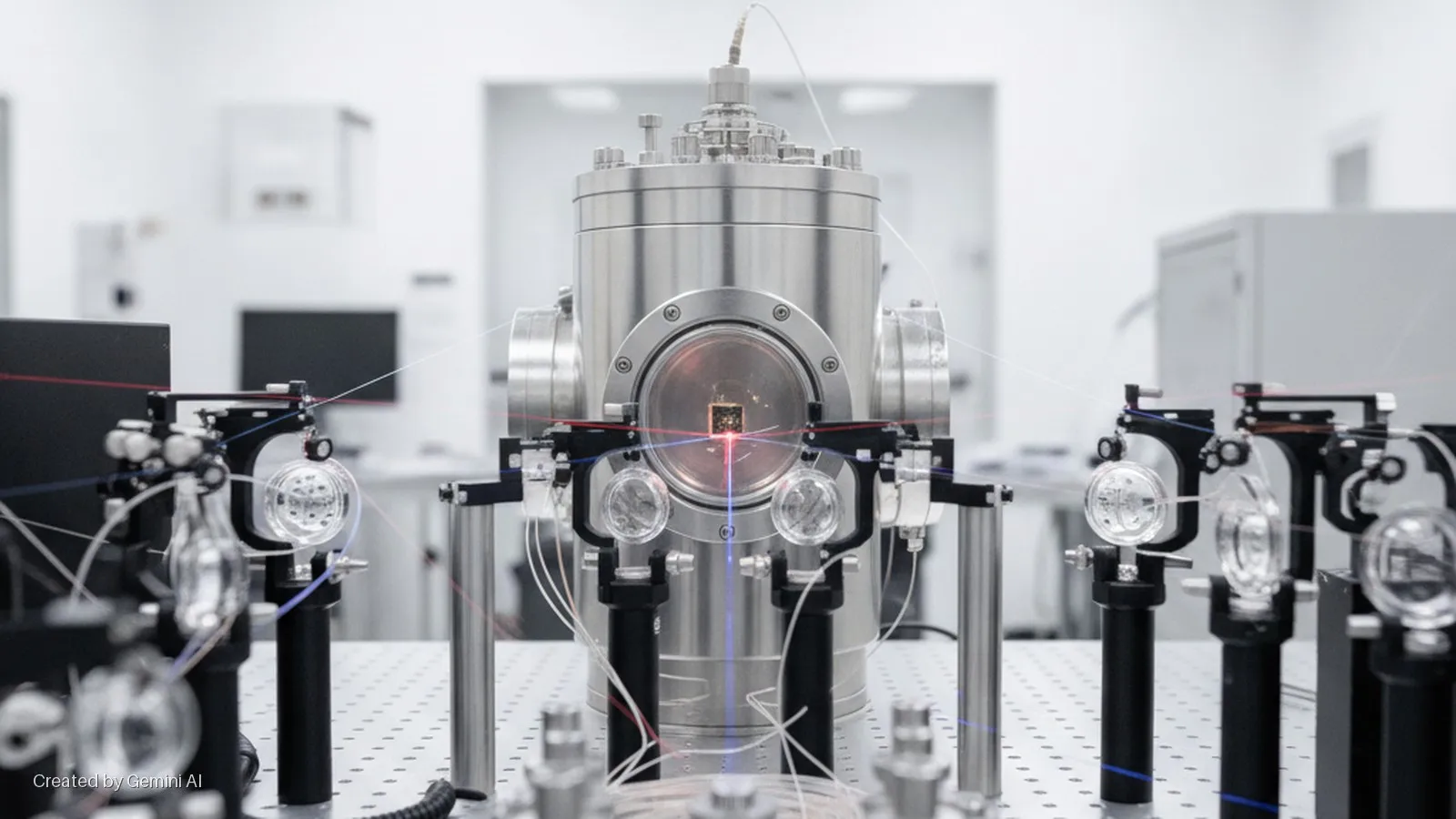
ZuriQ, a quantum computing company spun out of ETH Zürich, has raised $25.5 million in seed funding to accelerate development of its two-dimensional trapped-ion processor architecture. The round is led by Quantonation, with participation from Forward.one, Extantia, Firgun Ventures, and all investors from the company's earlier $4.2 million pre-seed round closed in 2025. Proceeds will go towards expanding the team, broadening the research programme, and scaling chip fabrication.
The Zürich-based company was founded by Dr Pavel Hrmo, Dr Tobias Sägesser, and Dr Shreyans Jain, and has grown from four to eighteen employees since that pre-seed raise. ZuriQ says it has recruited staff with backgrounds at IonQ, Xanadu, and Hamamatsu, and is targeting further hires with this capital.
The architecture
The technical differentiator ZuriQ is advancing centres on geometry. Conventional trapped-ion systems organise qubits in one-dimensional chains, connected via junction structures that grow increasingly complex as qubit counts rise. ZuriQ replaces this arrangement with Penning micro-traps and a static magnetic field, allowing ions to occupy a natively two-dimensional array without junctions. The company argues that qubit count in such a layout scales with the area of the chip rather than its length, which it says creates a clearer path to the thousands of qubits considered necessary for industrially useful computation.
As a proof of concept, ZuriQ has built a working 3x3 array of nine individually controlled ions, which the company says is the largest two-dimensional trapped-ion array demonstrated to date. The demonstrator was completed in eighteen months, and the underlying chips were fabricated by semiconductor manufacturer Infineon, indicating that the design is compatible with established industrial processes rather than bespoke academic tooling.
Professor Jonathan Home of ETH Zürich, a scientific adviser to the company, said: "Hold ions in a line and the count grows one at a time; hold them in two dimensions, and it grows with the area of the chip, on a standard chip, that is the difference between tens of ions and many thousands."
Market context
The trapped-ion segment of the quantum-computing market is well-populated, with IonQ and Quantinuum as the most prominent commercial players, both scaling one-dimensional architectures that they are progressively extending. ZuriQ's bet is that native two-dimensionality is a structurally easier path to scale than retrofitting existing designs. Whether that advantage persists as qubit counts rise into the hundreds or thousands remains to be demonstrated; the company's next milestone is reaching hundreds of qubits on a single chip.
More broadly, the quantum-computing market is still pre-revenue at the systems level for most vendors. Government-backed programmes in Europe, the United States, and Asia continue to provide a significant portion of sector funding, and commercial timelines have repeatedly shifted. Lead investor Quantonation is a specialist quantum-focused fund, giving ZuriQ backing from a firm whose diligence process is specifically oriented to assessing quantum-hardware claims.
From a standards perspective, the NIST post-quantum cryptography migration timeline, which targets federal adoption of new algorithms by 2030, is driving enterprise interest in quantum readiness without yet requiring fault-tolerant hardware. That dynamic creates a window for hardware vendors to build capability and attract pilot customers before commercial demand crystallises.
ZuriQ has not disclosed a valuation, named a commercial customer, or indicated expected revenue timelines. Investors and prospective enterprise partners will likely watch for a named first customer engagement and published qubit-fidelity benchmarks as the clearest near-term indicators of progress.