
Integer Technologies and USM win $9.8m Navy seabed AI contract
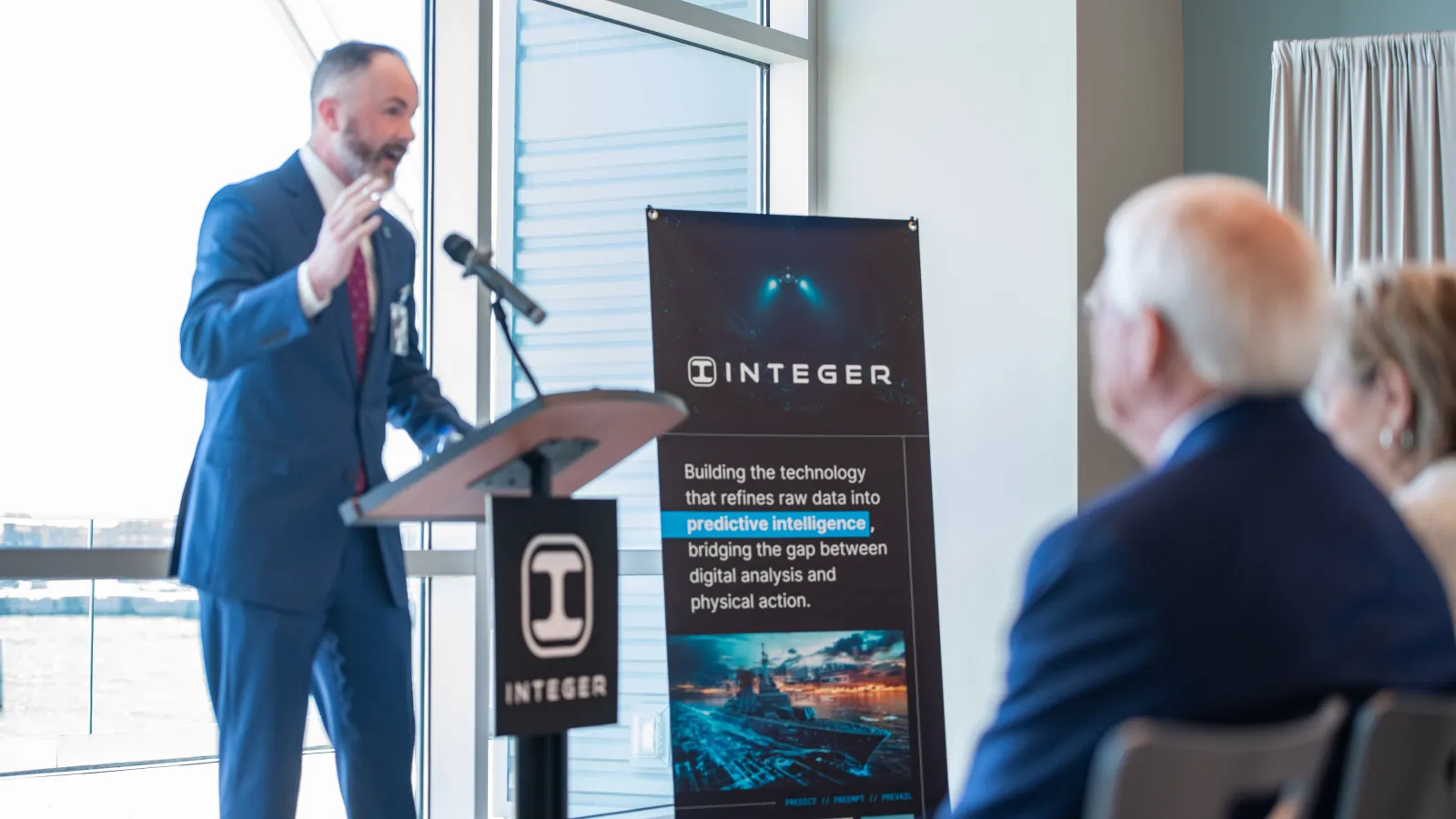
Integer Technologies and the University of Southern Mississippi (USM) have been awarded a $9.8 million option exercise contract modification from the Office of Naval Research, expanding a joint programme to develop AI-driven decision support software for autonomous undersea operations. The award brings the programme's total cumulative value to $24.8 million.
The contract funds continuing research and development of an operational decision support tool designed to enable unmanned undersea vehicles (UxVs) to adapt to changing ocean conditions, extend mission endurance, and operate with minimal human oversight in communications-denied environments. The software combines Integer's predictive modelling expertise for unmanned platforms with USM's ocean engineering and oceanography capabilities.
The programme
Josh Knight, COO and co-founder of Integer Technologies, framed the work around a specific operational challenge: autonomous systems that must reason and act when datalinks are degraded or severed entirely. "The work we're doing with USM is about redefining how the fleet leverages data, physics, and AI to create persistent, intelligent capability in the undersea domain," he said. The company's April expansion into USM's Roger F. Wicker Center for Ocean Enterprise in Gulfport provides direct Gulf of America water access, supporting rapid prototyping and in-water testing cycles.
Kelly Lucas, Vice President for Research at USM, highlighted the programme's dual role as both a scientific and economic driver. "By partnering with Integer Technologies, we are bringing high skill jobs to the Gulf Coast and strengthening a technology ecosystem that attracts new partners and investment," she said.
The option exercise is a modification to a previously announced contract rather than a new award, indicating the programme has cleared an evaluation milestone and the Navy has elected to proceed to its next phase.
Market and strategic context
Autonomous undersea systems are an intensifying area of defence technology investment across NATO allies, driven by concerns over adversary seabed infrastructure activity and the proliferation of low-cost unmanned underwater vehicles. The US Navy's interest in software that supports persistent, low-intervention autonomous missions reflects a broader doctrinal shift: as the undersea battlespace becomes more congested, the operational tempo of human-supervised systems is increasingly seen as a constraint.
On the commercial technology side, edge AI inference for intermittent connectivity scenarios is a problem shared across defence, offshore energy and deep-sea survey applications. Vendors that can demonstrate reliable autonomous decision-making under sensor uncertainty and denied communications stand to address a wide addressable market beyond direct Navy contracts.
Integer positions itself as a defence-focused digital engineering firm, with a portfolio spanning unmanned systems, sensors, cyber-physical systems and advanced manufacturing. Its university-embedded model at USM, combining academic ocean science with applied software engineering, is a structure used by a number of defence technology firms to access specialist research talent and government-funded infrastructure without the overhead of proprietary laboratory build-out.
Regulatory and procurement context
The award is structured as an Other Transaction Authority-style option exercise through the Office of Naval Research, a procurement vehicle that allows the Navy to move faster than traditional Federal Acquisition Regulation contracts and to incorporate non-traditional defence contractors and academic partners. The cumulative $24.8 million contract value is modest by major defence programme standards but significant for a software-led research effort at a regional university.
As autonomous maritime systems move closer to operational deployment, they will increasingly intersect with international maritime law, rules of engagement frameworks and emerging NATO standards for unmanned platform interoperability. Integer and USM have not publicly disclosed a timeline for transitioning the decision support tool from a research prototype to a deployable system, or named any platform programmes it is intended to support.