
JLT Mobile Computers and Visy to demo rugged port tech at TOC Europe
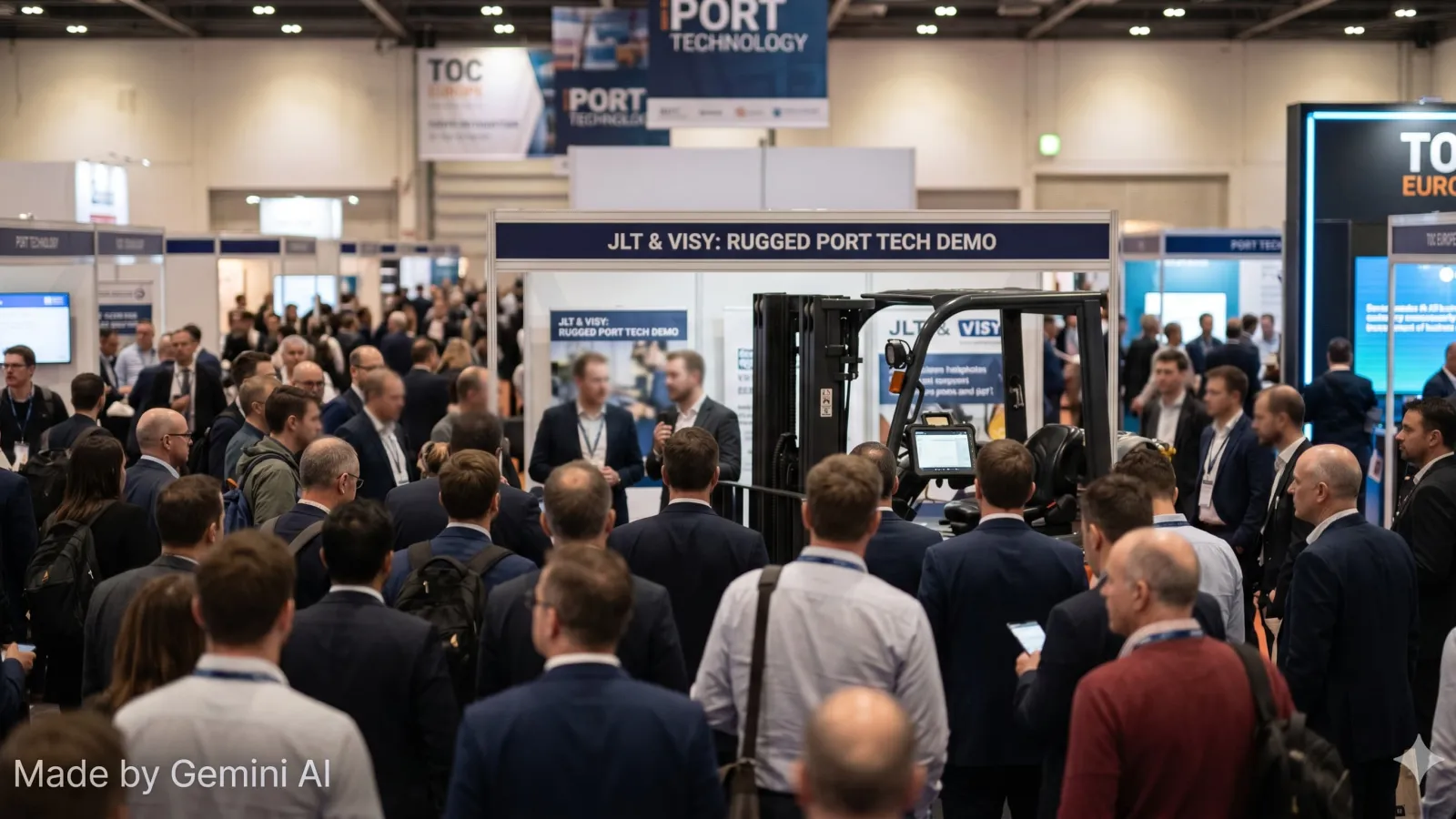
JLT Mobile Computers and vision-automation specialist Visy will jointly exhibit at TOC Europe 2026 in Hamburg from 19 to 21 May, demonstrating rugged vehicle-mounted computers and AI-powered optical character recognition systems designed for continuous port and container terminal operations. The two companies will share stand C74 at Hamburg Messe, where visitors can book live demonstrations with named representatives from both firms.
The Swedish hardware vendor is presenting two products specifically positioned for terminal environments running the Kaleris N4 Terminal Operating System (TOS). The JLT6015 is a high-performance, vehicle-mounted computer with a full HD widescreen display aimed at data-intensive workflows, while the more compact JLT6012 targets space-constrained installations in harsh dockside conditions. JLT says both units carry its Navis Ready validation, a continuous certification programme that tests compatibility with major Kaleris N4 releases to reduce deployment risk and simplify long-term maintenance.
Customer context
Orlando Valerón, IT Manager at container terminal operator OPCSA, is cited in JLT's release as a reference customer, noting that his organisation sought hardware and software capable of serving operations "years into the future" rather than merely satisfying present-day requirements. JLT did not disclose the commercial terms or scale of the OPCSA deployment, nor the number of terminals currently running its hardware.
Visy, described as a specialist in AI-powered vision and OCR for ports and terminals, will contribute the automation intelligence layer to the joint demonstration. The release does not detail Visy's underlying model architecture, camera hardware, or throughput benchmarks — information that enterprise buyers evaluating automation ROI typically require before procurement.
Market landscape
Port and terminal automation is an increasingly competitive segment, with rugged-computing vendors competing against a growing tier of integrated hardware-software providers. Terminal operators are under pressure to reduce turnaround times, improve gate throughput, and lower labour costs — dynamics that have accelerated investment in automated gate systems, vehicle-mounted computers, and AI-driven container identification. Major logistics and terminal operating systems vendors, including Kaleris (which markets the N4 TOS cited by JLT), are actively expanding their certified hardware ecosystems as a stickiness mechanism.
JLT, founded in 1994 and listed on Nasdaq First North Growth Market since 2002 under the ticker JLT, operates from offices in Sweden, France, and the US and serves sectors including warehousing, manufacturing, mining, and agriculture in addition to ports. The company describes three decades of rugged-hardware development as its primary differentiator, a positioning that faces pressure as general-purpose industrial tablet vendors — many backed by larger balance sheets — pursue the same terminal-automation opportunity.
Standards and certification path
Navis Ready validation is a commercially significant credential in the terminal-operating-system market, as operators running Kaleris N4 at scale are unlikely to risk deploying uncertified hardware in mission-critical workflows. For JLT, maintaining this certification status represents both a competitive barrier and an ongoing engineering commitment, as Kaleris releases updates requiring re-validation. Buyers operating in EU ports will also be monitoring NIS2 obligations — which came into force for critical-infrastructure operators in October 2023 — as connected port systems fall within scope for cyber-resilience requirements.
TOC Europe is one of the primary industry events for container logistics technology procurement discussions; JLT's decision to exhibit alongside Visy signals a strategy of positioning rugged hardware within a broader automation stack rather than as a standalone device sale.