
Micron ships 245TB 6600 ION SSD, claiming density record
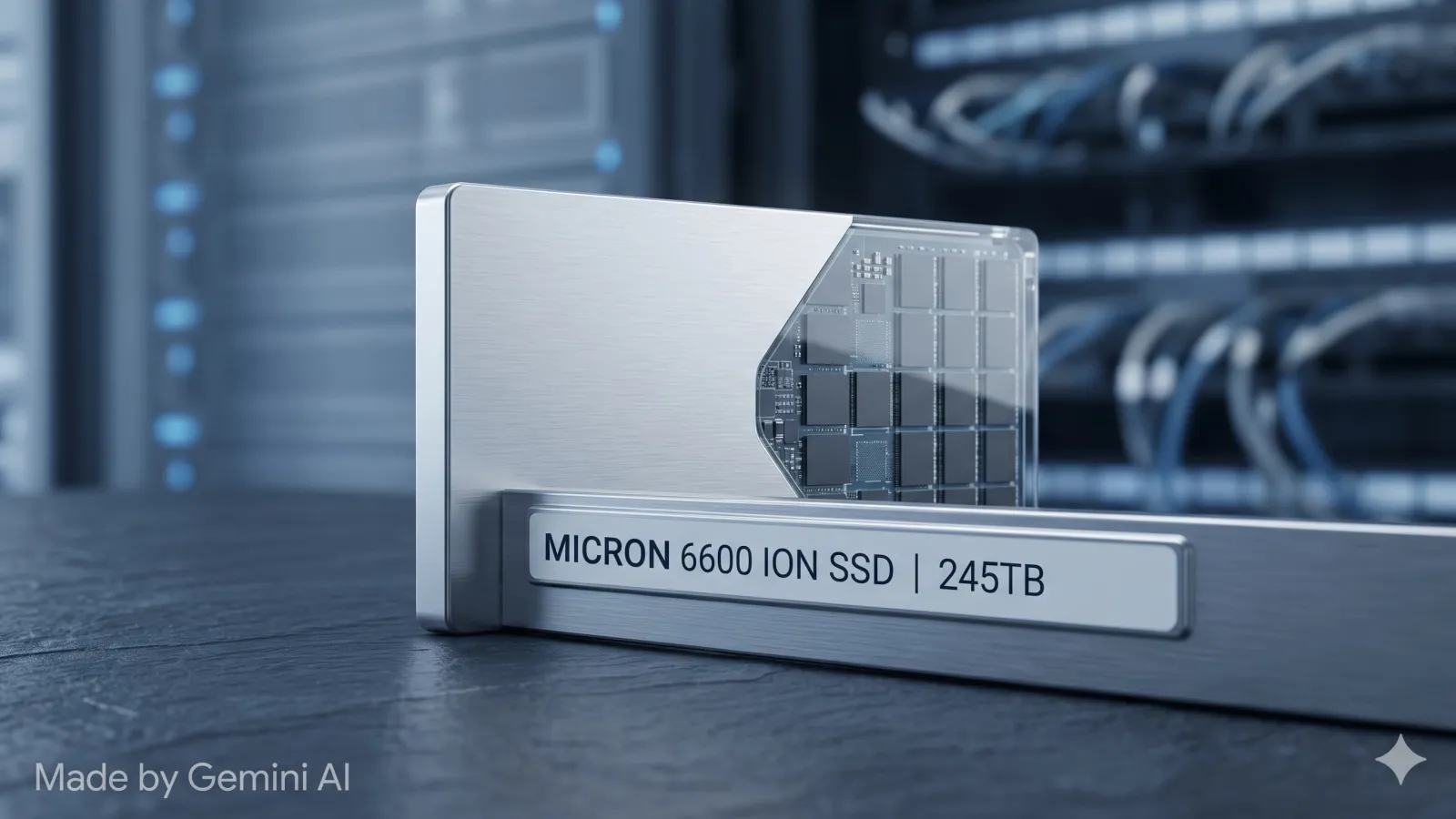
Micron Technology has begun shipping the 245TB version of its 6600 ION data centre SSD, which the Boise-based NASDAQ-listed chipmaker describes as the highest-capacity solid-state drive commercially available. The E3.L and U.2 form-factor drive is built on Micron's G9 QLC NAND and is aimed at AI data lakes, cloud-scale object storage, and hyperscale file workloads where rack density and power efficiency are primary constraints.
Jeremy Werner, senior vice president and general manager of Micron's Core Data Center Business Unit, said power availability has become a defining constraint for AI infrastructure scale. "With 245TB in a single SSD, the Micron 6600 ION makes solid state storage the clear choice for modern data centres," Werner said. Micron says operators can achieve equivalent raw capacity with 82% fewer racks compared with HDD-based deployments, based on a comparison of 245TB SSD-populated 36U racks against 44TB HDD-populated equivalents.
Performance and efficiency claims
Micron published a set of internal benchmark figures comparing the 245TB drive against arrays of 16 data centre HDDs. For AI extraction, transformation and loading (ETL) workloads, the company reported up to 84 times better energy efficiency, 8.6 times faster preprocessing, and latency up to 29 times lower. For object storage, tested using the Warp S3 benchmark against a RAID-0/JBOD HDD array, it reported up to 435 times better throughput per watt and 96 times faster time-to-first-byte. Readers should note that all figures originate from Micron's own engineering labs and have not been independently verified; methodology footnotes in the release confirm the HDD comparison set is drawn from a single unnamed manufacturer.
The drive operates at a maximum 30W, which Micron says is roughly half the aggregate peak power of an equivalent-capacity HDD deployment. At exabyte scale, the company projects annual savings of approximately 921 MWh and 438 metric tonnes of CO₂, alongside HVAC cooling reductions of more than 3.14 billion BTU per year — figures extrapolated from a 1EB deployment running at maximum power continuously.
Dell Technologies is among the named early adopters; Travis Vigil, senior vice president of ISG product management at Dell, said the drive would be available in Dell storage systems for AI and would deliver "meaningful" total cost of ownership reductions for large-scale data centre buildouts. The 245TB 6600 ION will be on display at Dell Tech World in Las Vegas, 18–21 May 2026.
Market context
The shift from HDD to SSD in data centre bulk storage has been under way for several years but has historically been constrained by cost-per-terabyte economics. QLC NAND — which stores four bits per cell — has narrowed that gap at the high-capacity end, and the transition is now accelerating as AI training and inference pipelines generate sustained random-read workloads that favour flash. IDC research vice president Jeff Janukowicz, quoted in the release, said AI dataset growth was "shifting storage economics from individual drives to rack-level efficiency," a framing that reflects the broader industry consensus.
Micron's principal competitors in high-capacity data centre SSDs include Samsung, SK Hynix, Kioxia, and Seagate (which offers a hybrid flash-HDD product line). Micron's claim that its G9 QLC is at least one generation ahead of competing QLC used in data centre SSDs is cited against a Forward Insights analyst report from Q1 2026, but no independent technical validation was provided in the release.
From a regulatory standpoint, Micron operates under US export-control rules that restrict advanced NAND technology transfer to certain jurisdictions; any hyperscale deployments outside allied markets will require the company to navigate Bureau of Industry and Security licensing requirements. European data centre operators will also be weighing energy-efficiency mandates under the EU's revised Energy Efficiency Directive, where the power savings profile of high-density SSDs could support compliance reporting.