
IBA launches myQA StarTrack³ 2D ion chamber array for linac QA
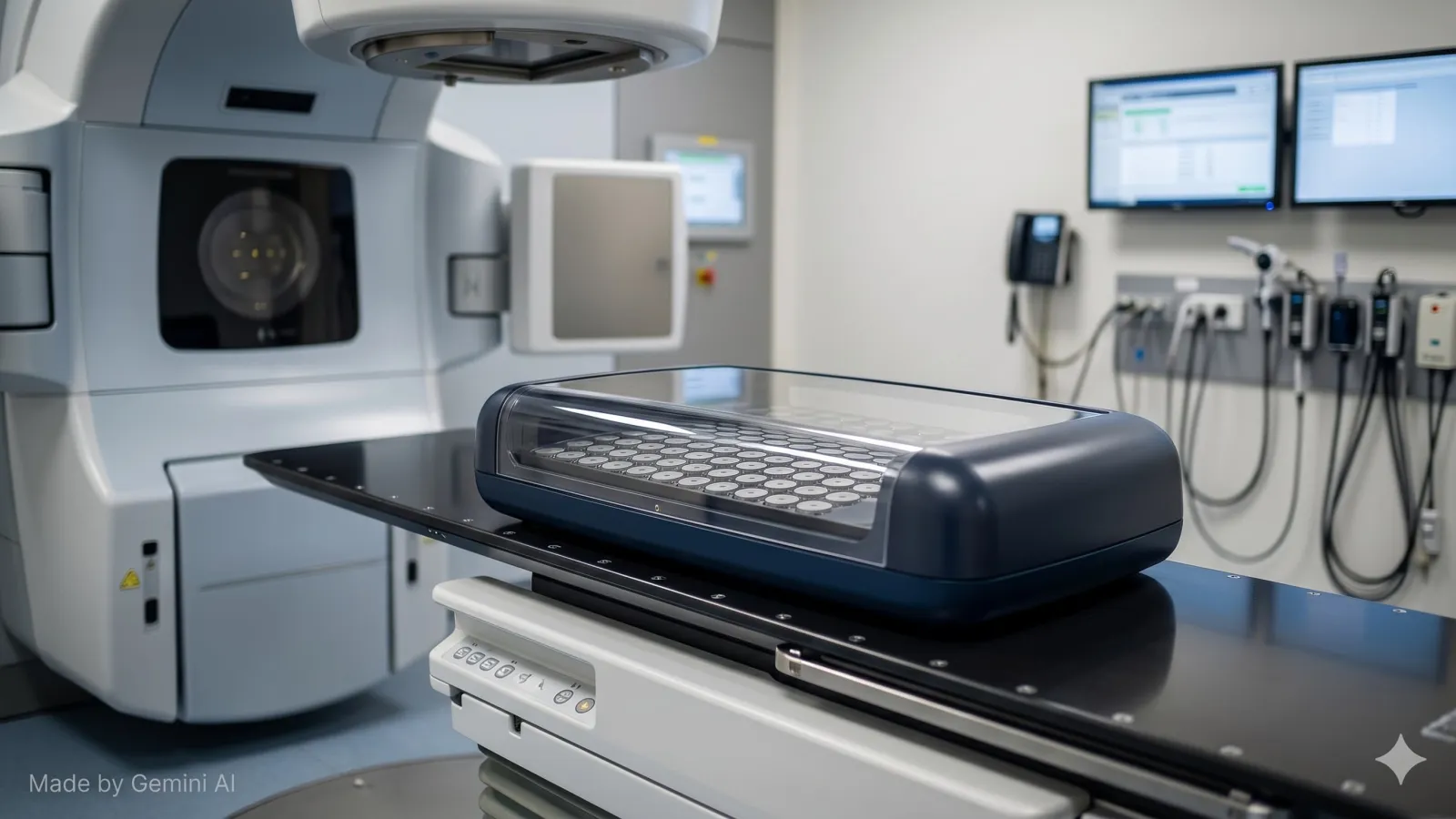
Ion Beam Applications (IBA), the Belgian particle-accelerator and dosimetry group listed on Euronext, has launched the myQA StarTrack³, a high-resolution 2D ionisation chamber array designed to consolidate linear-accelerator (linac) beam quality assurance into a single detector setup. The company says the system delivers measurement accuracy comparable to a water tank — the traditional reference standard for beam profiling — while cutting setup-to-acquisition time to under five minutes.
The device targets medical physics departments running monthly and annual machine QA programmes, where workflow efficiency has become a growing operational pressure as radiotherapy techniques grow more complex. A 2.5 mm spatial resolution across a measurement field of up to 34 × 34 cm² at isocentre supports assessment of both photon and electron beam profiles across multiple energies. A rechargeable battery and wireless data transfer are designed to allow the unit to move freely between treatment rooms without cable management overhead.
Product detail
The StarTrack³ ships alongside a web-based software platform that acts as a centralised QA data repository. IBA says the software includes built-in machine QA test protocols and supports both routine beam QA and more detailed beam assessment workflows in real time, accessible from any location. This cloud-adjacent architecture reflects a broader shift in radiotherapy informatics toward centralised, audit-ready data stores that support multi-site clinical governance.
Jean-Marc Bothy, president of IBA Dosimetry, said the system was designed with practical clinical deployment in mind: "One detector, one setup, and one platform for data analysis enables confident decision making while reducing the operational burden of machine QA."
IBA will demonstrate the product at the ESTRO 2026 Annual Congress in Stockholm from 15 to 18 May, where the company occupies booth C11:59.
Market context
The linac QA equipment market sits at the intersection of medical physics instrumentation and enterprise healthcare software, with a small number of specialist vendors — including Sun Nuclear (a Mirion Technologies subsidiary), PTW Freiburg, and IBA itself — competing on detector resolution, workflow integration, and software analytics capability. The trend across the sector is toward reducing the number of discrete measurement devices required for a full machine QA programme, and toward software platforms that can aggregate data across a radiotherapy department or health system rather than storing results locally per device.
Regulatory and accreditation frameworks such as those published by the American Association of Physicists in Medicine (AAPM) and, in Europe, the European Federation of Organisations for Medical Physics (EFOMP) increasingly require documented, reproducible QA records — a requirement that favours cloud-connected platforms with audit trails over legacy standalone systems. IBA's decision to lead with a web-based software layer alongside the hardware suggests an attempt to deepen its position in the data and workflow layer, not only the detector market.
The company has not disclosed pricing, named a launch customer, or provided independent benchmark results for the StarTrack³. Buyers will be looking for peer-reviewed or AAPM-benchmarked performance data before committing at scale. IBA's B Corp certification and roughly 2,100-person global headcount position it as a mid-size specialist rather than a pure-play instrumentation startup, which may lend additional commercial credibility during the procurement cycle.