
3D Systems debuts SLA 825 Dual and AddiTrak factory software
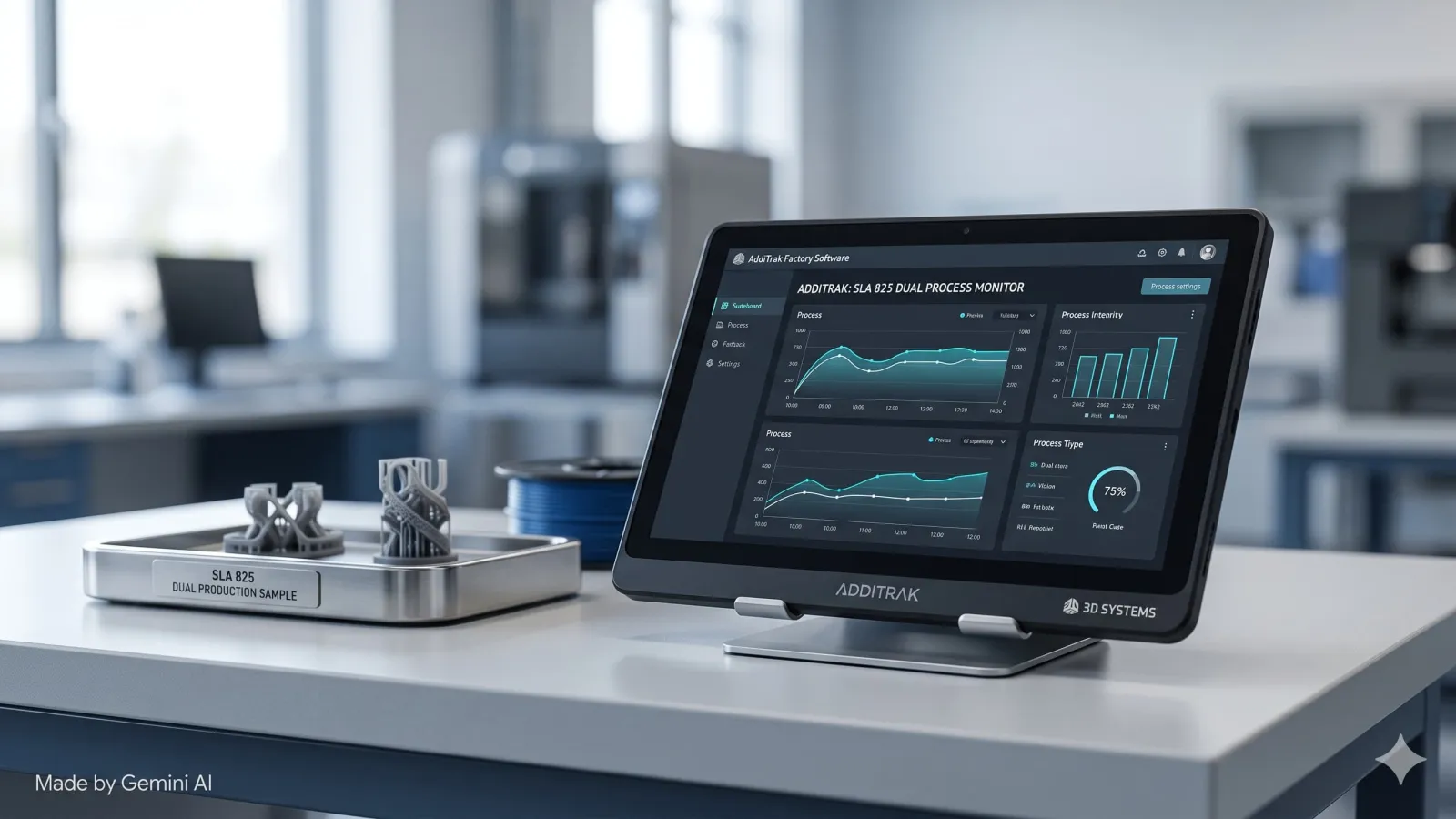
3D Systems (NYSE: DDD) has unveiled two products at RAPID + TCT 2026 in Boston aimed at pushing additive manufacturing beyond prototyping and into full production workflows: the SLA 825 Dual stereolithography system and AddiTrak, a factory-floor software platform for managing connected printer fleets. Both products were introduced to the US market at the company's Booth #1801 on 13 April.
The SLA 825 Dual is described by 3D Systems as offering a 22% larger build volume and up to 25% faster build speeds than its predecessor. Target applications include motorsport components, precision prototyping, and investment casting patterns — environments where dimensional accuracy and throughput per shift are critical commercial variables. The system has been available internationally but makes its US trade-show debut at RAPID + TCT.
AddiTrak: fleet visibility for the factory floor
AddiTrak is a secure, on-premises software platform designed to provide centralised monitoring, analytics and process control across the full range of 3D Systems printers. The platform supports Industry 4.0-compatible connectivity standards, including MTConnect and OPC UA, and integrates with the company's existing 3D Sprint workflow software to cover job preparation, scheduling, build execution and post-build performance analysis through a unified dashboard.
The on-premises architecture is a deliberate design choice. Manufacturers in aerospace, defence and healthcare have consistently resisted cloud-hosted process data because of IP sensitivity and regulatory obligations; keeping design and build data within the customer's own environment addresses a genuine procurement objection in those verticals.
Patrick Dunne, Senior Vice President and Technical Fellow at 3D Systems, said the industrialisation of additive manufacturing is accelerating as companies recognise its ability to deliver "performance gains through design innovation and operational flexibility through digital production."
The company also highlighted a customer application with Norwegian firm Eureka Pumps AS, which uses 3D Systems' Direct Metal Printing technology to manufacture large-format metal spare parts on demand — a use case that addresses part obsolescence and extended supply-chain lead times in industrial environments.
Market context and competitive positioning
The production additive manufacturing market has been developing for several years, with 3D Systems competing against a field that includes EOS, Stratasys, Desktop Metal and a growing cohort of specialist metal and polymer platform vendors. The central competitive challenge for incumbents has been persuading industrial buyers to commit to additive as a primary production method rather than a supplementary prototyping tool — a transition that requires demonstrable repeatability, fleet-level process control, and integration with existing manufacturing execution systems.
AddiTrak's MES-compatible connectivity and on-premises data model position 3D Systems to address that integration requirement directly, though the company has not disclosed pricing, named early-adopter customers beyond Eureka Pumps, or published independent throughput benchmarks for the SLA 825 Dual. The performance claims — up to 25% faster build speeds — are vendor-stated figures and have not been verified against named third-party tests.
More broadly, the additive manufacturing software layer is becoming a competitive battleground in its own right. Hyperscalers and industrial-software vendors including Siemens, PTC and Dassault Systèmes are all expanding their digital-thread and MES offerings, meaning 3D Systems' decision to build a proprietary, ecosystem-native fleet platform carries both differentiation potential and lock-in risk for customers.
Chief executive Dr Jeff Graves framed the launches as the output of "disciplined investments to refresh our portfolio," with the company's focus narrowed to manufacturing applications where additive delivers measurable value. Investors will look for revenue contributions from both products in the company's next quarterly results, particularly given 3D Systems' ongoing effort to demonstrate a credible path to profitability.